


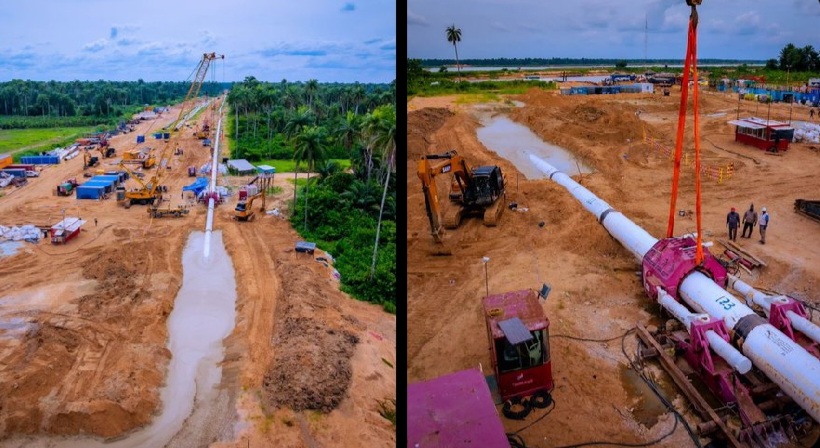

Nigeria’s energy ambitions received a powerful boost as NNPC Limited announced a landmark engineering feat—the successful crossing of the River Niger on the strategic OB3 Gas Pipeline project.
The breakthrough, delivered by its subsidiary, the NNPC Gas Infrastructure Company (NGIC), marks a defining moment in the development of the 130-kilometre Obiafu-Obrikom-Oben (OB3) Gas Pipeline, a backbone project set to transform Nigeria’s gas transmission network.


Constructed nearly two kilometres beneath the riverbed of the River Niger, the complex operation deployed advanced horizontal directional drilling technology, showcasing Nigeria’s growing technical prowess in large-scale energy infrastructure.
With the crossing now complete, the OB3 pipeline is poised to transport up to 2 billion standard cubic feet of gas daily—unlocking enhanced energy supply, boosting industrial capacity, and strengthening electricity generation nationwide.
Group Chief Executive Officer of NNPC Limited, Bashir Bayo Ojulari, hailed the achievement as a “defining milestone,” emphasizing that it reflects disciplined execution, innovation, and unwavering commitment to excellence.
He noted that the success builds on previous accomplishments, including the AKK River Niger crossing in 2025, demonstrating the company’s expanding engineering capability even in the challenging terrain of the Niger Delta.
Ojulari also credited strong institutional support, particularly from the administration of Bola Ahmed Tinubu, whose Gas-to-Prosperity agenda continues to drive investment and growth in the sector.
“This is more than a technical success—it is a critical link in building a resilient, integrated gas network that will power industries, homes, and economic growth across Nigeria,” he stated.
The milestone aligns with the Federal Government’s ambitious targets to ramp up production to 3 million barrels of crude oil per day and 12 billion standard cubic feet of gas daily by 2030.
As NNPC pushes forward, the OB3 project now stands as a symbol of Nigeria’s determination to harness its vast gas resources for national development—turning underground potential into tangible prosperity.
About The Author
