



By Abdullahi Alhassan, Kaduna
Government agencies, scientists, civil society organisations and development stakeholders in Kaduna State have called on entrepreneurs and small and medium-sized enterprises (SMEs) to turn climate change, waste management and environmental challenges into opportunities for innovation, job creation and economic growth.


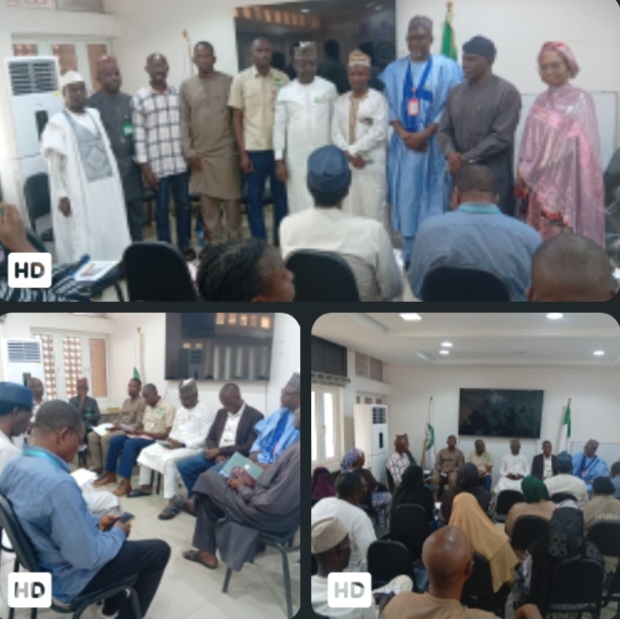
The stakeholders made the call during the September edition of the Kaduna Monthly Climate Hangout, organised by the ITIEC Secretariat in collaboration with the Desk of Climate Change and Environment of the Interfaith Mediation Centre (IMC), Kaduna, and African Climate Reporters (ACR).
The one-day scientific and trade engagement, held under the theme “Empowering Entrepreneurs and SMEs through Climate-Smart Agriculture, Green Innovation, Sustainable Trade and Economic Growth,” brought together government officials, farmers, entrepreneurs, scientists, environmental experts and other stakeholders.
Speaking at the event, the Kaduna State Manager of the Small and Medium Enterprises Development Agency of Nigeria (SMEDAN), Mallam Badamasi Yau Barau, said climate change was already affecting farmers, processors and traders through erratic rainfall, flooding and rising temperatures.
Barau said entrepreneurs and small businesses should not see climate change solely as a government or scientific issue, but as a challenge requiring private-sector innovation and investment.
“When we talk about climate change, many people think only about government or scientists. But the truth is that entrepreneurs and small businesses are also very important to the solution,” he said.
He explained that climate-smart agriculture goes beyond the adoption of modern technology, stressing that it also involves finding practical ways to increase food production while using fewer resources and adapting to changing weather conditions.
According to him, opportunities exist in solar-powered irrigation, improved agricultural storage, post-harvest management, climate-smart farming services and the conversion of agricultural waste into animal feed and compost.
The SMEDAN manager encouraged young people and women to explore emerging green businesses in recycling, waste management, renewable energy, sustainable packaging and climate-smart agriculture.
“Do not wait for everything to be perfect before you start. Look around you. Identify a problem and find a business solution,” Barau said.
He urged entrepreneurs to acquire new skills, maintain proper business records, embrace technology, reduce waste and build partnerships, noting that training alone would not be sufficient without access to finance, markets, technology, business registration and mentorship.
Also speaking, the Kaduna State Coordinator of the National Environmental Standards and Regulations Enforcement Agency (NESREA), Emmanuel Dangari, said environmental sustainability and economic development should be pursued together.
Dangari said Nigeria’s agricultural sector has significant potential to support the transition from a traditional “take, make and dispose” model to a circular economy in which waste is converted into valuable resources.
He explained that crop residues, animal manure and food-processing waste could be transformed into compost, biogas and organic fertiliser, creating additional sources of income for farmers and entrepreneurs.
He also raised concerns over the growing volume of agricultural plastics, including irrigation materials and fertiliser bags, warning that their improper disposal contributes to flooding and environmental pollution.
“The question is not whether plastics are used. The question is what happens to them at the end of their useful life,” Dangari said.
He encouraged SMEs to explore business opportunities in waste collection, recycling, sustainable packaging, biogas production, efficient irrigation and digital platforms that connect waste generators with recyclers.
The NESREA coordinator also urged producers to take responsibility for their packaging waste through the Extended Producer Responsibility approach, stressing that environmental compliance should form part of business planning from the beginning.
“Do not see environmental sustainability as something that belongs only to government. See it as an opportunity for innovation,” he said.
The Co-Executive Director of the Interfaith Mediation Centre (IMC), Kaduna, Mr. Samson Auta, called for stronger collaboration among government institutions, civil society organisations, businesses, farmers, scientists and communities in tackling environmental challenges.
Auta emphasised that protecting the environment should not be left to government agencies alone, saying collective action was necessary to address climate change, waste pollution, deforestation and other forms of environmental degradation.
He said organisations and individuals must join hands to protect the environment because the consequences of environmental degradation affect communities regardless of their social, religious or economic backgrounds.
According to him, stronger partnerships among environmental organisations, development agencies, the private sector and local communities can help promote sustainable practices while creating opportunities for livelihoods and economic development.
Auta also stressed the importance of creating greater public awareness and encouraging communities to take ownership of environmental protection efforts.
The Head of Science and Environment Journalists at African Climate Reporters, Comrade Ibrahima Yakubu, said the September edition of the Kaduna Monthly Climate Hangout was designed to bring economic and agricultural stakeholders together with scientists and waste-management experts to develop practical responses to climate change and environmental degradation.
Yakubu said marketers, commercial farmers, SMEs and entrepreneurs needed greater awareness of how climate change and environmental degradation were affecting different sectors of the economy.
He noted that the Kaduna Monthly Climate Hangout had, over the past five years, provided a platform for scientists, geologists, environmental journalists, civil society organisations, NGOs, conservationists and government representatives to regularly exchange knowledge and discuss practical approaches to environmental protection.
According to him, the engagement also provides an opportunity for scientists and journalists to strengthen collaboration and improve public access to credible information on climate change, agriculture, waste management and environmental conservation.
The stakeholders agreed that building a climate-resilient economy requires stronger collaboration among government institutions, businesses, farmers, financial institutions, development partners and consumers.
They stressed that agriculture, processing and waste management should no longer be viewed as separate sectors, but as interconnected components of a circular economy capable of creating jobs, reducing pollution and improving livelihoods.
Dangari urged entrepreneurs to see environmental challenges as opportunities for innovation, saying, “Let us move from waste to resources, from pollution to prevention, and from environmental challenges to entrepreneurial opportunities.”
About The Author
