


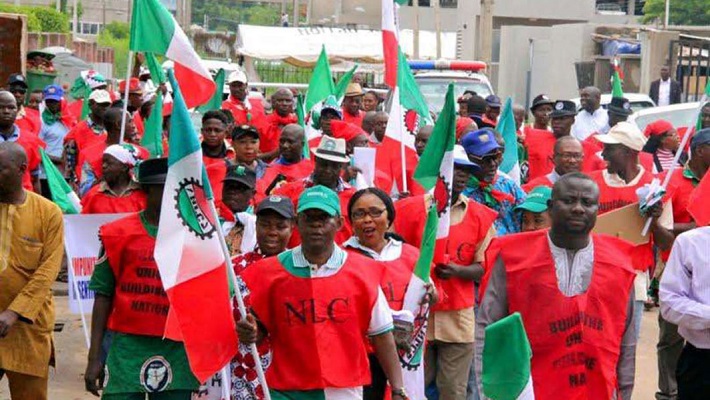
 has launched a blistering attack on Nigeria’s energy system, declaring that the country is “producing megawatts)
Labour accuses privatised system of producing ‘megawatts of darkness’ • Demands end to energy poverty, foreign-dominated policies
The Nigeria Labour Congress (NLC) has launched a blistering attack on Nigeria’s energy system, declaring that the country is “producing megawatts of darkness” while businesses and households continue to pay heavily for unreliable electricity.
The labour movement said the time had come for the Federal Government to undertake a fundamental overhaul of the energy sector and abandon policies that treat electricity primarily as a profit-making commodity rather than a public good.


National Coordinator of the NLC’s Climate Change, Green Jobs and Just Transition Programme, Eche Asuzu, made the demand in Nairobi, Kenya, during the New Energy for Africa II Convening, organised by the International Trade Union Confederation (ITUC-Africa).
Asuzu said Nigeria’s power crisis had exposed the failure of the models adopted over the years, particularly the privatisation of the electricity sector, which he argued had failed to deliver the reliable power needed to transform the economy.
His words: “People are making profit out of darkness instead of generating enough power to unlock our potential as a country.”
He added: “We privatised. What has become of it? We privatised, but we are producing megawatts of darkness, and that is very unfortunate.”
According to the labour leader, Nigeria must now abandon a top-down approach to energy policy and bring ordinary citizens, workers and affected communities into decisions concerning the sector.
He said communities battling energy poverty understand the crisis better than policymakers sitting far away from the realities of unreliable electricity.
“We need to democratise energy in Nigeria. We need to put people at the centre of energy policy, energy considerations and energy action,” Asuzu said.
The NLC also called for an end to the practice of making Nigerians bear the burden of an energy system that fails to provide sufficient and dependable electricity.
Asuzu said the government must confront energy poverty as an urgent national crisis, noting that more than 60 per cent of Nigerians, according to his assessment, lack access to affordable, sufficient and reliable energy.
“Our experience is one of exclusion. So far, people have been excluded, as if they do not know anything about energy. But they know energy because they use it every day,” he said.
He urged the government to “begin where it hurts us,” arguing that energy poverty is directly undermining Nigeria’s industrial and economic potential.
The NLC further called for stronger government involvement in the energy sector, insisting that the state cannot afford to abandon the strategic industry entirely to commercial interests.
Asuzu said government must reclaim a significant role in energy provision and use the sector as a catalyst for industrialisation, economic transformation and job creation.
“The Constitution says government must have business in business. In the area of energy provision and the role of government in the economy, especially as it relates to energy, government must have a role,” he said.
He urged authorities to muster the political will to correct what he described as longstanding policy failures.
“Clearly, the models we have adopted have not worked, and that calls for a lot of political will to do the right thing,” he said.
The labour body also warned the government against excessive dependence on foreign-assisted or foreign-dominated energy policy frameworks.
Asuzu argued that Nigeria must develop policies based on the realities and needs of its own people, while ensuring that all relevant stakeholders have a voice in shaping the sector.
“Government must bring every stakeholder on board and avoid all these foreign-assisted and foreign-dominated energy policy frameworks. They have not worked,” he said.
He called for the resolution of the longstanding controversies surrounding the Mambilla Power Project and urged the government to fully exploit Nigeria’s abundant hydropower and other renewable energy resources.
The NLC also linked Nigeria’s energy crisis to the country’s struggle to industrialise and create quality employment.
Asuzu said Nigeria, with one of the world’s youngest populations, could not afford to remain trapped in energy poverty while other economies were embracing green industrialisation.
He called for increased investment in renewable energy while insisting that the transition must also protect workers.
“Green jobs may not necessarily be decent jobs. So, we must make them decent by ensuring living wages, improved working conditions and, of course, social protection,” he said.
He added that Nigeria should not necessarily abandon fossil fuels immediately, arguing that gas could serve as a transition fuel if the country adopted appropriate policies.
Asuzu particularly criticised the dollarisation of gas pricing in Nigeria, describing it as one of the technical issues contributing to instability and hardship in the energy sector.
“Until we de-dollarise our gas pricing structure, we will not get it right. It is a Nigerian asset. Why do we need to dollarise the payment?” he asked.
For the NLC, the solution to Nigeria’s power crisis goes beyond adding more megawatts to the national grid. It requires a fundamental rethink of who controls energy policy, who benefits from the sector and who ultimately pays when the system fails.
The labour movement is therefore demanding an energy framework that puts people before profit, industrialisation before short-term commercial gains and reliable power before the continued business of darkness.
About The Author
