



By Abdullahi Inuwa
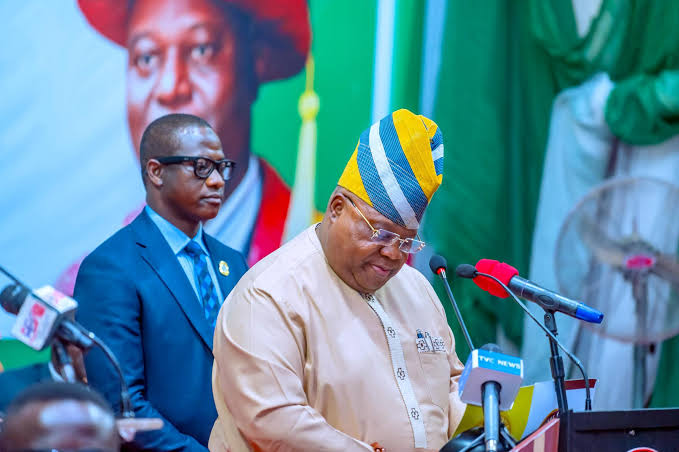
The ballots have been counted, the campaigns are over and Governor Ademola Adeleke has secured another term in office. But beyond the celebrations, victory speeches and political congratulations lies a much bigger question: what does Adeleke do with the mandate, and what does his victory mean for the future of Osun State?


The 2026 Osun governorship election was more than a routine contest for the Government House in Osogbo. It was a major political test, coming just months before Nigeria’s 2027 general elections and amid intense speculation about shifting alliances, opposition strategies and the growing influence of President Bola Ahmed Tinubu in the South-West. Analysts had described Osun as one of the last major electoral tests before 2027.
Adeleke has now survived that test. The real challenge begins after the victory.
Perhaps the first and most important task before Adeleke is to transform campaign promises into measurable results.
During his re-election campaign, the governor promoted a renewed five-point agenda covering youth and women empowerment, infrastructure, agriculture, healthcare and education, as well as an improved business environment. His administration also highlighted projects and reforms in health, education and public infrastructure.
Now, voters will expect results rather than rhetoric.
The second term provides Adeleke with something many governors rarely enjoy: political breathing space. He no longer needs to spend his energy preparing for another governorship election. This gives him an opportunity to concentrate on governance, strengthen institutions and leave behind projects that can define his administration long after he leaves office.
Political analysts believe his legacy will ultimately be judged less by the size of his campaign rallies and more by the condition of Osun when his tenure ends.
Another major issue will be Adeleke’s relationship with President Tinubu.
The two politicians belong to rival political camps, yet their relationship has remained relatively cordial. Adeleke has also recently been at the centre of political speculation concerning possible understandings between him and the presidency.
Whatever the political calculations behind the scenes, Adeleke will have to carefully manage his relationship with Abuja.
Osun cannot afford unnecessary confrontation with the Federal Government, particularly on issues involving infrastructure, security, federal appointments and development funding. At the same time, Adeleke must preserve his political identity and demonstrate that cooperation with the presidency does not mean surrendering his political independence.
The balancing act could become even more important as the country moves closer to the 2027 presidential contest.
Interestingly, Senator Orji Kalu has argued that Adeleke’s victory should not be interpreted as a major setback for Tinubu’s 2027 ambitions, urging the APC instead to rebuild its grassroots structures and reconnect with voters.
That observation points to an important reality: the Osun election may be over, but the political consequences have only begun.
Adeleke’s victory will inevitably reshape the balance of power in the state.
The opposition, particularly the APC, will now be forced to rethink its strategy. The party entered the election determined to challenge the incumbent and deploy its political structure across the state. Before the election, APC leaders openly presented the contest as a battle that could overturn Adeleke’s political dominance.
After the defeat, however, the party faces a choice: rebuild patiently at the grassroots or wait for another electoral cycle before mounting a serious challenge.
For Adeleke, this presents both an opportunity and a danger.
A strong opposition can keep government accountable, but a weakened opposition can also encourage complacency within the ruling camp. The governor therefore has a responsibility to ensure that governance does not become synonymous with partisan politics.
Perhaps the greatest challenge ahead is economic.
Osun remains a state with enormous human and agricultural potential but significant development needs. Youth unemployment, infrastructure deficits, healthcare delivery, education, agriculture and the cost of living will remain central concerns.
Adeleke’s second term must therefore move beyond visible projects to policies capable of generating sustainable economic opportunities.
Agriculture, particularly, could become a major pillar of his legacy. With the right investment in processing, storage, transportation and access to finance, Osun can move from simply producing agricultural commodities to developing an agro-industrial economy.
The same applies to tourism and small businesses. Osun possesses cultural and historical assets capable of attracting visitors and investment, but these opportunities require serious infrastructure and coordinated promotion.
Another issue Adeleke cannot afford to ignore is the youth vote.
Young people are increasingly influential in Nigerian politics, and their expectations are changing. They want employment, skills, technology, affordable education and a government that listens.
Adeleke’s administration will therefore need to develop programmes that create genuine opportunities rather than temporary political empowerment schemes.
If his government can demonstrate that young Osun residents are better positioned economically at the end of his second term than they were at the beginning, that could become one of his strongest legacies.
Then comes the question many politicians and political watchers are already asking: what next for Ademola Adeleke after Osun?
The governor cannot seek a third consecutive term as governor. Consequently, the political network he has built in Osun will eventually face the question of where it goes next.
Could Adeleke become a major voice in South-West politics? Could he influence the 2027 presidential contest? Could his political family seek greater influence at the national level?
Those possibilities remain open, but they should not distract him from the immediate assignment.
History is often kinder to governors who concentrate on governance before political ambition.
Adeleke has won the election. Now he must win the harder battle — the battle for legacy.
The people of Osun have given him another opportunity to govern. They will expect better roads, stronger schools, improved healthcare, more jobs, greater security, investment and an administration that treats public office as a responsibility rather than a reward.
His first term established Adeleke as a formidable political force. His second term will determine whether he becomes remembered merely as a successful politician or as a transformative governor.
The election gave him the mandate.
What he does with that mandate will determine the history he leaves behind.
Abdullahi Inuwa Social Commentator ainuwa303@gmail.com
About The Author
