


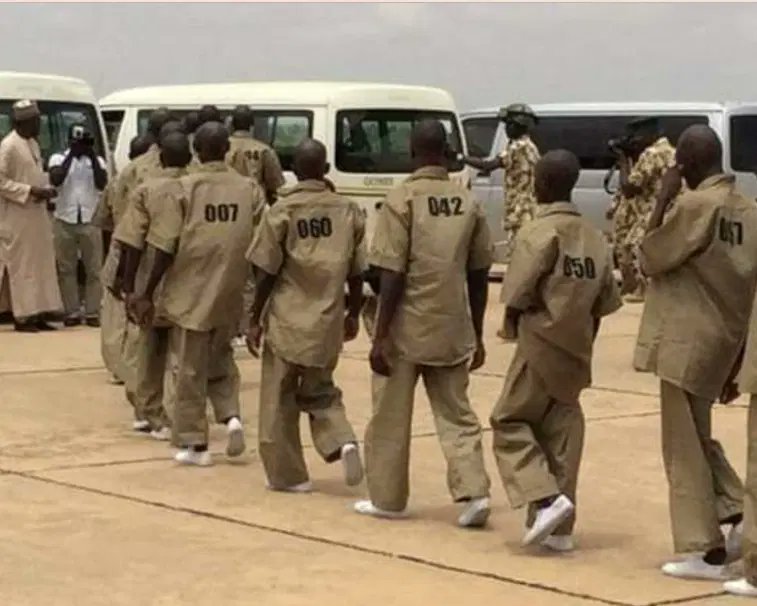

A storm of outrage has erupted across the country following the Federal Government’s decision to reintegrate hundreds of repentant terrorists into society, with critics warning that the move risks deepening wounds and undermining justice for victims.
Last week, authorities announced that 744 former insurgents had completed a six-month deradicalisation and vocational training programme under Operation Safe Corridor, paving the way for their return to civilian life.


But the development has triggered fierce backlash from retired military officers, human rights activists, lawyers, and concerned citizens, many of whom argue that the policy appears to prioritise perpetrators over victims of terrorism.
Voices of dissent have grown louder, with critics insisting that thousands of families displaced, injured, or bereaved by insurgent violence are yet to receive adequate support, compensation, or rehabilitation.
“Justice must not be sacrificed on the altar of reconciliation,” a retired senior officer said, warning that reintegrating former fighters without visible justice for victims could erode public trust in the system.
Nigeria has battled a brutal insurgency for over a decade, largely driven by Boko Haram and its splinter faction Islamic State West Africa Province, with communities in the North-East bearing the brunt of killings, abductions, and displacement.
While government officials maintain that deradicalisation programmes are essential to ending the cycle of violence, critics say the approach lacks balance.
Human rights advocates argue that reconciliation efforts must go hand-in-hand with justice, truth-telling, and adequate reparations for victims.
“There is a moral burden here,” a legal practitioner noted. “Reintegration without accountability sends a dangerous signal—that those who commit grave crimes can simply walk free after a short programme.”
Others have questioned the effectiveness of the deradicalisation process itself, raising concerns about monitoring mechanisms and the risk of recidivism.
Security analysts warn that without robust post-reintegration tracking and community-based safeguards, the policy could pose fresh security challenges, especially in already fragile regions.
Beyond security concerns, the emotional toll on affected communities remains a major flashpoint. Survivors and families of victims say they feel sidelined, as attention shifts to rehabilitating former fighters while their own struggles continue largely unaddressed.
For many, the wounds of insurgency remain raw—villages destroyed, livelihoods lost, and loved ones gone.
“Before reintegrating them, what about us?” one displaced resident asked. “We are still trying to rebuild our lives.”
Supporters of the programme, however, argue that rehabilitation is a globally recognised strategy in counter-insurgency, aimed at encouraging defections, reducing the fighting force of extremist groups, and promoting long-term peace.
They insist that not all former fighters are beyond redemption, particularly those who were coerced or recruited under duress.
Government officials also emphasize that participants undergo psychological evaluation, ideological reorientation, and skills acquisition before being cleared for reintegration.
Yet, the debate continues to intensify, exposing a deep divide between security strategy and public sentiment.
Analysts say the controversy highlights the urgent need for a more inclusive framework—one that addresses both the reintegration of ex-combatants and the rehabilitation of victims.
Such a framework, they argue, should include compensation schemes, trauma support services, community dialogue initiatives, and stronger accountability measures.
As the nation grapples with the complexities of post-conflict recovery, the question remains: can reconciliation succeed without justice?
For now, many Nigerians remain unconvinced, insisting that true peace cannot be built on perceived injustice.
Until victims feel seen, heard, and supported, critics warn, efforts to reintegrate former terrorists may continue to face resistance—both in policy circles and within the communities most affected by years of bloodshed.
About The Author
