



By Abubakar M. Kareto
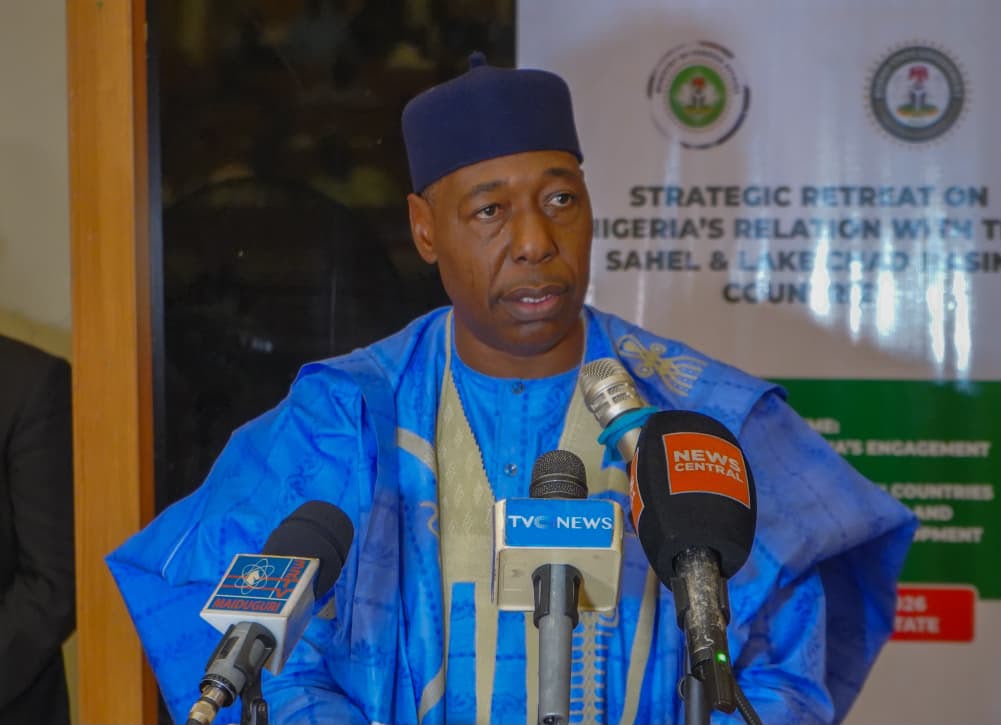
For over a decade, Maiduguri was defined in global headlines by the destructive shadow of Boko Haram and the Islamic State West Africa Province (ISWAP). Yet, at the Musa Usman Secretariat, a remarkably different narrative took center stage. By hosting ambassadors, diplomats, and regional envoys from across the Sahel, Borno State proved that it is no longer merely the epicenter of a historic crisis, but an indispensable focal point for sub-regional security leadership.


At the center of this transformation is Borno State Governor, Professor Babagana Umara Zulum. Convening this high-level retreat demonstrates a clear-eyed, pragmatically grounded understanding of asymmetric warfare, sub-national governance, and cross-border diplomacy.
Piercing the Silos of Sahelian Security
For years, the global response to Sahelian insurgency has stumbled on a fatal flaw: an over-reliance on purely kinetic military operations, alongside fragmented institutional responses. While battlefield victories remain vital to push back terror elements, military force alone cannot defeat an ideology nourished by porous borders, economic disenfranchisement, and sub-regional political tensions.
Governor Zulum’s address at the retreat captured the essence of an evolving framework for regional stability, where he emphasized that while armed forces continue their brave operations, regional actors must enhance intelligence sharing, community-based border management, and joint stabilization initiatives alongside the Multinational Joint Task Force.
This approach confronts a fundamental reality: violent extremist organizations do not respect administrative or political boundaries. As Chadian Ambassador Brah Mahamat noted during the retreat, terror groups exploit institutional divisions, whether between ECOWAS, CEMAC, or the Alliance of Sahel States, to maneuver across borders. By bringing international diplomats directly to Maiduguri, Zulum is actively bridging these diplomatic gaps, advocating for unified intelligence and operational synergy over bureaucratic isolation.
The Borno Model: Aligning Security with Human Dignity
What gives Governor Zulum’s sub-regional advocacy compelling weight is that it is anchored in tangible domestic results. Under his administration, Borno State pioneered the Borno Model, a multi-dimensional framework that connects kinetic military pressure with humanitarian development and peacebuilding. This non-kinetic framework has successfully managed the surrender and profiling of over 160,000 former insurgents and their families, significantly weakening Boko Haram and ISWAP combat capabilities from within.
Global conflict history proves that non-kinetic interventions are not soft options, but strategic imperatives. In Colombia, the state successfully weakened the Revolutionary Armed Forces of Colombia (FARC) not merely through gunboat diplomacy, but by pairing targeted military pressure with massive individual and collective demobilization programs. Colombia’s structured Disarmament, Demobilization, and Reintegration (DDR) frameworks pulled tens of thousands of combatants out of the jungle, systematically dismantling the organizational network of Latin America’s oldest insurgency.
Beyond managing surrenders, Borno State has actively focused on closing formal displaced persons camps in Maiduguri to restore human dignity. Displaced families are being safely resettled into fortified agrarian communities, allowing thousands of farmers to return to their ancestral lands, rebuild local markets, and secure regional food supplies. By coupling frontline security operations with post-conflict social infrastructure, basic education, and healthcare, Zulum offers practical solutions forged in the daily realities of crisis governance.
Similar community-first stabilization efforts yielded transformative outcomes during Rwanda’s intervention in Mozambique’s Cabo Delgado province. By coupling infantry operations with civilian protection, infrastructure reconstruction, and localized community engagement, Rwandan forces effectively decimated insurgent strongholds and enabled over 60 percent of displaced civilians to return safely to their homes. These international success stories prove that Zulum’s dual-track policy of kinetic pressure combined with social reintegration is the global gold standard for defeating persistent insurgencies.
Maiduguri as the Anchor of Sub-Regional Peacebuilding
The geopolitical timing of this conference is significant. For too long, high-level deliberations on Sahelian security took place in distant foreign capitals, far removed from the human and geographic reality of the conflict. By anchoring these security talks directly in Borno, Zulum grounds diplomatic dialogue in real context and local agency.
As Nigerian foreign affairs officials highlighted during the retreat, the deep historical, cultural, and economic ties linking Nigeria to the wider Sahel mean that Borno’s security matrix directly influences the economic stability of neighboring nations like Chad, Niger, and Cameroon. Zulum’s proactive stance demonstrates how sub-national leadership can effectively complement national foreign policy to foster sustainable cross-border security.
The Imperatives Ahead
As security challenges across West Africa and the Sahel evolve, the Maiduguri retreat offers three critical takeaways for regional policymakers.
First, regional security cooperation must remain operational and flexible. Counter-terrorism measures and intelligence-sharing must be insulated from wider diplomatic tensions between regional political blocs.
Second, long-term stabilization requires addressing structural drivers. Sustainable security will only be achieved when military action is matched by investments in border infrastructure, agricultural recovery, and youth livelihoods.
Third, effective strategies must center localized leadership. Sustainable peace initiatives must be led by stakeholders who understand the immediate terrain, community dynamics, and socio-economic realities on the ground.
Governor Babagana Umara Zulum continues to show that addressing complex security crises demands both strategic firmness and constructive dialogue. By positioning Borno as a center for regional coordination, he reinforces a vital lesson: lasting peace in the Sahel will be built through unified strategy, socio-economic recovery, and sustained cooperation.
Abubakar M. Kareto is a Public Affairs Analyst and Strategic Communications Specialist. He focuses on governance and public policies in Nigeria and Africa. He can be reached via amkareto@gmail.com or X (formerly Twitter) @amkareto.
About The Author
