


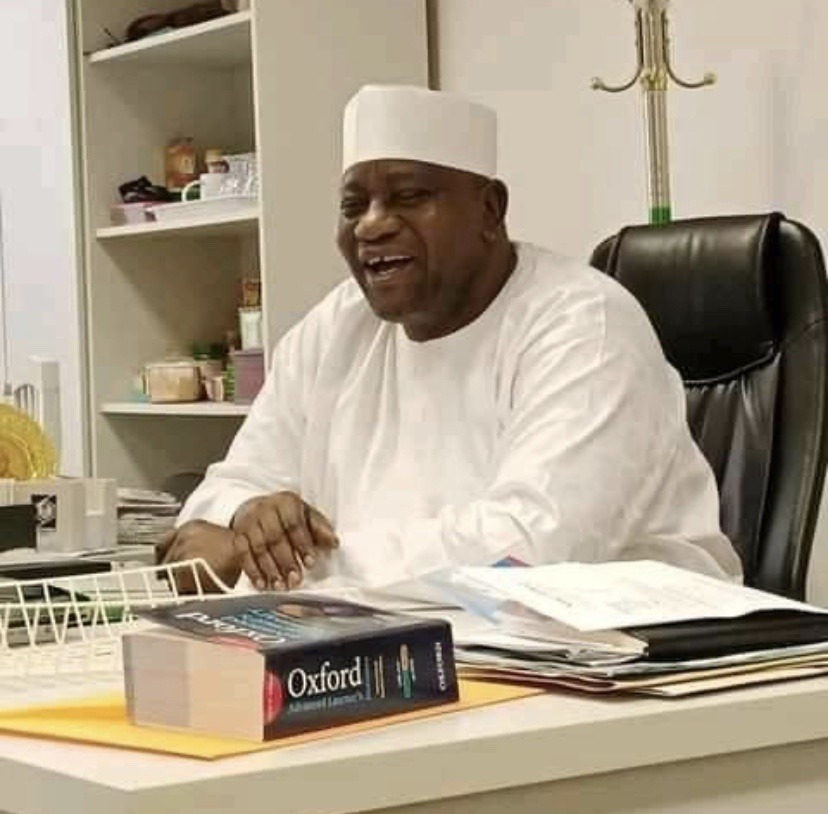
 has opened a new chapter in Katsina State politics, bringing)
By: Abdullahi Inuwa
The return of Dr. Mustapha Muhammed Inuwa to the All Progressives Congress (APC) has opened a new chapter in Katsina State politics, bringing back to the party a politician whose political journey has taken him through the APC, the Peoples Democratic Party (PDP) and, most recently, the African Democratic Congress (ADC).


For political observers in the state, however, Inuwa’s return is more than just another defection. It is being interpreted as the homecoming of a politician who was deeply involved in the formation and growth of the APC in Katsina and who played a prominent role in the party’s electoral successes between 2015 and 2023.
His political movement has, therefore, triggered fresh conversations about loyalty, political alliances, personal convictions, and the ever-changing calculations ahead of future elections.
Inuwa was among the politicians who worked for the establishment and consolidation of the APC in Katsina State at a time when the party was building its structure across the country.
The party’s victory in the 2015 general elections marked a major turning point in Nigerian politics, ending the dominance of the PDP at the federal level and producing a new political order in several states, including Katsina.
For Inuwa and other founding figures of the Katsina APC, the period between 2015 and 2023 represented years of political influence and party-building.
But political relationships, as history has repeatedly shown, are rarely permanent.
Inuwa eventually left the APC, joining the PDP before moving to the ADC. His departure created a political narrative around a man who had once been closely associated with the APC structure but had chosen to chart a different political course.
Now, after about three and a half years away from the APC, he has returned.
And that return has naturally generated the question: Why did the ‘landlord’ come home?
Political analysts believe Inuwa’s return can not simply be dismissed as an ordinary defection.
In a political environment where politicians frequently move between parties in response to changing alliances and circumstances, the return of a founding member can carry symbolic and strategic significance.
The APC that Inuwa left is not exactly the same political environment he is returning to.
New actors have emerged, old alliances have shifted, and a new generation of political figures has gained influence. Consequently, his return could potentially introduce another layer into the existing political calculations.
Some analysts see the development as a reunion between a politician and a political family he helped build.
Others believe it could be an attempt by Inuwa to reposition himself ahead of the next phase of Katsina politics.
Whatever the interpretation, one thing is clear: his return has placed his political profile back under the spotlight.
Inuwa’s political journey through three major political platforms — APC, PDP, and ADC — offers an interesting case study of Nigeria’s fluid party politics.
His movement demonstrates how political affiliations can change as politicians reassess their relationships, ambitions, and ideological or strategic positions.
But unlike politicians who have remained permanently outside their former parties, Inuwa has now chosen to return to the platform where his political journey had previously flourished.
The significance of the move is, therefore, not merely where he is going, but where he is coming from.
His experience in the PDP and ADC means he is returning with perspectives shaped by nearly three and a half years outside the APC.
That experience could become useful if properly deployed in strengthening relationships and broadening the party’s political reach.
Among the descriptions frequently associated with Inuwa is that of a straightforward politician — a man who is perceived by supporters and political associates as someone willing to express his views without excessive political ambiguity.
That attribute can be both an advantage and a challenge in politics.
Politics is often a game of negotiation, compromise, and carefully managed relationships. A politician who speaks directly can gain the reputation of being principled and predictable but may equally find himself at odds with those who prefer political diplomacy.
For Inuwa, however, his straightforward image appears to have remained part of the political identity surrounding him.
His latest return could, therefore, test how that characteristic interacts with the realities of a party that has evolved significantly since he left.
The immediate question is whether Inuwa’s return will strengthen the APC or create new political negotiations within the party.
His supporters could bring additional political energy to the party, while his experience across different political platforms could provide another perspective on opposition politics.
At the same time, existing political actors may have their own calculations.
The APC will have to balance the enthusiasm of returning members with the interests of those who remained in the party and worked through periods of political difficulty.
This is where leadership and political maturity become important.
If managed carefully, Inuwa’s return could become an opportunity for reconciliation and consolidation rather than another source of internal competition.
Ultimately, the story of Inuwa’s return is a reminder that Nigerian politics is often defined by movement.
Politicians leave, return, form alliances, break alliance and sometimes retrace their political steps.
But Inuwa’s case has a distinctive element: he is returning to a political structure whose early foundation in Katsina he helped establish.
For that reason, supporters may see the development not as a simple defection but as a homecoming.
After three and a half years away, the politician who once helped build the APC in Katsina has returned to the fold.
Whether that return will produce a new political alliance, reshape existing power calculations, or simply mark the beginning of another chapter in his political career remains to be seen.
For now, though, the message from the political theatre is unmistakable:
The ‘landlord’ has returned home — and Katsina’s political chessboard may never look exactly the same again.
Abdullahi Inuwa Social Commentator ainuwa303@gmail.com
About The Author
