


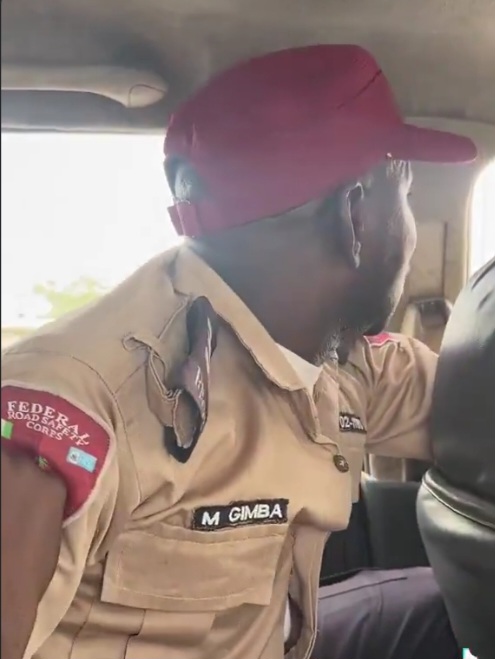

By Abdullahi Inuwa
There is a troubling contradiction at the heart of road safety enforcement: the people deployed to prevent crashes and save lives must never become the very reason lives are placed in danger.


A motorist may have broken the law. He may have driven recklessly, ignored traffic regulations or refused to obey an officer’s instruction. Whatever the offence, there must be consequences.
But there is a line between enforcing the law and recklessly endangering lives in the process of enforcing it.
That line must never be crossed.
No traffic offence, however serious, should justify an enforcement action capable of triggering a deadly crash involving innocent motorists, passengers, pedestrians or the officers themselves.

This is not an argument against firm enforcement. Far from it.
Road users need disciplined and effective enforcement. They need officers who can stop dangerous driving, apprehend offenders and ensure that traffic laws are respected.
What they do not need is enforcement that introduces a bigger danger than the offence being punished.
When a Road Safety Officer drives aggressively, pursues a vehicle recklessly, suddenly blocks traffic or takes an unnecessarily dangerous position on a busy highway, the consequences can be catastrophic. A split-second mistake can turn a routine traffic violation into a tragedy.
And when that happens, the question should not simply be: What did the driver do wrong?
The equally important question should be: Did the officer act professionally?
That question deserves honest answers.
A uniform is not a licence to act without restraint. Authority does not eliminate responsibility. In fact, it increases it.
The public expects law enforcement officers to demonstrate better judgment than the average road user. They are trained to understand the dangers of the highway. They know how quickly vehicles can collide and how little room there is for error.
Therefore, when an officer’s conduct creates unnecessary danger, the excuse cannot simply be that the officer was “doing his job.”
Doing the job is not enough; doing it professionally matters.
There must be mechanisms for investigating complaints against officers whose actions put lives at risk. Where wrongdoing is established, appropriate sanctions should follow.
Accountability should not be viewed as an attempt to weaken law enforcement. It is precisely what makes law enforcement credible.
If motorists are expected to obey the rules, enforcement officers must also obey the principles of professionalism, restraint and public safety.
The public should never be forced to choose between obeying a traffic officer and protecting itself from an unnecessarily dangerous enforcement manoeuvre.
This is ultimately about trust.
People must trust that the officer standing by the roadside is there to protect lives—not create another hazard.
The driver who violates the law must be held accountable.
But so must the officer whose reckless conduct puts innocent lives in jeopardy.
Road safety is not achieved simply by stopping offenders. It is achieved when enforcement itself is conducted safely, responsibly and professionally.
Anything less is not road safety.
It is simply another danger wearing a uniform.
About The Author
