



….YOWICAN Hails Gov. Radda’s Youth, Peace-Building Efforts in Katsina
By Abdullahi Inuwa
Religious leaders and security stakeholders have issued a fresh call for stronger cooperation among faith communities and security agencies, warning that the fight against insecurity, extremism and social division cannot be won by government or security forces alone.


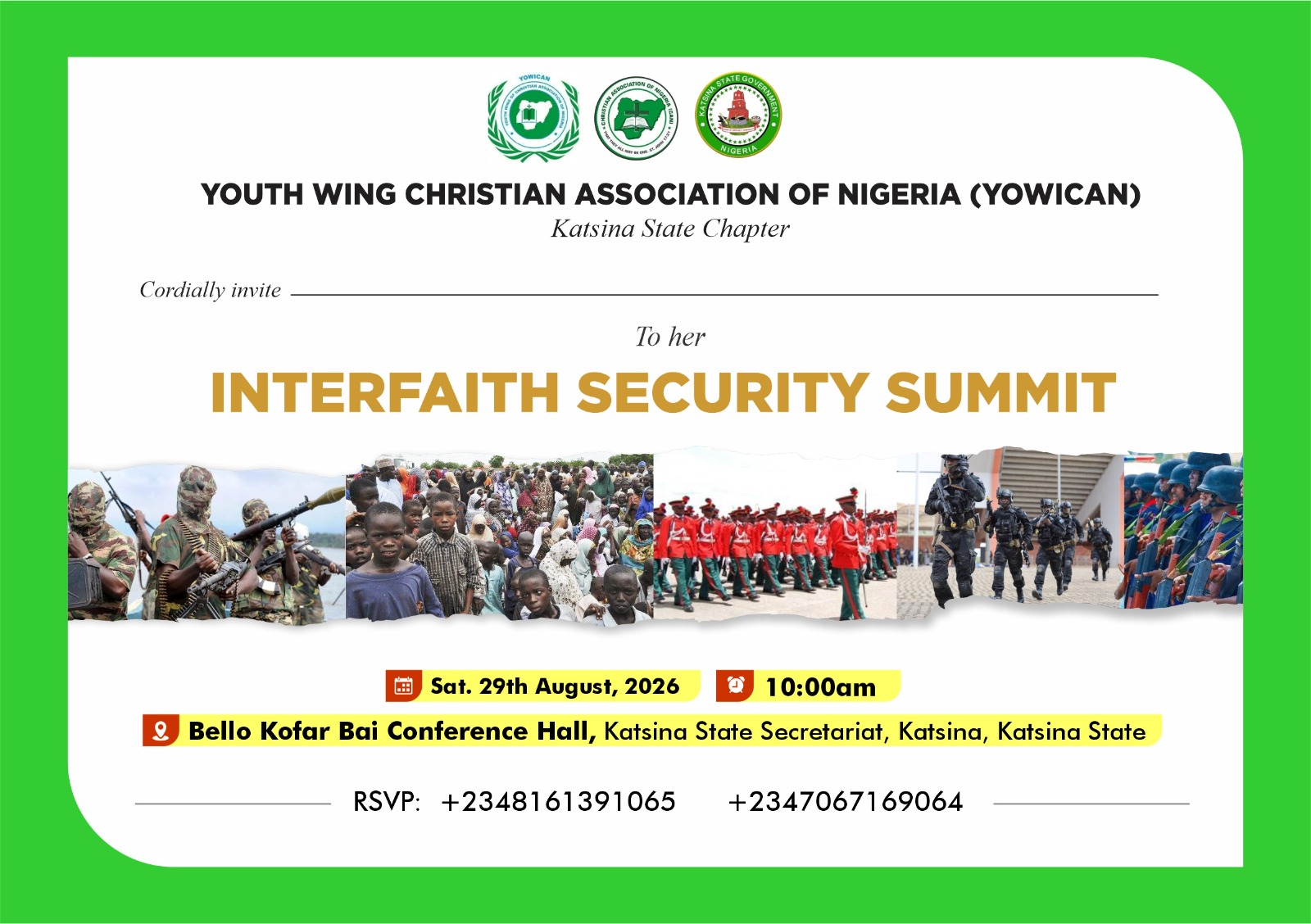
The call was made at an Interfaith Security Summit, where Christian and Muslim leaders, representatives of faith-based organisations, security experts and other stakeholders converged to develop practical strategies for protecting worshippers and strengthening peaceful coexistence.
Declaring the summit open, the Chairman and host said the gathering had become necessary at a time when security challenges were increasingly affecting communities irrespective of religious or social boundaries.
He said the presence of stakeholders from different backgrounds demonstrated that security must be viewed as a shared responsibility, rather than an issue belonging exclusively to government, the military, police or any particular religious group.
According to him, threats facing churches, mosques and other places of worship ultimately affect the wider society because violence in one community can quickly create fear, suspicion and tension elsewhere.
The Chairman urged participants to look beyond religious differences and concentrate on areas where cooperation could save lives and prevent violence.
He said the summit was designed to transform interfaith dialogue from mere conversation into practical security partnerships capable of producing early warnings, coordinated responses and stronger community resilience.
He identified improved communication between religious institutions and law-enforcement agencies as one of the major priorities of the summit.
Other areas of focus included emergency preparedness, security awareness, digital safety and the identification of factors that contribute to hate, radicalisation and extremism.
Security analysts at the gathering noted that modern security challenges require more than physical protection.
They argued that while surveillance cameras, access controls, trained guards and emergency procedures remain important, community trust and timely information-sharing can often prevent threats before they become violent incidents.
The summit stressed that an attack on one religious community should not be treated as an isolated incident by others.
Participants were encouraged to develop stronger relationships that would enable communities to share information, support one another during crises and collectively reject attempts to exploit religion for violence.
The Chairman said the message from the summit should be unmistakable to those seeking to divide society: religious differences will not be allowed to become a weapon against national unity.
He urged participants to use panel sessions, workshops and networking opportunities to develop practical security frameworks that religious institutions can implement in their respective communities.
A significant highlight of the gathering was the appreciation extended by the Youth Wing of the Christian Association of Nigeria (YOWICAN) to His Excellency, Mallam Dikko Umar Radda, Executive Governor of Katsina State, for his continued commitment to the development and progress of the state and Nigeria at large.
YOWICAN praised Governor Radda for his tireless efforts and continuous support, particularly in areas concerning youth development and peaceful coexistence.
The organisation noted that empowering young people and creating an environment where communities of different faiths can live together peacefully are crucial components of any sustainable security strategy.
Political and security observers say such initiatives are particularly significant because Nigeria’s long-term stability will depend not only on the capacity of security agencies, but also on the ability of governments and communities to address unemployment, exclusion, radicalisation and other conditions that can make young people vulnerable to criminal and extremist influences.
The summit’s organisers urged stakeholders not to allow the gathering to end with speeches and photographs alone.
They called for concrete follow-up mechanisms, regular communication between religious and security leaders, improved emergency preparedness and sustained community engagement.
The Chairman expressed appreciation to the organising committee, speakers, religious leaders, security experts and guests for contributing to the summit.
He called for the partnerships forged at the event to be maintained beyond the conference hall.
The gathering ultimately delivered a simple but powerful message: peace cannot be secured by one faith, one institution or one agency alone.
For Nigeria to overcome the security challenges threatening its communities, stakeholders must be prepared to trust one another, communicate, protect one another and stand together against violence and extremism.
And as YOWICAN’s commendation of Governor Radda underscores, investing in young people, peaceful coexistence and inclusive development may prove just as important to Nigeria’s security future as the deployment of boots on the ground.
About The Author
