


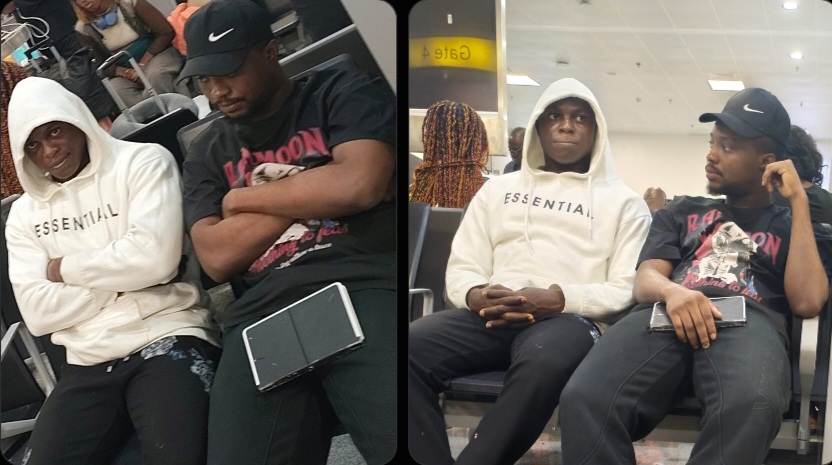

LAGOS — The Economic and Financial Crimes Commission (EFCC) has extradited two Nigerian men to the United States to face prosecution over alleged online sexual exploitation and sextortion of teenage boys, in cases linked to the deaths of two American minors.
The suspects, Mudashiru Afeez Olawale and Adebola Festus Adekunle, were handed over to U.S. authorities on Wednesday, August 26, 2026, following investigations into separate alleged sextortion operations targeting male teenagers between the ages of 13 and 17.


The extradition was facilitated by the Lagos Zonal Directorate 2 of the EFCC as part of growing cooperation between Nigerian and U.S. law enforcement agencies in tackling cyber-enabled crimes involving the exploitation of minors.
According to investigations by the U.S. Federal Bureau of Investigation (FBI), the alleged schemes involved obtaining or soliciting sexually explicit images from minors and subsequently using the material to threaten and extort victims for money.
Investigators said payments were allegedly demanded through channels including money-transfer services, gift cards and cryptocurrency.
The cases took a tragic turn after two American teenage boys allegedly died by suicide following online sexual exploitation and extortion.
In one case, the FBI said a 13-year-old boy was contacted through Instagram by an individual who proposed exchanging nude photographs.
After the exchange, the alleged perpetrator reportedly threatened to circulate the boy’s photographs among his Instagram contacts unless he paid money.
The situation allegedly continued even after the teenager indicated that he was contemplating taking his own life.
The FBI subsequently traced intelligence connected to the alleged operation and sought assistance from Nigerian authorities to identify and investigate individuals believed to be involved.
The request led to investigations by the EFCC, which eventually resulted in the arrest of Adekunle, who was brought before the Commission in connection with the case.
Olawale, meanwhile, faced a separate U.S. extradition request arising from a seven-count criminal case.
The allegations against him include sexual exploitation and attempted sexual exploitation of a minor resulting in death, enticement of a minor to engage in sexual activity, interstate threatening communications and the alleged distribution of child sexual abuse material.
Following the FBI’s request, the EFCC commenced extradition proceedings against Olawale at the Federal High Court in Lagos.
The case was filed as Suit No. FHC/L/CS/353/2024 before Justice A. Lewis-Allagoa.
The Federal High Court initially rejected the extradition application on June 10, 2024. However, the Office of the Attorney-General of the Federation challenged the decision at the Court of Appeal.
The legal battle eventually took a decisive turn on July 7, 2026, when the Court of Appeal, Lagos Division, in Appeal No. CA/LAG/CV/721/2024, overturned the Federal High Court decision.
The appellate court’s ruling cleared the legal path for Olawale to be extradited to the United States.
With the extradition of both suspects now completed, they are expected to face prosecution before the appropriate U.S. authorities.
The development highlights the increasing international dimension of internet-enabled crimes and the growing cooperation between Nigerian and American law enforcement agencies in pursuing suspects whose alleged activities cross national borders.
The EFCC said the case further demonstrates the importance of sustained collaboration in confronting cybercrime, particularly cases involving the sexual exploitation of children, online threats and sextortion.
The extradition also sends a strong warning that alleged perpetrators of online crimes targeting minors may face prosecution beyond Nigeria’s borders when investigations establish links to offences committed against victims abroad.
About The Author
