


By Abdullahi Inuwa
Borno State has recorded a major milestone in its education sector, with school enrolment rising to a record 1,801,295 learners across the state.


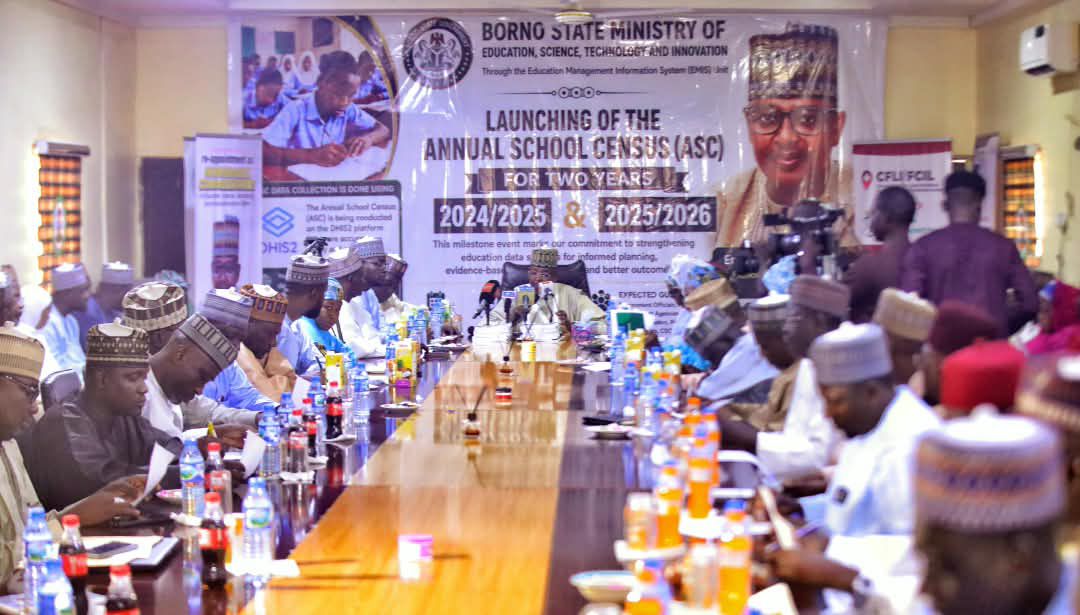
The figure was contained in the 2024/2025 and 2025/2026 Annual School Census (ASC) Report unveiled on Friday by the Commissioner for Education, Science, Technology and Innovation, Engr. Lawan Abba Wakilbe, at the Ministry of Education Work Hub, Musa Usman Secretariat, Maiduguri.
The latest statistics represent an increase of more than one million learners in nine years, compared with the 766,551 pupils recorded during the 2017/2018 academic session.
Wakilbe described the growth as a strong indication that ongoing efforts to rebuild Borno’s education system are restoring confidence among parents and communities.
He said the steady rise in enrolment was not merely a statistical achievement but a reflection of growing public trust in the state’s schools.
“When you look at where we started, 766,551 learners in 2017/2018, and see where we are today, this is not just a number; it is evidence that parents and communities once again trust our schools with their children’s future,” Wakilbe said.
According to the commissioner, the increase has been driven by sustained government investment in education, the expansion of learning facilities and deliberate efforts to rebuild the sector after years of disruption.
He credited Governor Babagana Umara Zulum for what he described as his sustained commitment to education, while also acknowledging the role of the Minister of Education, Dr Maruf Tunji Alausa, particularly in strengthening the country’s education data system through initiatives such as the Digital National Education Management Information System (DNEMIS).
Wakilbe also commended the enumerators, head teachers, Local Government Education Authorities and EMIS personnel who participated in the census exercise.
The commissioner said the expansion in enrolment has been accompanied by a corresponding increase in the teaching workforce.
He disclosed that the number of teachers serving across primary, junior secondary and senior secondary schools increased from 15,563 in 2024/2025 to 17,565 in 2025/2026.
At the senior secondary level, the number of teachers rose from 2,314 to 2,998, with the figure projected to reach 3,998 by 2027 following the recruitment of another 1,000 senior secondary school teachers in August 2026.
When facilitators working under the Sangaya and mass literacy programmes are included, the state’s combined teaching workforce is now estimated at 19,316.
Wakilbe stressed that increasing enrolment must go hand in hand with adequate staffing to prevent overcrowding and maintain quality learning.
“We cannot talk about access without talking about the people who stand in front of the classroom every day,” he said.
“That is why, alongside rising enrolment, we have deliberately grown our teaching workforce because more pupils must mean more qualified teachers, not more overcrowded classrooms.”
Public Secondary Schools Jump From 34 to 129
The census report also revealed a dramatic expansion in the number of functional public secondary schools in Borno.
According to Wakilbe, the number increased from just 34 in 2021 to 129 in 2026.
The state also achieved 100 per cent reporting coverage across pre-primary and primary schools, junior secondary schools, senior secondary schools, as well as science and technical institutions during the latest census cycle.
Another significant development highlighted in the report was the ongoing integration of Sangaya and Islamic education into Borno’s broader education system.
Wakilbe said the establishment of the Arabic and Sangaya Education Board, creation of High Islamic Colleges and the registration and verification of Sangaya centres, facilitators, enumerators and Islamiyya schools were part of efforts to bring the system into a more structured framework.
Data currently available on DNEMIS shows 127,652 verified Sangaya learners.
However, a separate verification exercise being conducted by the Sangaya Board has so far identified 498,295 learners across 5,335 centres.
The Sangaya Board, working alongside the State Agency for Mass Literacy, has deployed 1,751 facilitators to support learning across the centres.
The latest census, authorities said, is expected to provide policymakers with a clearer picture of the state’s education landscape and help guide future investments in infrastructure, teachers and learning opportunities.
The presentation was attended by key officials and stakeholders, including the Executive Chairman of SUBEB, Prof. Bulama Kagu; Executive Chairman of BSSEB, Prof. Yusufu Gana Balami; Executive Secretary of the Arabic and Sangaya Education Board, Dr Abdulkadir Abdulkarim; Permanent Secretary of the Ministry, Hajiya Yakaru Mustapha; Permanent Secretary of SUBEB, Dr Hyelni Mshelia; and AGILE Coordinator, Engr. Ibrahim Baba.
Others included a representative of the Commissioner for Planning and Economic Development, Alhaji Adamu Idris Bako; Dr Yusuf Isma, who led the UNICEF and donor partners’ delegation; and Mohammed Abdullahi, who led the Borno Civil Society Organisations’ delegation.
Also present were the Director-General of Statistics, Suleiman Askira; Chairman of SBMC, Alhaji Abba Bukar; Abba Kurama, DPRS representing the Executive Secretary of the Education Trust Fund, as well as education secretaries and directors from various agencies within the sector.
About The Author
