


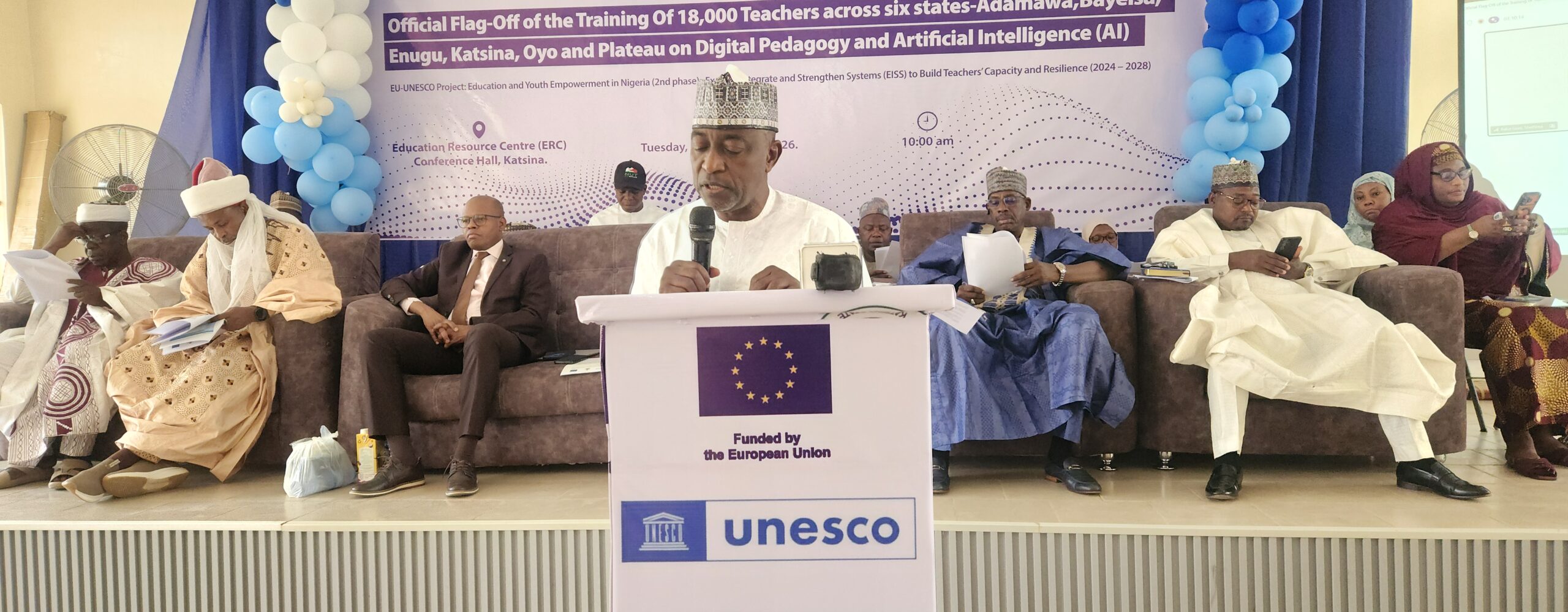
 have flagged off a major capacity-building)
…..Katsina Hosts National Launch as Six States Benefit from Education Transformation Programme
By: Abdullahi Inuwa


The European Union (EU) and the United Nations Educational, Scientific and Cultural Organisation (UNESCO) have flagged off a major capacity-building programme aimed at training 18,000 teachers in digital pedagogy and Artificial Intelligence (AI) across six states in Nigeria.
The initiative, being implemented under the second phase of the EU Programme on Education and Youth Empowerment in Nigeria, is designed to equip teachers with modern teaching skills, digital literacy and innovative approaches to improve learning outcomes.
The national flag-off ceremony, hosted by Katsina State, brings together six beneficiary states: Adamawa, Bayelsa, Enugu, Katsina, Oyo and Plateau.
The training is part of the EU-UNESCO project titled Expand, Integrate and Strengthen Systems (EISS) to Build Teachers’ Capacity and Resilience (2024–2028).
The programme seeks to strengthen Nigeria’s education system by investing in teachers’ professional development, improving the quality of teacher education and expanding access to continuous training opportunities.
Under the initiative, participating teachers are expected to acquire practical competencies in digital teaching methods, artificial intelligence, inclusive education and the effective use of technology in classroom instruction.
The intervention also aims to improve teachers’ subject knowledge, pedagogical skills and preparedness to respond to emerging challenges in the education sector, including disruptions that affect the delivery of quality education.
The selection of Katsina as the host of the national flag-off ceremony reflects the state’s ongoing collaboration with development partners and its commitment to improving basic and secondary education.
Through the Ministry of Basic and Secondary Education, Katsina State has established a State Project Steering Committee to coordinate the implementation of the EISS project.
The state has also demonstrated commitment to implementing the revised National Teacher Policy and providing a dedicated budget line to support the project’s activities.
The EU delegation recognises Katsina’s efforts to promote digital transformation in education, including the adoption of context-appropriate digital learning solutions, offline-capable learning tools and interventions to support the reintegration of out-of-school children.
The state’s experience in working with development partners, particularly UNESCO, is also expected to provide a foundation for the successful implementation of the training programme.
A major component of the initiative is Output 2.3 of the EISS project, which focuses on developing the capacity of states to strengthen the information and communication technology (ICT) skills and digital pedagogical competencies of in-service teachers.
The intervention is considered particularly important as education systems increasingly embrace technology and artificial intelligence to improve teaching methods and respond to the changing needs of learners.
Beyond introducing teachers to digital tools, the programme seeks to promote inclusive teaching practices that address the different learning needs of pupils and students, while strengthening teachers’ professional motivation, well-being and resilience.
The EU and UNESCO are also using the initiative to reinforce government commitment to education reforms and create greater awareness among stakeholders about the importance of investing in teachers.
The programme is expected to contribute to the achievement of Sustainable Development Goal 4 (SDG 4), which seeks to ensure inclusive and equitable quality education and promote lifelong learning opportunities for all.
With 18,000 teachers targeted across the six states, the initiative represents a significant investment in strengthening the capacity of Nigeria’s teaching workforce and preparing educators for the demands of 21st-century education.
The flag-off ceremony is expected to formally launch the training activities, reaffirm the partnership between the Federal and State Governments, the European Union and UNESCO, and mobilise education stakeholders towards achieving the programme’s objectives.
As Nigeria continues to confront challenges in access to quality education, teacher capacity and the integration of technology into classrooms, the EU-UNESCO intervention places professional development at the centre of efforts to build a more inclusive, responsive and resilient education system.
About The Author
