


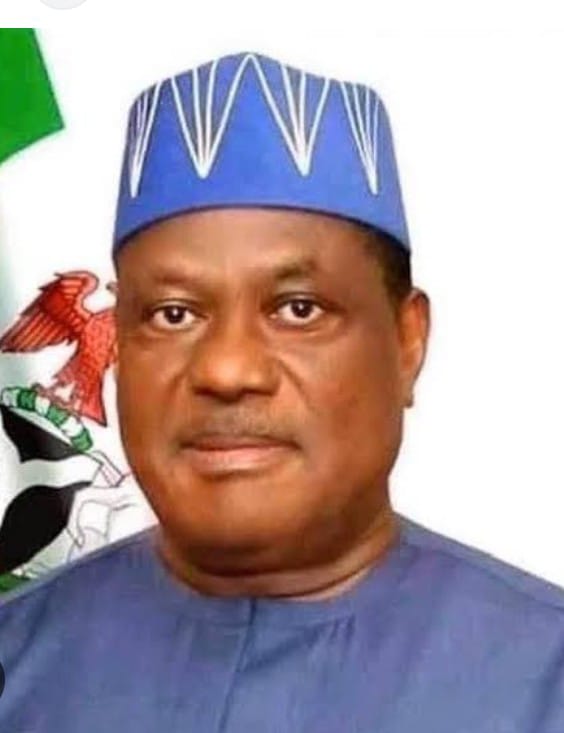

Party Unity, Loyalty, and Internal Democracy Under Pressure as Benue APC Faces Defining Moment
In Nigeria’s often turbulent political landscape, Senator George Akume, stands out as a symbol of patience, discipline, and long-term party loyalty. From his emergence as Governor of Benue State in 1999 to his rise as Senator, Minister, and now Secretary to the Government of the Federation (SGF), his career has followed a steady path defined by structure, restraint, and deep engagement within party systems.


But that long record of internal stability is now being tested in one of the most sensitive political tensions in Benue State’s recent history.
At the centre of the unfolding rift is his relationship with Governor Hyacinth Alia, whose political rise defied expectations. With limited prior political structure and experience, Alia defeated established figures within the political landscape, including seasoned politicians such as Barnabas Gemade and Steven Lawani, to clinch the governorship.
However, what began as a widely celebrated victory soon gave way to growing political friction between the new governor and the party establishment led by Akume.
According to political observers within the ruling All Progressives Congress (APC), the disagreement deepened shortly after the governor assumed office, with relations between both men steadily deteriorating without clear reconciliation points.
The tension escalated further when discussions around a possible second term for Governor Alia emerged. While many within Akume’s political circle expressed concern over perceived shifts in the party’s national posture, the SGF was said to have maintained calm and continued to align himself with party directives—even in difficult circumstances.
One of the most controversial moments came with the dissolution of the elected APC state executive in Benue and the appointment of a caretaker committee—an action Akume reportedly accepted in the interest of party unity. Even more contentious was the directive that elected office holders, including the governor, should return unopposed in future elections, a position Akume communicated while urging cohesion within the party structure.
At a political gathering in Makurdi, he was quoted as saying:
“All those elected on the platform of the APC, from the State Assembly to the National Assembly, are expected to return automatically… and of course, the Governor is also expected to be returned.”
That stance, however, was openly rejected by Governor Alia, who insisted that no automatic tickets would be granted, citing alignment with the position of the President and the party’s national leadership. The development effectively exposed a widening divide between the state structure and the emerging power configuration.
Despite the rising tension, Senator Akume has largely maintained composure, choosing to operate within formal party frameworks rather than escalate confrontation. Supporters describe his approach as restrained, even in the face of sustained political provocation.
But beneath the calm exterior lies a deeper struggle over the soul of party democracy in Benue State.
Critics warn that the unfolding crisis reflects a dangerous assumption—that party structures can be bypassed, internal processes ignored, and long-standing political actors sidelined without consequences.
Now, voices within the APC are calling for a reset.
They argue that rather than imposition or closed-door arrangements, the party must return to open competition and internal democracy. Aspirants, they say, should be allowed to emerge freely, and political choices should be determined by party members and the electorate—not predetermined interests.
As tensions mount, one message is becoming increasingly clear: the future of the APC in Benue State may depend not on who controls the structure, but on whether the structure itself is allowed to function.
And as one political stakeholder put it, bluntly: no party survives long when its internal democracy is consistently placed under strain.
The coming months may therefore determine whether Benue APC recalibrates toward unity—or slides further into internal fragmentation with lasting consequences.
About The Author
