



By: Prof. Matawalli Ajagana Geidam
Department of Biochemistry
Kashim Ibrahim University, Maiduguri, Nigeria
I just watched Professor Jeffrey Sachs deliver an important lecture at the headquarters of the European Parliament in Brussels. In discussing projected population growth across the world, beginning with China, India and Europe, he drew attention to a demographic reality that deserves the attention of every responsible leader: Africa’s population will continue to grow significantly for decades to come, potentially reaching between 3 and 3.5 billion people by 2100.
Turning to members of the European Union, he posed a very pertinent question: “What are you doing about education in Africa?”
His concern was straightforward but profound. If Africa is to have a population of about 3.5 billion by the end of this century, and the world does little or nothing to ensure that these children have access to adequate, quality education, the consequences could be monumental, not only for Africa but for the entire world.
He was right to raise this concern. The implications of a rapidly growing population without commensurate investment in education, skills development, and human capital formation are too serious to ignore.
At that point, the moderator interjected with an example from personal experience. He explained that, having appreciated the magnitude of the problem, he had established a small school in Burundi, which he described as the poorest country in the world. Among other interventions, he had provided 200 smart devices and internet services, with the benefits extending to other schools in the neighbourhood.
That was a commendable initiative. It demonstrated that individuals, even without the resources of governments or international organisations, can make meaningful contributions towards addressing the educational challenges facing Africa.
However, there is something Professor Jeffrey Sachs and many others who express concern about Africa’s demographic future need to know. Africa is not without people who understand the dangers of an expanding population of out-of-school children. Across the continent, there are leaders, public officials, philanthropists, community organisations and ordinary citizens who are working, often under extremely difficult circumstances, to prevent precisely the crisis he fears.
With limited resources at their disposal, many are working tirelessly to construct conducive classrooms, enrol children of school age, provide textbooks and school uniforms, and, where possible, introduce digital learning facilities. Their concern goes beyond getting children into classrooms. They are also working to ensure that the children remain in school, complete their education and acquire the knowledge and skills necessary to become productive citizens.
These efforts may not always attract international attention. They may not feature prominently in the reports of global development institutions or the discussions of international conferences. Yet, they are taking place in communities across Africa, where the struggle to educate every child is real, urgent and often personally demanding.
Let me bring this discussion closer to home, to Maiduguri, Borno State, Nigeria.
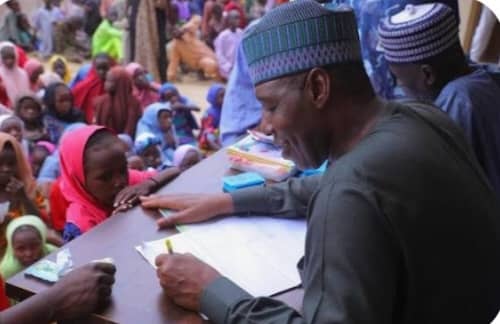
During his last visit to Maiduguri, Vice President Kashim Shettima, GCON, had another opportunity to interact with parents whose children had largely been left outside the formal school system. These were children whose circumstances had denied them the opportunity to enjoy the benefits of conventional schooling.
What happened next deserves recognition.
The Vice President, who has consistently demonstrated a keen interest in getting children of school age of the Fulani extraction, orphans, and internally displaced children, into classrooms and ensuring their retention, had a school dedicated to the education of these children. A bus was also provided to convey them to and from school. The intervention included free school uniforms, free textbooks and one meal per day. There are many of these Mega schools spread across Maiduguri and Borno State.
Think about what this means to families who might otherwise struggle to afford the basic requirements of schooling. For such parents, the cost of uniforms, books, transportation and feeding can become formidable barriers to education. Removing these obstacles is not merely an act of charity; it is a practical investment in the future of the children and the society in which they live.

More importantly, these children are being given something far more valuable than material provisions: an opportunity to learn, develop their abilities, discover their potential and participate meaningfully in society.
This is the kind of intervention that deserves to be documented, studied, supported and replicated wherever similar circumstances exist.
Of course, isolated interventions, however commendable, cannot by themselves resolve Africa’s enormous educational challenges. The scale of the problem requires sustained government commitment, adequate funding, stronger educational institutions, effective policies and meaningful partnerships with the private sector, philanthropists and international development organisations. Above all, it requires a deliberate determination to ensure that no child is denied an education simply because of poverty, insecurity, disability, geographical location or the circumstances of birth.
But as we discuss the future of Africa’s population, we must be careful not to portray the continent merely as a demographic problem waiting to explode. Africa’s growing population also represents an enormous reservoir of human potential. Whether that potential becomes a demographic dividend or a source of social and economic instability will depend substantially on the decisions we make today, particularly our commitment to education.
Professor Jeffrey Sachs must therefore know that there are heroes in the very part of the world whose future he fears for. Some are working in government, others in communities, schools, foundations and charitable organisations. Many are doing so quietly, without international recognition, while stretching their limited resources to reach children who might otherwise be forgotten.
Vice President Kashim Shettima’s interventions in Maiduguri are examples worth bringing to the attention of the international community. They demonstrates that, even in a region confronted by serious educational, social and security challenges, purposeful leadership can make a tangible difference in the lives of vulnerable children.
The question, therefore, is not simply what Europe, the United Nations or other international partners are doing about education in Africa. It is also what African governments, leaders and communities are doing, what more they can do, and how international partners can support and strengthen the initiatives already underway. His successor, Prof. Babagana Umara Zulum CON has impressively continued where Sen. Kashim Shettima had left.
We need partnerships, not paternalism; investment, not mere expressions of concern; and practical collaboration, not narratives that portray Africa only in terms of its problems.
By 2100, Africa may indeed have between 3 and 3.5 billion people. The critical question is what kind of people they will be. Will they be adequately educated, skilled, innovative and productive, or will millions be denied the opportunities necessary to contribute meaningfully to their societies?
The answer will be shaped by what we do today.
Professor Jeffrey Sachs, please look beyond the projections and the alarming figures. There are people on the ground, including in Maiduguri, who are already working to change the story. They deserve to be seen, heard, supported, and celebrated.
Our unsung heroes are not waiting for 2100 to confront the challenge. They are confronting it today, one child, one classroom, and one school at a time.
About The Author
