



By Abdullahi Alhassan, Kaduna
Stakeholders at a high-level workshop on innovative financing for social protection in Kaduna State have moved to douse concerns over the institutionalisation of Zakat and Waqf, insisting the initiative is anchored on inclusivity, poverty reduction, and constitutional legality, and not on religious imposition.

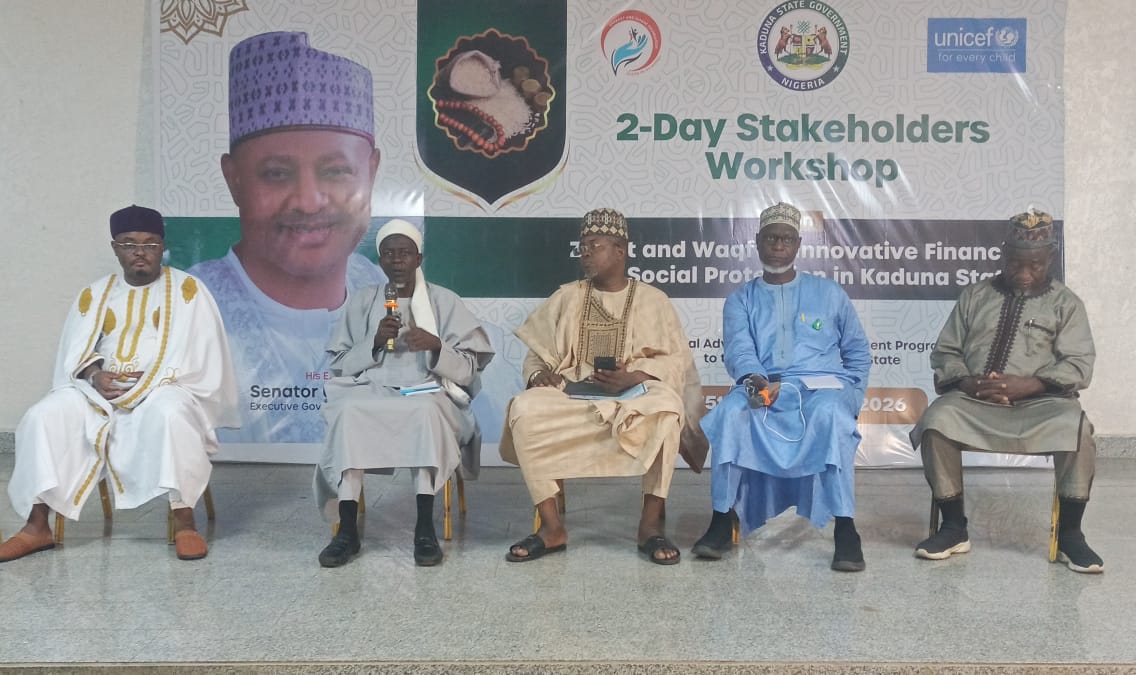
The two-day stakeholder workshop on Zakat and Waqf as Innovative Financing for Social Protection in Kaduna State was organised by the Office of the Special Adviser to Governor Uba Sani on Social Investment Programmes, with support from UNICEF, while the Zakat and Waqf Foundation provided technical support.
Speaking at the forum, Malam Tahir Buba of the Kaduna Bureau of Interfaith said discussions at the workshop reflected a growing consensus that humanitarian concerns transcend religious and ethnic boundaries.
He noted that Kaduna State, under the current administration, is prioritising inclusivity and ensuring that no citizen is left behind in policy formulation and implementation.
Buba recalled how participants were deeply engaged during goodwill messages, stressing that issues of humanity naturally resonate across divides.
According to him, sustained engagement and consultation between government and citizens remain central to achieving shared development goals and fostering unity in the state.
Delivering a goodwill message on behalf of the Christian Association of Nigeria (CAN), Reverend Joel Madaki emphasised that poverty alleviation and care for the vulnerable are universal religious values.
Quoting biblical references, he said any initiative that uplifts the poor aligns with Christian teachings and the broader moral obligation to support those in need.
Madaki affirmed CAN’s commitment to social justice, noting that Christian organisations in Kaduna have long engaged in humanitarian efforts, including scholarships, medical outreach, and skills acquisition programmes.
He acknowledged Zakat and Waqf as established mechanisms within Islam for wealth redistribution and expressed respect for the rights of Muslims to deploy such tools for the common good.
He called for transparency, accountability, and sustained dialogue, adding that Kaduna’s history of tension makes collaboration across faiths essential for lasting peace.
He expressed optimism that the workshop would yield practical outcomes benefiting widows, orphans, and unemployed youth across the state.
Also speaking, Engineer Muhammad Lawal Maidoki highlighted existing faith-sensitive policies of the Kaduna State Government, including adjustments to working hours during Ramadan, as evidence of respect for religious diversity.
He argued that Zakat and Waqf, as Islamic social finance tools, are fundamentally about addressing poverty and promoting social welfare.
Drawing comparisons with global practices, Maidoki noted that similar ethical financing models operate successfully in countries such as the United States, Japan, France, and other non-Muslim-majority nations, where they are used strictly for development purposes.
He explained that such systems are not instruments of religious conversion, but rather mechanisms for supporting vulnerable populations regardless of their faith.
He further cited examples within Nigeria, pointing out that states like Imo and Anambra have benefitted from interventions linked to the Islamic Development Bank without any religious implications.
Projects in Kaduna, he added, including school development and water supply in Zaria, serve all residents without discrimination, reinforcing the universal nature of such interventions.
Maidoki also referenced broader humanitarian efforts, including those funded by global organisations such as the Bill and Melinda Gates Foundation, particularly in polio eradication campaigns across Nigeria, stressing that beneficiaries are never selected based on religion.
On the legal framework, a judicial representative at the event, Justice Nasir Siri, clarified that the proposed structures around Waqf are firmly grounded in the Constitution of the Federal Republic of Nigeria.
He explained that issues such as jurisdiction and administration are being addressed strictly within existing legal provisions, dismissing claims of illegality or hidden religious agendas.
Speaking on Waqf as a sustainable mechanism for social development, a case study of global best practices, he stressed that institutionalising Zakat and Waqf should be viewed as a complementary social protection strategy.
He said the development should be seen as similar to global best practices rather than a sectarian project, urging citizens to focus on its potential to reduce poverty and strengthen social cohesion
About The Author
