



….Why Humanitarian Acts by Frontline Soldiers Must Be Protected, Not
Exploited
SPECIAL REPORT AND ANALYSIS:


A special report on humanitarian assistance, civilian responsibility, privacy and operational security in
conflict affected communities
In a region where the image of a soldier is often associated with combat, patrols, checkpoints and
counter insurgency operations, another dimension of military service is sometimes overlooked: the
human relationship between troops and the communities they protect.
It is the soldier who pauses after duty to listen to a struggling family. It is the officer who receives an
appeal for assistance and, within the limits of his personal capacity, responds. It is the member of the
Nigerian Army who understands that protecting communities is ultimately about protecting people.
That dimension deserves recognition. It also deserves protection.
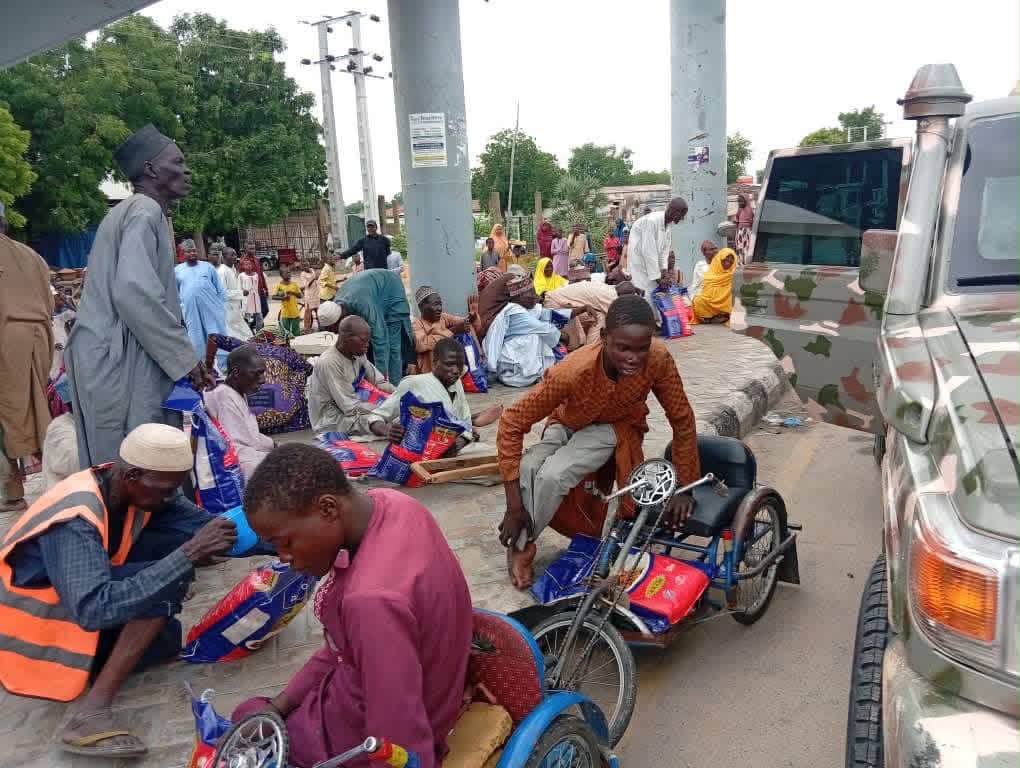
The recent humanitarian gesture by Colonel Manga towards vulnerable members of the community in
Maiduguri has attracted public commendation. According to accounts surrounding the intervention,
some people had previously presented requests to him and he responded whenever he was able to
do so, providing assistance according to his capacity and what circumstances made possible.
The latest intervention has come at a time when many households are facing economic pressure,
food insecurity and the rising cost of basic necessities. For beneficiaries, however, the value of the
gesture goes beyond the material assistance itself. It is also about being heard, being acknowledged
and receiving help from someone who chose to respond.
That is the part of military service that rarely makes the headlines, yet it can have a powerful effect on
public confidence and the relationship between security personnel and the communities they serve.
THE SOLDIER IS ALSO PART OF THE COMMUNITY
Across Borno State, from Damboa and Biu to Dikwa, Gamboru Ngala, Kala Balge and Marte, military
personnel continue to operate in demanding security environments. Similar realities exist in parts of
Yobe State, including Gaidam and Nguru, and in several communities across Adamawa State where
troops are deployed on frontline and security duties.
In such places, the relationship between the military and civilians cannot be reduced to combat
operations. Counter insurgency efforts also depend on public confidence, cooperation, information
sharing and the willingness of communities to regard security personnel as partners in protecting
lives and restoring normality.
Humanitarian gestures can contribute to that relationship. An officer who helps a vulnerable family
does not cease to be a soldier. When such assistance is lawful, appropriate and within the officer’s
personal capacity, it can reinforce the human dimension of military service and strengthen trust between troops and civilians.
CIVIL MILITARY RELATIONS: THE TRUST THAT SUPPORTS SECURITY
At the heart of this discussion is the importance of healthy civil military relations. In conflict affected
communities, the military does not operate in isolation from the population. Soldiers live, patrol, work
and sometimes sacrifice their lives within communities whose cooperation is essential to the
restoration and maintenance of peace.
Civil military relations are therefore not simply about the interaction between armed forces and civilians during military operations. They are about trust, communication, mutual respect and an
understanding of shared responsibilities. Where civilians trust security personnel, they are more likely to provide useful information, cooperate with lawful security measures and support efforts aimed at protecting their communities.
The relationship works both ways. Civilians expect soldiers to protect lives, respect human dignity
and conduct themselves professionally. Soldiers, in turn, require civilians to understand the security
environment in which they operate and to avoid actions that could expose personnel, equipment,
locations or operations to unnecessary risk.
This is why a humanitarian gesture by a serving officer can carry significance beyond the immediate
assistance provided. When a vulnerable family sees a soldier not only as an armed security official
but also as a fellow human being willing to listen and assist within his capacity, it can help reduce
psychological distance between the military and the civilian population.
Such gestures, when undertaken appropriately, can contribute to confidence building and strengthen
the social foundation upon which effective security operations depend. They should not be confused
with the formal responsibilities of government welfare agencies or humanitarian organisations, but
they can complement broader civil military engagement and community confidence building.
At the same time, civilians must understand that showing appreciation for soldiers does not require
exposing them. A photograph taken to celebrate an act of kindness can inadvertently reveal a military
officer’s identity, location, movement or association with a particular community. Protecting the officer
from unnecessary exposure is therefore itself an act of responsible civil military partnership.
The strongest civil military relationship is not one in which civilians simply applaud soldiers, nor one in
which soldiers simply demand cooperation from civilians. It is one built on reciprocal responsibility:
the military protects the people, civilians respect legitimate security requirements, and both sides
recognise that the ultimate objective is the protection of life, restoration of peace and return to normal
community life.
COMPASSION MUST NOT BECOME A SECURITY VULNERABILITY
There is, however, another side to the story. The growing habit of photographing, recording and
immediately publishing encounters involving military personnel can create serious privacy and operational security concerns. Not every good deed needs a photograph. Not every photograph needs to become a social media
post. And not every positive looking image involving a military officer is necessarily safe to publish.
The public must understand that, in a conflict affected environment, apparently harmless information
can reveal more than the person taking the photograph intends. An image may expose a location, identify an officer, reveal a military vehicle or installation, show operational equipment or establish
that a particular officer was present in a particular community at a particular time.
Individually, such details may appear insignificant. Collectively, they can create an operational
security risk. Civilians should therefore exercise particular restraint when photographing military
personnel, military locations or ongoing military activities, especially in frontline and operational
areas.
THE LAW PROTECTS PRIVACY, BUT CONTEXT MATTERS
There is also a need to correct a common misunderstanding about data protection law. The Nigeria
Data Protection Act 2023 establishes a national framework for the lawful processing of personal data
and provides several lawful bases for processing.
Section 25 recognises consent as one lawful basis, while also providing for circumstances involving
legal obligations, vital interests, public interest and legitimate interests, subject to the requirements
and limitations of the Act.
It would therefore be legally inaccurate to claim that every photograph of another person is automatically unlawful simply because express permission was not obtained before the photograph was taken.
The more responsible approach is to consider privacy, purpose, lawful basis, reasonable expectations, potential harm and the circumstances surrounding the collection and publication of the
material.
The issue becomes particularly sensitive when vulnerable people, children, private family
circumstances or serving security personnel are involved.
The practical principle is simple:
If you are not certain that publishing an image is lawful, necessary, ethical and safe, pause before pressing the publish button.
THE NIGERIAN MILITARY ALREADY RECOGNISES THE DANGER
This concern is not merely theoretical.
The Armed Forces of Nigeria has an established policy governing social media use. The Defence
Headquarters policy warns against the publication of sensitive information about personnel and units,
including schedules, events, locations, weapons and equipment. It also addresses the risks
associated with location functions and geo tagging during operations.
Perhaps most significantly, the policy recognises that security risks can arise through civilian friends
and relatives. It directs military personnel to educate people around them about military security and
what should not be posted on social media.
That provision should attract serious attention from the public.
It means military security is not exclusively the responsibility of soldiers. Civilians who interact with military personnel also have a responsibility to avoid unintentionally
exposing information that could compromise security.
THE HUMANITARIAN WORK THAT RARELY BECOMES NEWS
Security expert and defence correspondent Liman Ahmed Kingimi, in discussing the issue,
emphasises the importance of humanitarian assistance at a time when vulnerable families are confronting economic difficulties and food insecurity
The point is significant.
Across conflict affected communities, there are many military personnel whose interactions with civilians never become public knowledge. Some provide assistance privately. Some respond to individual appeals. Some support families within their means. Some assist displaced or vulnerable people. And some simply use their personal resources to help someone they encounter in distress.These actions may never appear in official military statements.
They may never feature in newspapers.
They may never trend on social media.
Yet they form part of the human relationship between troops and the communities they serve.
The story of Colonel Manga therefore should not be viewed merely as the story of one officer giving
assistance. It should provoke a wider conversation about the often overlooked humanitarian dimension of military
service.
FROM BATTLEFIELD TO HUMANITARIAN RESPONSIBILITY
Military history is filled with examples of soldiers operating in environments where humanitarian
considerations become inseparable from security responsibilities.
In contemporary conflict and post conflict environments, military forces frequently engage in activities
connected with civilian protection, humanitarian assistance, reconstruction support, evacuation,
medical assistance and civil military cooperation. From Afghanistan and Pakistan to Yemen and Ukraine, and across parts of Africa affected by
insurgency and armed conflict, the relationship between military operations and humanitarian needs
has repeatedly demonstrated one important reality:
Security is ultimately about people.
A community cannot truly experience security if its people are starving, abandoned, traumatised or
completely disconnected from those deployed to protect them.
This does not mean soldiers should replace humanitarian agencies, civil authorities or social welfare
institutions. They should not.
It means that when an individual military officer, acting within the law and within his capacity, extends
personal assistance to a vulnerable civilian, such conduct should be understood in its proper
humanitarian and human context.
DO NOT TURN A GOOD DEED INTO AN OPERATIONAL LIABILITY
There is an unfortunate tendency in today’s social media environment to believe that an act has little
value unless it is photographed and published.
That mindset needs to change.
Some of the most valuable acts of kindness happen without cameras.
A person who helps another human being does not necessarily need online applause.
A soldier who assists a vulnerable family does not necessarily need his face displayed across multiple platforms. And a beneficiary should not automatically assume that receiving assistance gives them unrestricted
permission to publish the identity, location or circumstances of the person who provided it.
Human dignity works both ways.
The dignity of the beneficiary must be respected. The privacy of the benefactor must be respected. And where the benefactor is a serving military officer, the operational security implications must also
be considered.
MEDIA HOUSES MUST EXERCISE GREATER RESPONSIBILITY
The responsibility does not rest only with ordinary social media users. News organisations also need to ask difficult questions before publishing images involving military
personnel.
Was the image obtained legitimately?
Was consent necessary in the circumstances?
Does publication expose an operational location?
Could the image reveal sensitive military information?
Does the photograph identify a serving officer whose deployment or activities could be exploited?
Does the public interest in publishing the image outweigh the possible security and privacy consequences?
Would the story remain meaningful if the face or identifying details were removed?
These questions should become part of responsible editorial practice.
The fact that an image is already circulating online does not automatically make it appropriate for a professional news organisation to reproduce it.
Virality is not verification.
Availability is not consent.
And public curiosity is not always public interest.
A LESSON FROM THE RECENT DISAPPEARANCE OF ONLINE MATERIAL
The circulation of images of the humanitarian assistance reportedly attracted significant attention across social media and some online platforms. Some of the material was subsequently removed or became unavailable on certain platforms.
That development should itself encourage reflection.
Digital publication creates a permanent record even when a post is later deleted. Screenshots can survive.
Copies can be redistributed.
Search engines can retain traces. And material originally published for humanitarian purposes can eventually be taken out of context
and used for completely different purposes. This is particularly important in conflict affected environments.
A photograph intended to portray compassion today may, in another context, expose a person’s identity, location, relationship or routine.
The safest approach is therefore not to assume that a well intentioned photograph can never create unintended consequences.
THE WIDER QUESTION FOR THE MILITARY
There is also an institutional lesson here. The Armed Forces of Nigeria has increasingly emphasised a people centred approach to military
service. Defence Headquarters currently describes its strategic philosophy in terms of strengthening the Armed Forces while maintaining their core responsibility of protecting Nigeria’s sovereignty and
prosperity. Humanitarian engagement can complement that philosophy when properly managed.
Rather than discouraging every form of positive public visibility, military authorities could consider structured ways of documenting appropriate humanitarian activities through authorised channels,
while protecting operational information and the identities of vulnerable beneficiaries where necessary.
This would allow the public to see the human side of military service without turning individual soldiers
into exposed targets. It would also provide professional media organisations with credible material through authorised
military communication structures.
THE PUBLIC HAS A ROLE TO PLAY
For civilians, the message should be clear. Do not photograph military personnel simply because you can.
Do not record military activities from close range without considering the consequences. Do not publish the location of troops or military installation.
Do not expose operational details. Do not reveal sensitive information about military personnel. Do not assume that deleting a post later will erase the consequences. And where a soldier provides humanitarian assistance, ask first whether the person is comfortable with being photographed and whether publication could create a security problem. Sometimes the most respectful way to appreciate a good deed is simply to say:
A NEW CULTURE OF RESPONSIBLE APPRECIATION
The people of the North East have endured years of violence, displacement, economic hardship and uncertainty. They understand the value of those who stand between vulnerable communities and violent extremist groups. They also understand the importance of compassion.The challenge before society is therefore not to choose between security and humanitarianism. It is to protect both.
Colonel Manga’s reported assistance to vulnerable families provides an opportunity to recognise the
human side of military service while simultaneously reminding the public that soldiers operate under a professional security system with responsibilities that extend beyond the moment captured by a camera.
The lesson should not be that humanitarian gestures must be hidden.
Nor should it be that every good deed involving a soldier must become viral content.
The lesson is that compassion must be accompanied by responsibility. The soldier deserves recognition.
The beneficiary deserves dignity.
The military deserves operational security. And the public deserves accurate, responsible information.
In an age where one photograph can travel from Maiduguri to millions of screens within minutes,
responsible citizenship means knowing when to take a picture, when to ask permission, when to seek authorisation and, sometimes, when to simply put the phone away. Because in a conflict affected environment, not every photograph is innocent, not every publication is harmless, and not every act of kindness needs a camera to prove that it happened.
The strongest form of appreciation may sometimes be the one that protects the person who chose to
help.
About The Author
