


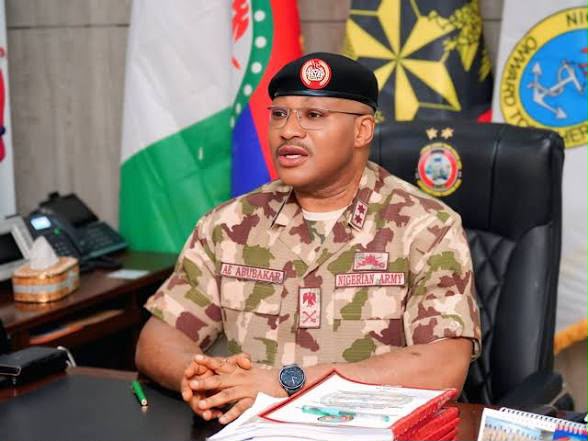
, Maj.-Gen. Abdulsalam Abubakar, has singled out)
The outgoing Theatre Commander of the North-East Joint Task Force, Operation HADIN KAI (OPHK), Maj.-Gen. Abdulsalam Abubakar, has singled out the Borno State Government’s partnership with the military as a major factor in the ongoing restoration of peace and normalcy across the state.
Abubakar, who spoke during a farewell and introduction engagement with humanitarian organisations, Borno State Government representatives and journalists in Maiduguri on Tuesday, said the level of cooperation between OPHK and the state government was unmatched among military theatres in the country.


According to him, the partnership had moved beyond conventional civil-military relations, with the Borno Government providing operational assets that directly enhanced the capacity of troops fighting insurgency.
“I say it plainly; no theatre of operations in this country enjoys a stronger partnership with its host government,” he said.
The outgoing commander particularly commended Governor Babagana Umara Zulum for consistently supporting the military with critical operational equipment, including Mine-Resistant Ambush Protected vehicles, long-range surveillance cameras and drones.
He said such interventions had strengthened the ability of troops to protect communities, confront terrorist networks and create the security conditions necessary for the return of displaced residents.
Abubakar stressed that the campaign against insurgency could not be sustained by military action alone, noting that the government’s responsibility for reconstruction, humanitarian assistance and community recovery made collaboration between the military and civil authorities essential.
He therefore appealed to the Borno State Government to maintain the same level of cooperation with his successor, Maj.-Gen. Ibikunle Ajose, who is taking over as the 16th Theatre Commander.
“I therefore respectfully request that this same partnership and support be extended to the incoming Theatre Commander as he assumes the duty of sustaining the gains we have made,” Abubakar said.
7,000 families return home
The commander linked the partnership among security agencies, government and humanitarian organisations to what he described as tangible progress in restoring normal life across Borno.
He disclosed that more than 7,000 displaced families had returned to their ancestral communities across the state during his tenure.
According to him, communities that had remained deserted for years were gradually coming back to life, with returned communities now recorded across all 27 local government areas of Borno.
He also disclosed that troops facilitated the rescue of 638 civilians from terrorist enclaves, while all 46 students caught up in the attempted abduction at the Federal Government Girls College, Monguno, were safely rescued.
Abubakar further highlighted the voluntary, safe and dignified return of more than 3,000 Nigerians from Cameroon through a joint effort involving the Borno State Government, Federal Ministry of Humanitarian Affairs and Poverty Reduction and the United Nations High Commissioner for Refugees.
He said the developments demonstrated the importance of combining military operations with humanitarian intervention, government support and community participation.
Humanitarian partnership
Abubakar also praised humanitarian organisations operating across Borno, Adamawa and Yobe, particularly the United Nations Office for the Coordination of Humanitarian Affairs (UN OCHA), for their contribution to assisting vulnerable populations.
He said humanitarian organisations had played an important role in addressing the consequences of the insurgency, particularly the needs of internally displaced persons and other vulnerable civilians.
He noted that while humanitarian agencies operated according to principles of humanity, impartiality and neutrality, the military provided the security environment required for aid workers to reach affected communities.
The commander urged stakeholders to maintain regular dialogue, saying effective communication remained crucial to resolving misunderstandings and improving humanitarian operations.
He specifically reminded humanitarian organisations that requests for military escorts should be submitted at least 48 hours before movement to allow adequate operational planning.
ICRC, British support acknowledged
Abubakar also acknowledged the contribution of the International Committee of the Red Cross (ICRC), particularly in strengthening professionalism, knowledge of International Humanitarian Law and protection of civilians within OPHK.
He said ICRC interventions had also improved detainee management at the Joint Interrogation Centre, contributing to improvements that attracted commendations for the Theatre.
He acknowledged that disagreements occasionally occurred between military and humanitarian actors, but said the ability of stakeholders to resolve such issues through dialogue had strengthened the relationship.
“Our relationship with the humanitarian partners has not been without friction, but the honest dialogue we have built is itself an achievement,” he said.
The outgoing commander also commended Team HADIN KAI for its contribution to intelligence-led operations since its integration into OPHK on May 8, 2026.
He cited the May 15 operation at Metele, which he said led to the neutralisation of Abu-Bilal Al-Minuki, identified in his remarks as the ISIS second-in-command, as one of the notable outcomes of the collaboration.
He said the partnership had improved precision targeting, non-kinetic operations, intelligence coordination and capacity building within the Theatre.
The British Defence Staff–West Africa also received recognition for its support, particularly in strengthening combat capabilities and Counter-Improvised Explosive Device operations.
According to Abubakar, British advisers had provided expertise, training and equipment support, with the partnership expanding to Forward Operating Bases through assistance in defensive measures, tactical drone deployment and surveillance.
‘Protect the partnerships’
As he prepared to hand over command to Maj.-Gen. Ajose, Abubakar urged all stakeholders to preserve the partnerships developed during his tenure.
He said the gradual reopening of markets and trade routes, resumption of educational activities and return of displaced families to their communities were among the signs of progress made through the combined efforts of security forces, government and humanitarian partners.
He also appreciated other security agencies, hybrid forces and what he described as the “friends of OPHK” for their contributions, saying intelligence sharing, cooperation and encouragement remained essential to the Theatre’s mandate.
Abubakar maintained that defeating insurgency and securing lasting recovery in the North-East required a collective approach involving security agencies, governments, humanitarian organisations and local communities.
He therefore urged stakeholders to extend the same cooperation and goodwill to the incoming Theatre Commander, stressing that sustaining the gains recorded would depend largely on the continued strength of the partnerships supporting Operation HADIN KAI.
Source:@ZagazolaMakama
About The Author
