



By: Babagana Bukar Wakil, Maiduguri
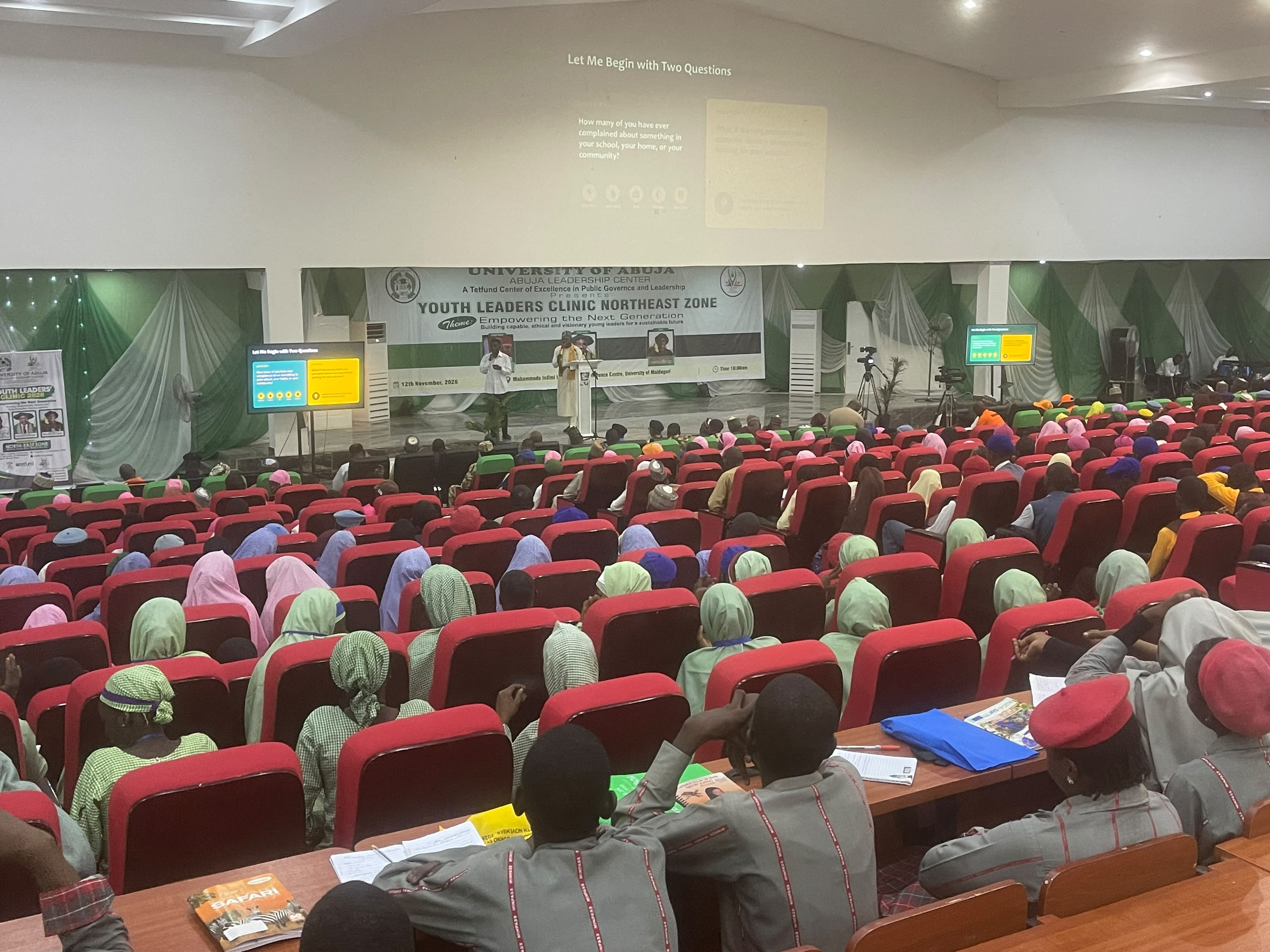
MAIDUGURI, — More than 500 students from 27 secondary schools across Nigeria’s North-East have participated in the third edition of the Abuja Leadership Centre (ALC) Youth Leaders’ Clinic, an initiative aimed at developing responsible young leaders, promoting civic values and preparing students for future leadership roles.


The event, held at Indimi International Conference Centre, Maiduguri, under the theme, *“Empowering the Next Generation Leaders,”* was organised by the Abuja Leadership Centre, University of Abuja, a TETFund Centre of Excellence in Public Governance and Leadership.
In his welcome address, the North-East Zonal Coordinator, Alhaji Sanda Garba, described the programme as an investment in character development, responsible citizenship, peacebuilding and the future of Nigeria.
He noted that the region’s experience with insecurity, humanitarian crises and developmental challenges makes it necessary to nurture young people who can promote peace, unity, integrity, discipline, resilience and responsible citizenship.
Garba explained that leadership goes beyond occupying positions or exercising authority, maintaining that it requires good character, dedication to service, accountability, vision and the ability to inspire others towards a common goal.
“Leadership is not simply about occupying a position or exercising authority. It is about character, service, accountability, vision, and the ability to inspire others to pursue a common good,” he stated.
He recalled that the first edition of the clinic was held on 22 July 2024 at the Multipurpose Hall of Government College, Maiduguri, while the second edition took place on 11 September 2025 at Borno State Hotel, Maiduguri.
The zonal coordinator thanked Borno State Governor, Professor Babagana Umara Zulum, for creating an enabling environment for the programme. He also acknowledged the support of the Commissioner for Education, Engineer Lawan Abba Wakilbe; the Director of Schools, Dr Abba Galtimari; and the management of the University of Maiduguri.
He equally commended the Abuja Leadership Centre for sustaining the initiative, noting that building a better society requires deliberate efforts to develop the intellectual capacity, character and leadership abilities of younger generations.
Delivering the keynote address, the Director of the Abuja Leadership Centre, Professor Abdulhamid Ozohu-Suleiman, said leadership development must be a deliberate process involving continuous learning, guidance, discipline and practical experience.
He explained that the Youth Leaders’ Clinic was established to equip secondary school prefects with the knowledge, values and practical skills required to lead effectively in their schools, communities and the wider society.
According to him, leadership training should begin early because the formative years play a major role in shaping character, personal values and attitudes towards responsibility.
“Because leadership is best cultivated early. Because values are shaped early. Because tomorrow’s nation-builders are sitting right here before us today,” he said.
Professor Ozohu-Suleiman maintained that young people who develop self-discipline, emotional intelligence, critical thinking, effective communication and sound national values at an early age are better positioned to reject corruption, embrace accountability and serve humanity.
He disclosed that the clinic was sponsored by PhD and MSc students of the Centre, who, having benefited from its leadership training programmes, decided to extend the opportunity to younger generations.
Emphasising the philosophy behind the initiative, he declared: “Leadership is not a title. Leadership is service.”
He urged the participants to strengthen their abilities in decision-making, time management, conflict resolution, goal setting, public speaking, teamwork, ethical conduct, social responsibility and confidence building.
Reflecting on the historical and cultural heritage of the North-East, the ALC Director noted that the region has a long tradition of scholarship, commerce and leadership dating back to the ancient Kanem-Borno civilisation.
He challenged the students to see themselves not merely as beneficiaries of development but as active contributors to the growth of their communities through education, entrepreneurship, innovation, peacebuilding and community development.
He further urged them to return to their schools and communities as role models, demonstrating through their conduct the values and lessons acquired at the clinic.
“Let them see greater discipline, let them see greater responsibility, let them see greater tolerance, let them see greater confidence, let them see a young person who understands that leadership is about service,” he urged.
Also speaking at the event, Professor Ibrahim Umara Gudumbali of the Department of Political Science, University of Maiduguri, warned that declining government investment in education could widen social divisions, encourage the proliferation of privately established schools and weaken the quality of graduates produced by the country’s education system.
He described education as a process of developing human capital, arguing that although it may not always produce immediate financial returns, its long-term benefits make it a worthwhile and cost-efficient investment in national development.
Professor Gudumbali cautioned that when governments consider education too expensive and gradually reduce funding, communities, parents and individuals are left to find alternative ways of providing learning opportunities for their children.
He explained that this situation could deepen educational divisions, as communities increasingly establish institutions based on their respective religious, cultural and ideological orientations. Citing Islamiyya schools and missionary schools established by churches, he warned that the separation of children into different educational environments could produce divergent social outlooks and weaken mutual understanding.
The university don also criticised the exclusion of children from public school admissions on the basis of indigeneity, particularly those whose parents have spent decades working and serving in states outside their places of origin.
He observed that public servants, members of the security forces and other professionals often dedicate much of their working lives to serving communities far from their ancestral homes, yet their children sometimes face admission restrictions because they are regarded as non-indigenes.
He warned that such practices deny children equal educational opportunities, discourage national integration and push more families towards private schools.
Professor Gudumbali further raised concerns about the management of some private educational institutions, particularly the tension between the responsibility to provide quality education and the commercial interests of school owners.
He explained that while school administration should prioritise students’ welfare and academic development, excessive emphasis on profit could encourage practices that compromise educational standards.
He warned that some schools might promote students who have not adequately mastered their subjects in order to satisfy parents and retain their financial support, ultimately producing graduates who struggle to meet the academic demands of higher institutions.
To address these challenges, he called on federal, state and local governments to increase funding for primary and secondary education and strengthen public schools, particularly unity schools, as instruments for promoting national integration.
He maintained that schools should provide opportunities for children from different ethnic, religious, cultural and geographical backgrounds to learn and interact from an early age, allowing them to develop mutual respect, tolerance and a shared sense of national identity.
He also called for a reassessment of national integration initiatives, including Unity Colleges and the National Youth Service Corps (NYSC), arguing that their objectives would be better achieved through programmes that encourage sustained interaction among Nigerians from different backgrounds.
According to him, sending participants back to their familiar communities immediately after orientation activities limits opportunities for meaningful cross-cultural engagement and weakens the broader objectives of national integration.
Drawing attention to the role of national institutions in holding the country together, Professor Gudumbali identified the Nigerian Armed Forces as one of the institutions that bring Nigerians from diverse backgrounds together, cautioning that the weakening of such unifying structures could threaten the country’s stability.
He called for a public education system that is adequately funded, inclusive and accessible to all Nigerians, irrespective of their backgrounds, describing education as a vital instrument for promoting equal opportunities, social harmony and national unity.
The third edition of the ALC Youth Leaders’ Clinic brought together government officials, representatives of security agencies, school administrators, principals, teachers, facilitators and students from participating schools across the North-East.
The programme provided an opportunity to engage young people on the responsibilities of leadership while drawing attention to the role of education, character development and national integration in shaping Nigeria’s future.
About The Author
