


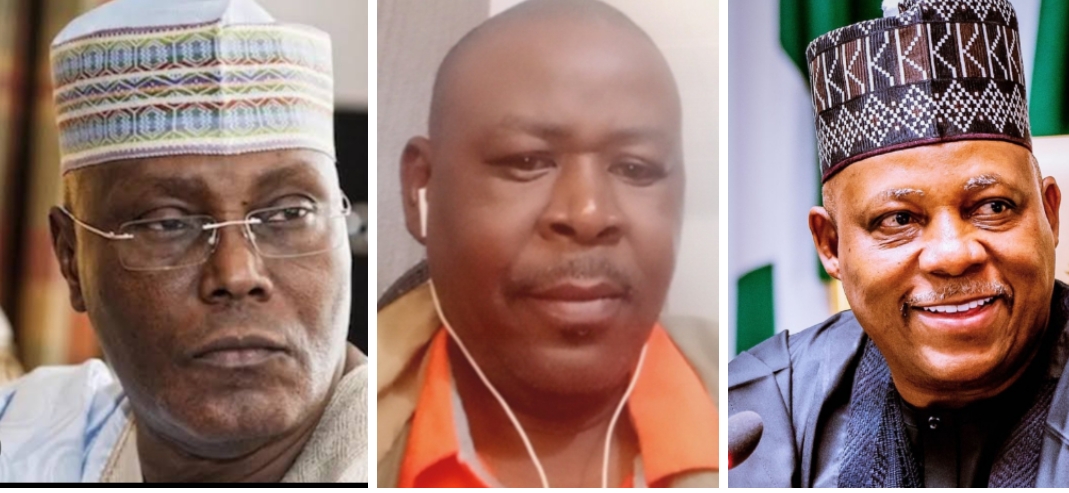

By: Dr James Bwala
Former Vice President Atiku Abubakar’s supporters often defend his political career by pointing to his long experience in public service, his influence in Nigerian politics, and the important positions he has held. Recently, Naibi Abdul Aziz, one of Atiku’s apologists, argued that Atiku had already made a name for himself before I even understood the meaning of journalism. He further stated that Vice President Kashim Shettima was still a boy when Atiku was in government.


I agreed with him on one narrow point: I was not born on the same day as Atiku Abubakar, and neither did Vice President Shettima. For me, therefore, I cannot claim to have witnessed every event of Atiku’s early political careers personally. However, age, seniority, or political experience does not place any public figure beyond criticism. The fact that Atiku was politically active before many Nigerians entered public life does not mean that his record should be protected from scrutiny. On the contrary, the longer a person has exercised power, the greater the responsibility to examine the consequences of his decisions.
The political context of Nigeria today is not the same as it was twenty-six years ago. The country has changed, the economy has changed, and the effects of past policies have become clearer. Many Nigerians who were children or were not yet born during the early years of the Fourth Republic are now adults struggling with unemployment, poverty, inflation, insecurity, and the collapse of productive industries. They have every right to ask how earlier policy decisions contributed to the conditions they inherited.
It is therefore both legitimate and necessary to examine Atiku Abubakar’s role in Nigeria’s privatisation programme, particularly his tenure as chairman of the National Council on Privatisation between 1999 and 2007 during the administration of President Olusegun Obasanjo. This examination should not be reduced to personal attacks or partisan propaganda. It should be based on evidence, public records, economic outcomes, and the lived experiences of Nigerians whose jobs, businesses, and communities were affected by the process.
Atiku’s supporters frequently present privatisation as a necessary economic reform. They argue that many state-owned enterprises were inefficient, overstaffed, corruptly managed, and dependent on government funding. In principle, there was a reasonable basis for reform. Several public enterprises had become financially unsustainable, and the government lacked the resources or discipline to operate them effectively. However, acknowledging the problems within state-owned enterprises does not automatically prove that the method of privatisation was successful.
The central question is not whether reform was needed. It is whether the reform was properly designed, transparently implemented, and beneficial to the Nigerian people. It is also necessary to ask whether the government protected workers, preserved strategic industries, encouraged genuine investment, and ensured that public assets were sold at fair value. These questions remain unanswered in many cases.
Between 1999 and 2007, the federal government, through the National Council on Privatisation and the Bureau of Public Enterprises, divested or transferred ownership of numerous public enterprises. The assets involved included manufacturing companies, agricultural enterprises, energy-related facilities, transport businesses, hotels, telecommunications institutions, and other national investments. Critics contend that some of these assets were sold at undervalued prices, sometimes to political associates, business interests, or individuals with strong connections to those in power.
When public assets are sold below their real value, the loss is not merely financial. Those assets were built with taxpayers’ money over many years. They represented national investments intended to provide employment, industrial capacity, food security, and economic independence. If they are transferred cheaply to a small group of private beneficiaries and later abandoned, the public loses twice: first through the sale itself and again through the destruction of jobs and productive capacity.
The fate of several industrial and agricultural enterprises illustrates the concerns surrounding the privatisation process. The Delta Steel Company in Warri, the Ajaokuta steel-related infrastructure, and the Aluminium Smelter Company of Nigeria in Ikot Abasi are frequently cited in public discussions about Nigeria’s industrial decline. These facilities were established with the expectation that they would support national development, create skilled employment, and strengthen local production. Yet many of them experienced prolonged decline, operational difficulties, abandonment, or failure to achieve their intended potential.
The steel industry is particularly important because no modern economy can achieve genuine industrial independence without a strong domestic steel sector. Steel is essential for construction, machinery, transportation, defence, and manufacturing. Nigeria invested enormous public resources in developing steel-related infrastructure, but the country has not been able to obtain the expected benefits. The continued weakness of the steel sector has forced Nigeria to depend heavily on imported materials while millions of young people remain unemployed.
The same concerns apply to agricultural and agro-allied enterprises. Savannah Sugar Company in Adamawa, Sunti Sugar Company in Niger, the Federal Superphosphate Fertiliser Company in Kaduna, and the National Fertiliser Company of Nigeria, commonly known as NAFCON, are among the enterprises often mentioned in debates about the consequences of privatisation and poor industrial policy. These companies were connected to food production, fertiliser supply, rural employment, and national food security. Their decline affected not only employees but also farmers, transporters, suppliers, local traders, and entire communities under Atiku’s watch.
The consequences of industrial collapse extend far beyond the gates of a factory. When a major company closes, workers lose their income. Small businesses lose customers. Local governments lose tax revenue. Families withdraw children from schools. Medical care becomes more difficult to afford. Young people migrate in search of opportunities, while communities that once depended on industrial activity become economically stagnant. In this way, the collapse of public enterprises contributes directly to poverty and social instability, and these people want Atiku to come in as president to continue from where he left off.
Critics argue that rapid commercialisation, asset stripping, and inadequate post-privatisation monitoring contributed to de-industrialisation and massive job losses. In some cases, companies were acquired by investors who appeared more interested in controlling the assets than in maintaining production. Machinery and equipment were allowed to deteriorate, workers were dismissed, and industrial sites became inactive. Where privatisation was intended to create efficiency and investment, the outcome was often unemployment and economic decline. The Atiku apologists would not want to hear this, but it happened long before I knew journalism as Naibi would put it.
It is important to be fair: Atiku Abubakar did not single-handedly cause every failure in Nigeria’s economy. Privatisation involved multiple institutions, ministries, advisers, investors, banks, and political actors. But as Chair, he must take responsibility. Indeed, some enterprises were already deeply troubled before they were transferred. Other failures were caused by corruption, inconsistent policies, poor infrastructure, unreliable electricity, insecurity, foreign exchange shortages, and weak regulation as some of his men have said. Nevertheless, as chairman of the National Council on Privatisation, Atiku occupied a central position in the policy structure. That position gives him a legitimate responsibility for the direction, quality, and consequences of the programme.
Leadership is not only about claiming credit for reforms that appear successful. It also requires accepting responsibility when policies produce harmful results. If a public official supervises the sale of national assets, that official should be prepared to answer questions about the valuation process, the identity of beneficiaries, the terms of the agreements, the protection of workers, and the performance of the companies after privatisation. Political supporters should not respond to such questions by invoking age, past fame, or personal loyalty.
The argument that Atiku was already prominent before many Nigerians were born according to some of his apologists is not an answer to these concerns. It may establish his seniority, but it does not establish the correctness of his policies. Experience can be valuable, but experience without accountability may simply mean that mistakes have been repeated for a longer period. A politician’s long presence in public life should invite deeper examination, not automatic praise. We supported VP Kashim Shettima; we praised him, but we also pointed out missing numbers for him tomorrow as a leader, and he did appreciate such advice.
Criticism of Atiku should not be interpreted as disrespect for his achievements. He has played an important role in Nigeria’s political history, built a national profile, and contributed to public debates. However, public service is not a private achievement that ends with personal recognition. Its true value must be measured by its impact on ordinary citizens. If policies associated with a leader contributed to unemployment, industrial decline, or the loss of national assets, those consequences deserve serious discussion.
There is also a generational dimension to this debate. Many Nigerians now suffering from unemployment and economic hardship were not old enough to participate in the decisions taken between 1999 and 2007. Yet they are living with the results. They inherited a country where industries had declined, public infrastructure was weak, and economic opportunities were limited. It is unjust to tell this generation that it has no right to criticise the leaders whose decisions helped shape the environment in which it lives.
Journalists, researchers, and citizens must therefore be free to examine the past. A democratic society cannot develop if historical records are treated as sacred possessions of political parties. The role of journalism is not to flatter powerful people but to ask difficult questions, investigate public decisions, and give voice to those affected by government policies. Criticism should be factual, responsible, and evidence-based, but it should never be suppressed simply because the subject is older, more experienced, or politically influential.
I witnessed the consequences of Nigeria’s industrial and economic decline while moving through the North and Lagos–Ibadan axis in the south-west as a representative of Conscience International Magazine. The abandoned factories, inactive industrial estates, unemployed workers, and struggling communities were not abstract statistics. They were visible realities. They reflected a country that had invested in productive capacity but failed to protect and develop it. Nigerians who lived through that period have the right to remember what happened and to demand explanations.
Ultimately, the debate about Atiku Abubakar should not be reduced to whether one person is a supporter or an opponent. The real issue is whether Nigerian leaders should be accountable for the long-term effects of their policies. Atiku’s role in privatisation must be examined honestly, including both the arguments in favour of the programme and the damage attributed to its implementation. His supporters may defend his intentions, but intentions! Can that heal the wounds millions of Nigerians lived with and reflect it in their daily lives?
James Bwala, PhD, writes from Abuja.
End
About The Author
