


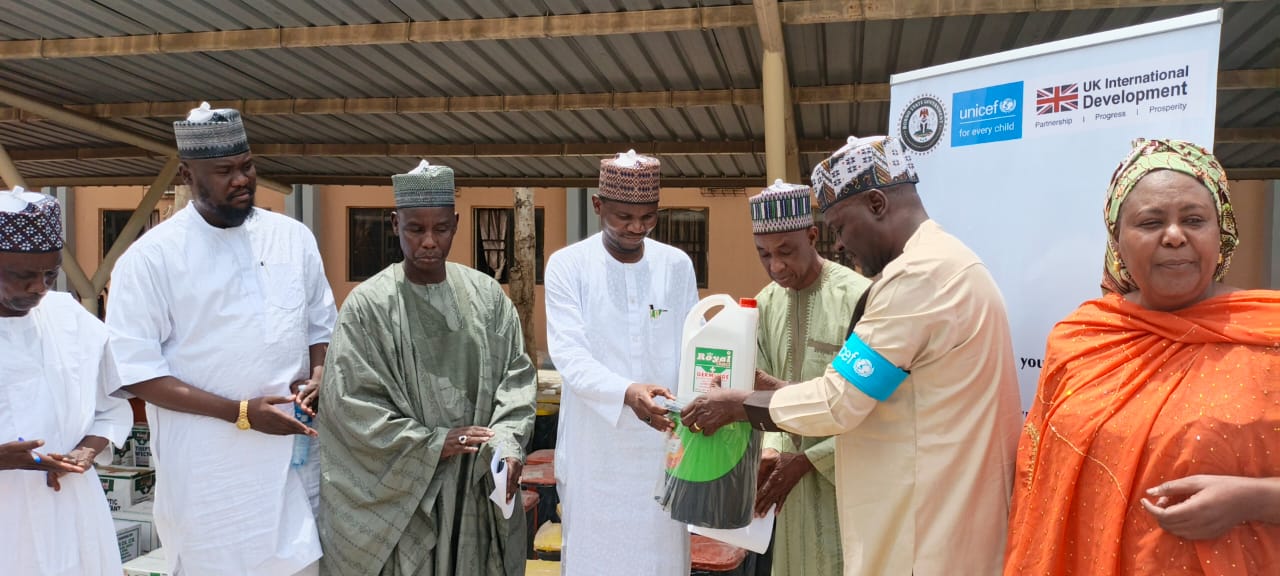
 has reaffirmed its commitment to strengthening healthcare delivery and disease prevention in Borno State with the symbolic)
By Babagana Bukar Wakil, Maiduguri
The United Nations Children’s Fund (UNICEF) has reaffirmed its commitment to strengthening healthcare delivery and disease prevention in Borno State with the symbolic handover of Water, Sanitation and Hygiene Facility Improvement Tool (WASHFIT) supplies to the state government in Maiduguri.


The ceremony, held at the headquarters of the Borno State Rural Water Supply and Sanitation Agency (RUWASA), brought together senior officials from the Borno State Ministry of Health and Human Services, the State Primary Health Care Development Board, development partners, and humanitarian stakeholders.
Speaking at the event, the Chief of UNICEF’s Maiduguri Field Office, Mr. Francis Busiku Butichi, described the initiative as a critical milestone in ongoing efforts to improve the quality, safety, and sustainability of healthcare services for women and children across the state.
He noted that the WASHFIT initiative, jointly implemented by the Borno State Ministry of Health and Human Services, RUWASA, the Borno State Primary Health Care Development Board (BOSEPA), and UNICEF, followed a comprehensive assessment launched in October 2025 to evaluate water, sanitation, hygiene, and infection prevention standards in health facilities across the state.
According to Mr. Butichi, the intervention is designed to strengthen infection prevention and control mechanisms, improve access to safe and reliable water supply, promote sound hygiene practices, and enhance healthcare waste management systems in health facilities.
“Such interventions remain vital in fragile and humanitarian settings like Borno, where healthcare facilities continue to serve as the frontline defence against disease outbreaks and public health emergencies,” he said.
The donated supplies, which include buckets, knapsack sprayers, detergents, and assorted sanitation materials, are expected to support infection prevention measures in health facilities at both local government and ward levels.
Mr. Butichi disclosed that more than 200 health facilities across the 27 local government areas of Borno State stand to benefit from the intervention, with priority accorded to communities currently experiencing outbreaks of acute watery diarrhoea. He stressed that improving hygiene conditions within health facilities would significantly reduce secondary infections among patients seeking medical care.
“Patients need clean water and a clean environment. People who come to health facilities for treatment should not be exposed to additional infections while receiving care,” he said.
The UNICEF official also raised concerns over Nigeria’s maternal mortality burden, noting that unsafe delivery environments and poor sanitation conditions remain major contributors to preventable deaths among women during childbirth. He added that the intervention, funded by the Government of the United Kingdom, would help create safer healthcare environments, improve service delivery, and reduce the financial burden on families arising from preventable infections and avoidable medical treatment.
In an interview shortly after the handover, the General Manager of RUWASA, Engr. Ali Mohammed Usman, commended UNICEF for its sustained strategic support to the health sector in Borno State. He explained that the WASHFIT assessment was conducted in line with national healthcare standards and global guidelines developed by UNICEF and the World Health Organization (WHO), providing a credible framework for routine monitoring, structured improvement planning, and targeted investment in healthcare facilities.
Also speaking, the Chairman of the Borno State Primary Health Care Development Agency, Prof. Muhammed Bukar Alhaji, applauded UNICEF for what he described as a timely and lifesaving intervention aimed at strengthening healthcare resilience in conflict affected communities.
The event underscored the enduring partnership between UNICEF and Nigeria, which spans more than seven decades. UNICEF established its first office in the country in 1952 and remains one of Nigeria’s longest serving development and humanitarian partners.
Humanitarian operations in the North East intensified following the escalation of insurgency in 2013, particularly in Borno, Adamawa, and Yobe states, where millions of residents have endured displacement, recurring disease outbreaks, and weakened public services.
Development experts note that integrated interventions such as WASHFIT are increasingly bridging the gap between emergency humanitarian response and long term health system strengthening by ensuring that healthcare facilities in fragile settings meet globally accepted standards for infection prevention, sanitation, and safe water access.
As UNICEF continues its collaboration with the Borno State Government and humanitarian partners, the latest intervention is expected to further stabilise healthcare delivery systems and improve public health outcomes for vulnerable communities across the Lake Chad Basin region.
The symbolic handover ceremony was attended by the representative of the Permanent Secretary of the Borno State Ministry of Health and Human Services, the Executive Secretary of the Borno State Primary Health Care Development Board, the General Manager of RUWASA, senior government officials, development partners, and members of the media.
About The Author
