



By ABC News Nigeria Political Desk
The political temperature in Katsina State may have taken a new turn ahead of the 2027 general elections following the public reunion of Governor Dikko Umaru Radda and former Secretary to the State Government, Dr Mustapha Muhammad Inuwa, under the platform of the All Progressives Congress (APC).


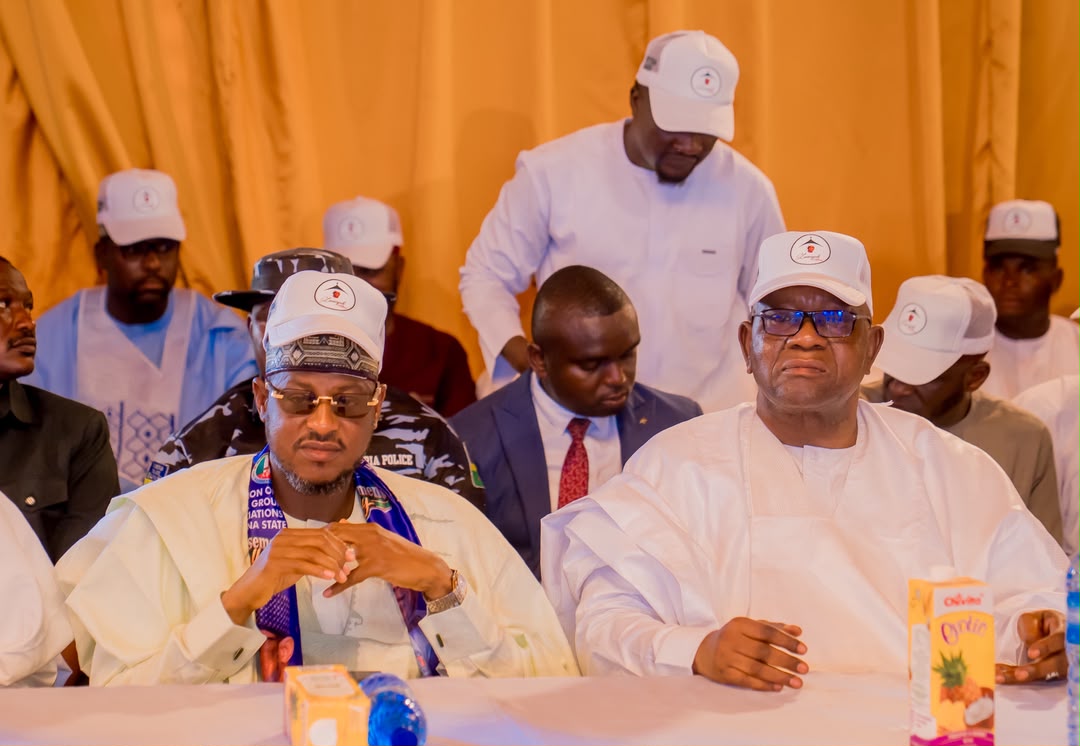
The reunion, which unfolded at a reception organised by the Zawiyyah Foundation in honour of Inuwa at Capital Hall, Katsina, was more than a ceremonial political homecoming.
For political observers, the appearance of the two prominent Katsina politicians together, coupled with their respective appeals for unity and collective support for the APC, could have implications for the party’s calculations as it begins to look towards the 2027 electoral contest.
Inuwa’s return to the APC comes after years of political movement across different platforms and political engagements.
His decision to return to the party therefore represents a potentially important development for an APC that would need to manage its internal relationships, mobilise its grassroots structures and present a united political front as the next election approaches.
Governor Radda was quick to acknowledge the political significance of Inuwa’s return, describing it as a boost to the strength and unity of the APC.
Beyond the immediate political symbolism, Radda’s remarks appeared to send a broader message about the importance of reconciliation and experience in party politics.
The governor recalled that his relationship with Inuwa dated back more than three decades, suggesting that their political connection goes beyond the immediate demands of electoral politics.
That history could prove important in an environment where political alliances are often shaped by long-standing personal relationships, grassroots networks and shared experiences.
Radda also used the occasion to draw attention to what he described as the changing political awareness of the electorate.
According to the governor, politics should be centred on service to the people rather than personal enrichment.
“Politics should ultimately be about service to the people and not personal enrichment,” he said.
That statement could become an important part of the political narrative going into 2027, particularly as voters are expected to scrutinise the performance, records and promises of political actors more closely.
The governor’s observation that the electorate has become increasingly politically conscious also points to one of the major challenges facing political parties ahead of the next election: winning public confidence beyond party structures.
For the APC in Katsina, the task will not simply be about assembling prominent politicians.
The bigger challenge will be translating political reconciliation into effective grassroots mobilisation and convincing voters that the party remains capable of delivering on its promises.
This is where Inuwa’s return could assume greater significance.
A veteran politician whose political career dates back to the 1990s, Inuwa has traversed different political movements and administrations, including the era of former President Umaru Musa Yar’Adua.
His experience gives him familiarity with Katsina’s political terrain and the dynamics that often influence political mobilisation.
His decision to publicly throw his weight behind Radda and the APC could therefore be interpreted as an attempt to consolidate political forces rather than allow differences among influential actors to weaken the party ahead of 2027.
Inuwa himself described the APC as his political home and pledged his support for Radda and the party.
He also emphasised the long-standing relationship between himself and the governor, noting that their political journey had evolved through years of engagement and shared experiences.
That message of political reconciliation could resonate beyond the two men.
In a state where political influence is often built through networks of party leaders, community figures, former office holders and grassroots actors, visible unity among influential politicians can provide a psychological advantage to a ruling party.
However, political analysts would likely caution that public reconciliation is only the first step.
The real test will be whether the renewed relationship can translate into sustained cooperation within the party, especially as political interests begin to crystallise ahead of 2027.
Every election cycle brings questions of tickets, appointments, influence, succession, campaign structures and the distribution of political opportunities.
How APC manages those competing interests could determine whether the current atmosphere of unity becomes a durable political alliance or remains largely symbolic.
For Radda, strengthening the APC ahead of 2027 would require bringing different political tendencies under a common platform while maintaining focus on governance.
For Inuwa, returning to the APC creates an opportunity to deploy his political experience toward the party’s objectives while rebuilding relationships within the structure.
Their reunion therefore comes at a politically sensitive period.
Across Nigeria, political parties are already positioning themselves for the 2027 elections, with politicians assessing alliances, realignments and the strength of competing political structures.
Katsina, with its significant electoral importance in the North, will naturally attract attention as the political contest gathers momentum.
The APC’s ability to maintain cohesion in the state could consequently become a major factor in its electoral strategy.
Yet, the ultimate verdict will not come from political gatherings or speeches.
It will come from the electorate.
Radda himself acknowledged this reality when he stressed that voters are increasingly capable of assessing the records and intentions of politicians seeking their support.
That makes the 2027 contest potentially less about personalities alone and more about performance, political organisation, credibility and the ability to connect with voters.
Against this backdrop, the Radda-Inuwa reunion can be viewed as an important piece in the APC’s emerging political puzzle in Katsina.
It signals reconciliation, strengthens the appearance of unity and brings together two politicians with a long history of political engagement.
But whether it becomes a decisive electoral advantage will depend on what follows.
If the renewed relationship produces genuine cooperation, wider reconciliation within the APC and stronger grassroots mobilisation, it could significantly strengthen the party’s position heading into 2027.
If, however, the reunion remains confined to public appearances without translating into sustained political coordination, its electoral impact may be limited.
For now, though, the message from both Radda and Inuwa is clear: differences can be set aside, political experience can be brought together, and the APC can present a more united front as Katsina prepares for another fiercely contested electoral cycle.
The political reunion has begun.
The bigger question is whether it can be transformed into an electoral machine capable of delivering victory in 2027.
About The Author
