



From Ardo Abdul
The Vice-Chancellor of Sa’adu Zungur University, Professor Fatimah Tahir, has emphasized the need for academic staff and researchers to embrace impactful and solution-driven research through effective collaboration with industries and relevant stakeholders for sustainable national development.


The Vice-Chancellor stated this during the closing ceremony of the 3-Day Stepdown Training Workshop on Research Administration, Industry Collaboration, and Commercialization organized by the Centre of Excellence for Research and Innovation (CERI) at the Gadau Main Campus of the University.
Professor Fatimah Tahir described the workshop as timely and highly significant, noting that research should not be confined to academic exercises or remain within laboratories, but should instead provide practical solutions capable of transforming society and improving livelihoods.
She urged participants to consider their participation in the training as a valuable opportunity to acquire relevant knowledge and skills that would enhance their research capacity and contribute meaningfully to the growth and development of the University and the society at large.
The Vice-Chancellor further advised participants to utilize the knowledge gained during the workshop by engaging in productive collaborations with industries, institutions, and development partners in order to produce innovative and usable research outcomes.
Professor Tahir reaffirmed the University’s commitment towards staff development and academic excellence through continuous training and capacity-building programmes aimed at improving the quality of teaching, research, innovation, and community service.
She also reiterated the readiness of the University to collaborate with relevant organizations and stakeholders in advancing research, innovation, and commercialization for the overall progress of Bauchi State and the nation.
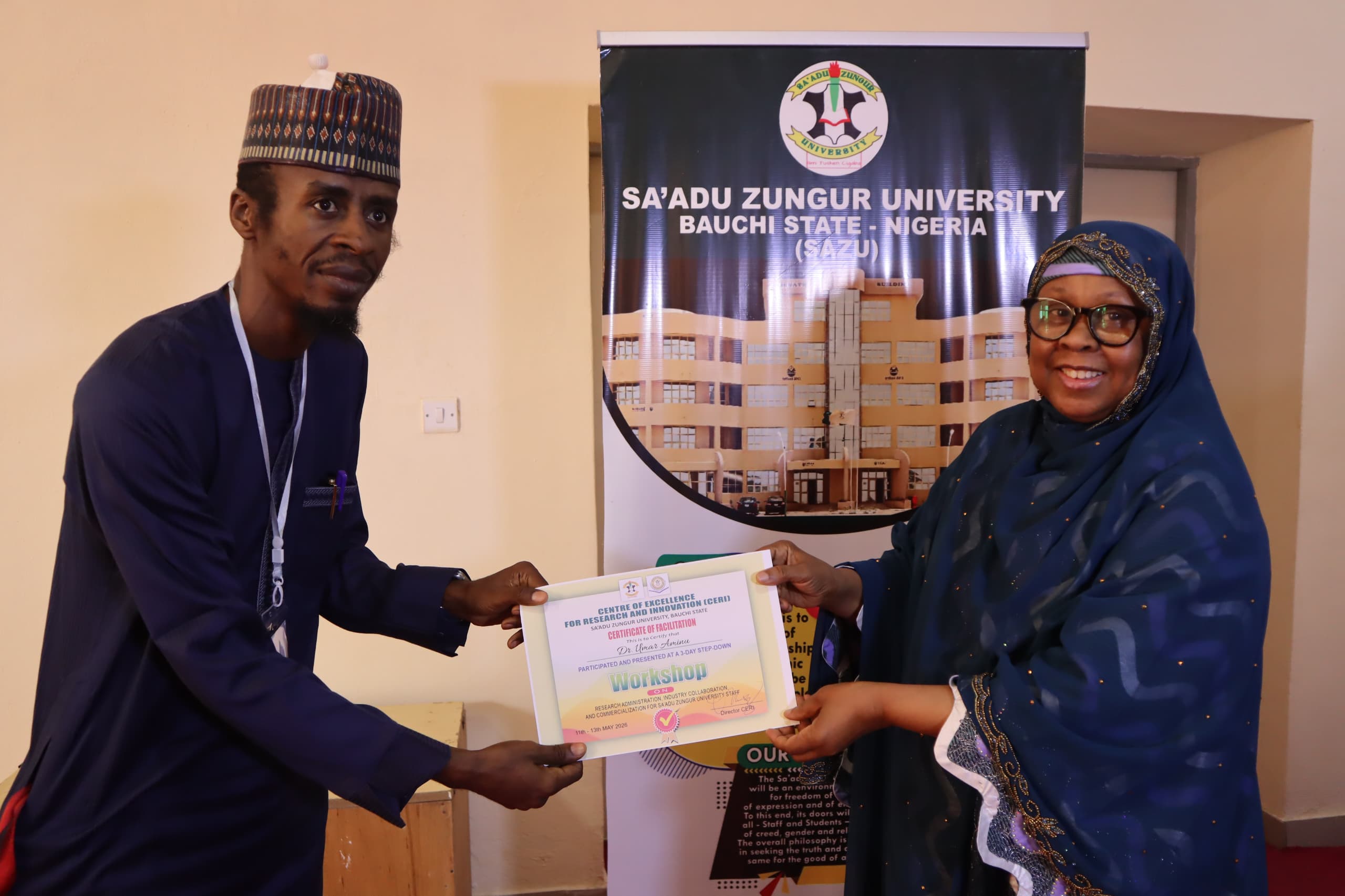
As part of the closing ceremony, the Vice-Chancellor presented certificates of appreciation to facilitators and certificates of participation to some participants in recognition of their contributions and commitment throughout the workshop.
Earlier in his remarks, the Director of CERI, Dr. Usman Waziri, explained that the workshop was organized on the directive of the Vice-Chancellor to extend the knowledge acquired by beneficiaries of previous TETFund-sponsored trainings to other members of staff of the University.
Dr. Waziri disclosed that no fewer than 64 academic staff drawn from various faculties and departments participated in the workshop, alongside external participants from Abubakar Tafawa Balewa University, Aminu Sale College of Education, and Federal University of Health Sciences.
According to him, the workshop was fully sponsored by the University as part of efforts to strengthen research administration, promote innovation, improve academia-industry collaboration, and enhance the visibility and competitiveness of the institution among its counterparts.
The workshop featured presentations by experts on various topics including University-Community Partnership, Accelerating Innovation in Universities, Managing Change as an Agent, Research Administration, Research Commercialization, Managing Academia-Industry Collaboration, Triple Helix, Leveraging Emotional Intelligence, and Building Research Partnerships and Collaborations.
Participants also engaged in interactive sessions and group presentations designed to assess their understanding of the concepts discussed during the training.
Stakeholders at the workshop observed that research for development remains essential in addressing societal challenges and promoting economic growth, stressing that stronger collaboration between academia, industry, and communities would significantly contribute to sustainable development.
About The Author
