


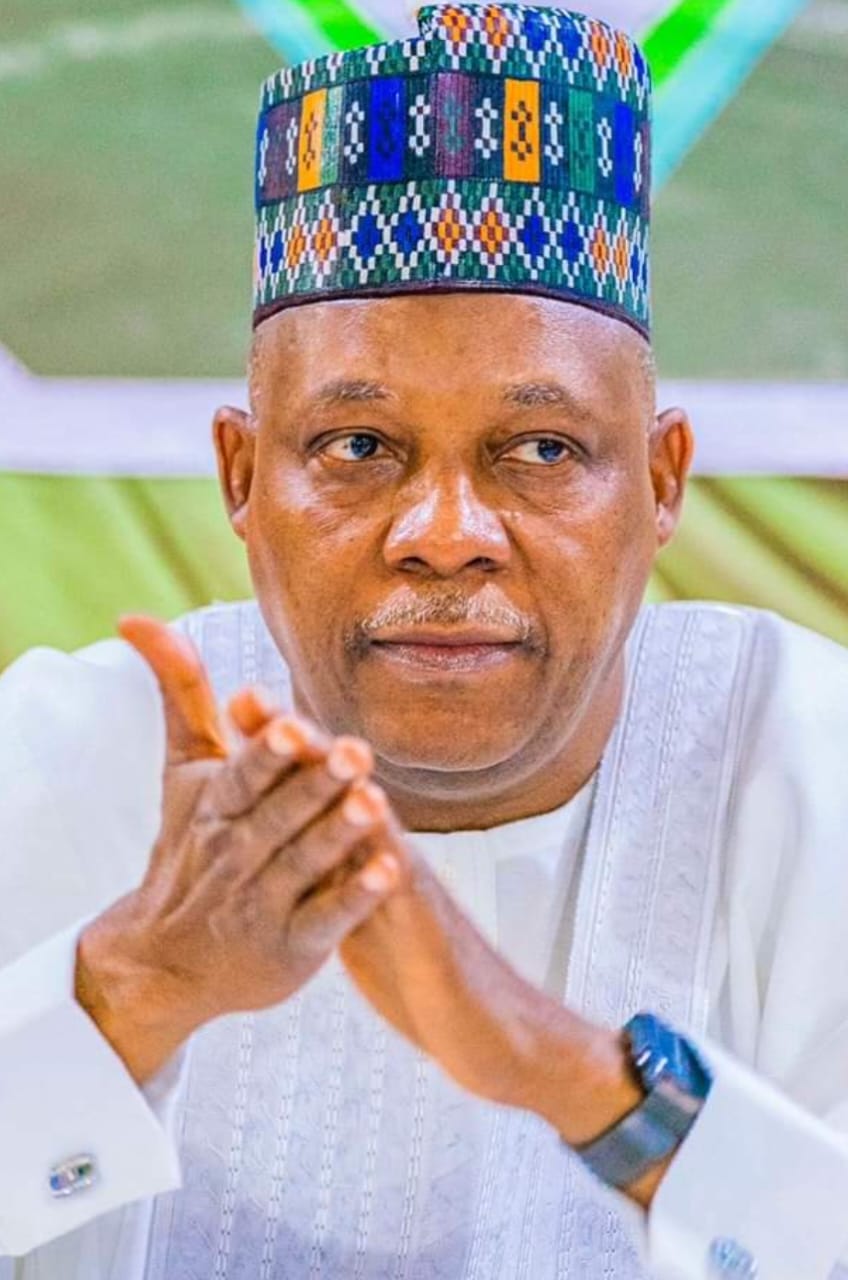

By: Hon. Yusuf Adamu
It is imperative to transcend the archaic paradigms of religious rhetoric and focus squarely on national progress. The persistent invocation of religious identities within political debates undermines the potential for cohesive governance and distracts from the critical imperatives of development and unity. This piece contends that the fixation on religious sentiments in politics is not only counterproductive but also naïve and regressive. It uses the example of Vice President Kashim Shettima—a leader whose career exemplifies secular, inclusive governance—to argue for a politics rooted in competence and national interest rather than sectarian considerations. I believe that a writer like Farooq Kperogi should have surpassed the lines of backward analysis of political happenings in Nigeria. He should come home and see how things have changed to have a good picture of the leadership today.


Nigeria is a nation with a rich mosaic of cultures, ethnicities, and religions. However, this diversity has often been exploited in political contests, reducing complex issues to simplistic binaries of “Muslim versus Christian” or “North versus South.” Such reductionism is harmful. It stokes division, fuels mistrust, and ultimately impedes the creation of inclusive policies essential for socio-economic development. The recent debate surrounding the Muslim-Muslim presidential ticket featuring President Bola Tinubu and Vice President Kashim Shettima highlights these challenges. While some critics—such as Farooq Kperogi—have framed their concerns with reference to religious balancing, this approach overlooks the nuances of national leadership and the practical realities of governance.
Farooq Kperogi’s criticism, while reflective of concerns shared by many Nigerians, can be considered somewhat detached, particularly given his physical distance from the country and possibly limited engagement with current political dynamics on the ground. It is easy from afar to emphasize religious sentiment as a decisive factor in Nigerian politics. Yet, those more intimately involved with grassroots realities recognize that governance cannot thrive on sectarian allegiances alone. Instead, effective leadership demands an embrace of Nigeria’s pluralistic identity and a focus on policies that foster inclusivity and progress.
A poignant illustration of the pitfalls of conflating religion with politics is the example of Professor Isa Pantami. A religious scholar and public figure who once vociferously criticized the People’s Democratic Party (PDP) on religious grounds, Pantami later sought and gained the PDP’s support in his gubernatorial bid in Gombe State. This incongruity exposes the opportunistic nature of religious rhetoric when wielded as a political tool. Pantami’s shift underscores how religious posturing often masks pragmatic political calculations rather than genuine ideological commitments. Such contradictions breed cynicism among citizens, further eroding trust in political institutions and actors.
Conversely, Kashim Shettima’s political career offers a salutary blueprint for leadership devoid of religious bias. As governor of Borno State, a region notable for its multicultural and multireligious composition, Shettima demonstrated an ability to govern inclusively, fostering relationships across ethnic and religious lines. His administration was marked by initiatives that prioritized security, education, and infrastructure development without resorting to sectarian favoritism. This track record attests to his capacity to put national interest above parochial considerations.
The argument that Shettima’s candidacy as vice president signals an endorsement of religious exclusivism is therefore misplaced. Rather, it is a recognition of his exemplary leadership qualities and his embodiment of a Nigeria where religious affiliation is secondary to patriotism and competence. By advancing Shettima’s role in the current administration, Nigeria stands to benefit from continuity in governance and a steadfast commitment to inclusive policy-making.
The fixation on religious identities in political discourse sends damaging signals both internally and externally. Domestically, it fuels divisions that can escalate into violence, weaken social cohesion, and stall development. Externally, it projects an image of a fractured polity unable to transcend sectarian differences for the sake of national progress. Nigeria’s vast potential as Africa’s most populous nation and largest economy depends on its ability to harness the talents and energies of all its citizens irrespective of religion.
Furthermore, conceptualizing political leadership through the lens of religion reduces citizens to mere representatives of faith groups, thereby diminishing individual merit and the democratic principle of equal opportunity. Politics should be a free market where competence, vision, and integrity are the currency, not religious affiliation. By embracing this stance, Nigeria can cultivate a leadership class committed to problem-solving and the advancement of the collective good.
It is also important to acknowledge that the Tinubu administration, now three years into its first term, has only begun to implement reforms necessary for Nigeria’s development trajectory. The criticisms grounded in religious opposition overlook this temporal context. The administration’s second term presents a crucial window for building upon initial gains and deepening reforms aimed at economic growth, security, and social welfare. Allocating the vice presidency to Kashim Shettima is strategically aligned with these objectives and reflects confidence in his ability to contribute meaningfully without religious encumbrances.
Nigeria must consciously move beyond the stage of religious rhetoric in politics. The fraught history of sectarianism and the contemporary realities of governance demand a focus on progress, inclusivity, and national unity. Vice President Kashim Shettima’s leadership exemplifies these values, demonstrating that effective governance transcends religious sentiment. The political discourse must therefore pivot towards discussions that prioritize competence and national development over divisive religious considerations. Only by doing so can Nigeria realize its vast potential and secure a harmonious future for all its citizens.
Honorable Yusuf Adamu writes from Maiduguri.
End
About The Author
