



By Abdullahi Alhassan, Kaduna
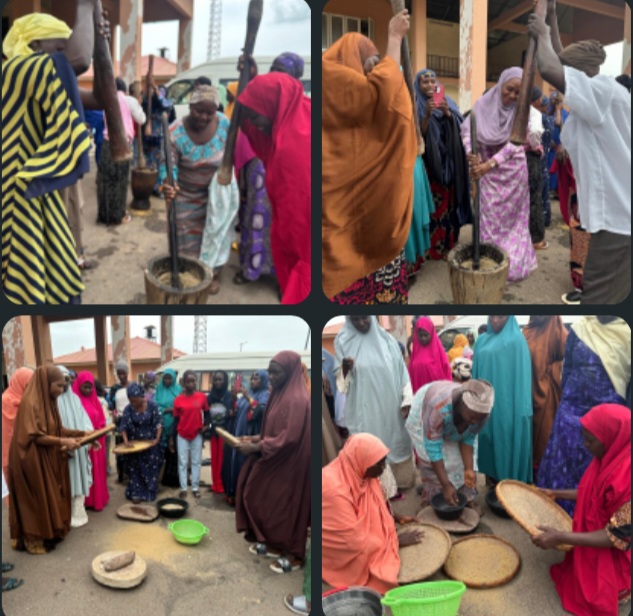
On Monday, the sound of mortars pounding guinea corn replaced the memory of conflict in Kasuwan Magani as residents marked the International Day of Peace with food, games and dialogue aimed at healing years of ethno-religious violence.


The Interfaith Mediation Centre organized the event with support from the German Embassy in Abuja. Instead of rallies, organizers put women and cultural practices at the center, arguing that everyday traditions are the most effective way to repair trust in the volatile Kaduna market town.
Kasuwan Magani has long been a crossroads for traders of different faiths and ethnic groups. It is also a community that has paid a heavy price in past clashes that claimed lives and destroyed businesses. IMC said this year’s approach was deliberate.
“Peace cannot grow where people are divided by identity,” IMC Co-Executive Director, Mr. Samson Auta, said. “If there is peace, there can be development. If there is interaction, there will be understanding. We should look at ourselves as humanity.”
The day featured communal cooking, the revival of grain pounding and grinding, and traditional games. Young people who have grown up mostly on phones were invited to learn the practices their parents and grandparents once shared across religious lines.
Auta expressed concern that technology was eroding those customs.
“People are not connected to their history, people are not connected to their culture,” he said. “We need to revisit this culture to teach our younger ones so that we just don’t lose our identity. Because when we lose our identity, we don’t know where we are.”
IMC said it is replicating the activities in Zone 1 and Zone 3 of Kasuwan Magani to keep the engagement going beyond Peace Day.
Community leader Jonathan Peter said the initiative was designed to transfer values from elders to youth at a time when he believes Western education alone has not been enough to sustain togetherness.
He placed special emphasis on the role of women.
“Women are critical to child upbringing and to achieving lasting peace,” Peter said. “That is why we are focusing on activities that strengthen relationships among women.”
Peter called on the Federal Government to take concrete steps to rebuild national trust and to integrate women fully into peacebuilding efforts. He also urged the Christian Association of Nigeria and Jama’atu Nasril Islam to collaborate sincerely, noting that “humanity comes before any religion.”
He further argued for greater recognition of traditional rulers in peace work.
“Unlike religious bodies that operate within limited mandates, traditional institutions have no boundaries and remain rooted in the core purpose of uniting people,” he said.
For many residents, the significance of the day was in the simple act of doing things together.
“My call to young ones is for us to reflect on what our olden days parents were doing, because there was no segregation between Christian and Muslim,” said Miss Gift Jerry. “They always do things together, they play together, they come together as one. When we see what our parents have been doing before, we reflect, then we will be able to follow their steps and do more.”
IMC said the commemoration is part of a wider effort to entrench peaceful coexistence in Kasuwan Magani by drawing on values that once defined daily life in the community.
On Monday, the message from the market town was clear. Lasting peace, organizers say, may not begin in conference halls. In Kasuwan Magani, it began with women around a fire, children in a circle, and neighbors sharing a meal.
About The Author
