



By Aliyu Bala Gerengi, Gombe
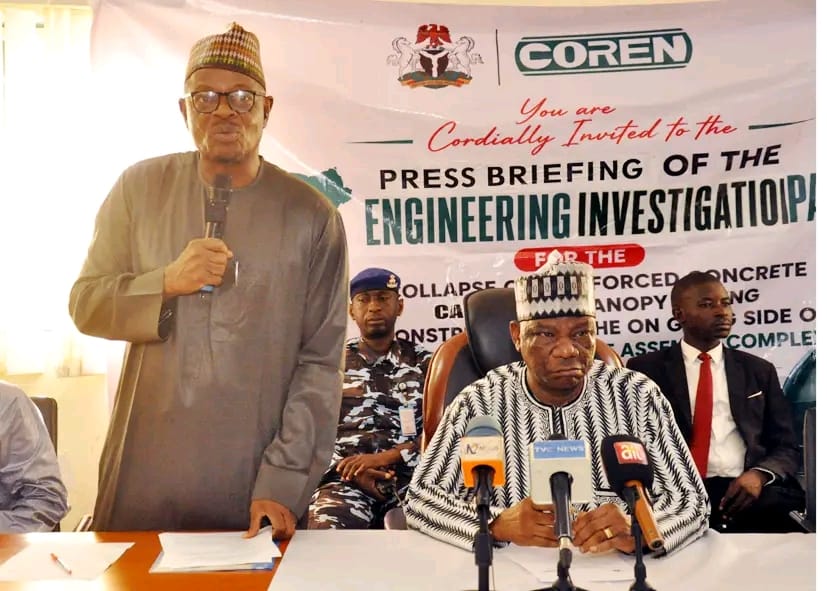
The Council for the Regulation of Engineering in Nigeria (COREN) has submitted its investigation report into the collapse of the reinforced concrete cantilever entrance canopy at the ongoing Gombe State House of Assembly Complex, recommending that construction continue under enhanced professional supervision and strict compliance with approved engineering standards.


Receiving the report on behalf of the Gombe State Government, the Deputy Governor, His Excellency Dr. Manassah Daniel Jatau, said the incident underscored the critical importance of quality assurance, professional oversight and adherence to approved specifications in the execution of public infrastructure.
“The contractor was in a haste, while the State Government wants quality.”
Dr. Jatau assured the investigation panel that the government would implement its recommendations to their logical conclusion, adding that the contractor could continue with the project, but only with stronger supervision and the active involvement of qualified and registered professionals.
The Deputy Governor commended COREN and members of the investigation panel for the painstaking technical exercise, reiterating the administration’s determination to ensure that public projects are delivered according to specification, with safety, durability, quality and value for money given priority.
He stressed that the State Government would not compromise standards in the delivery of critical infrastructure and directed that the recommendations of the panel be fully considered and implemented.
Presenting the report, the Registrar of COREN, Engr. Okorie Uche Austin, outlined the findings of the investigating panel and explained the technical issues examined, the evidence reviewed and the implications of the conclusions reached.
The investigation followed the collapse of the canopy and involved a physical inspection of the project site on 24 July 2026, alongside extensive consultations with engineers, contractors and other stakeholders involved in the project.
The panel reviewed key technical and project documents, including working drawings, structural designs, reinforcement detailing, concrete test results, construction sequence, temporary formwork and propping arrangements.
According to the panel, the consulting structural engineer possesses the requisite qualifications to practise. However, it noted that the engineer’s representative on site was a young graduate who had not yet attained registration status with COREN.
The panel also found that the contractor had not engaged all the required registered professionals, including relevant engineers and architects. It further observed that although the structural design had been checked and sealed by the consulting structural engineer, the working drawings had not been approved by the relevant State approval authority.
On the quality of construction materials, the panel reported that an assessment of the submitted concrete test results showed adequate compressive strength. This, it said, was further supported by integrity tests conducted on the standing structure.
The reinforcement bars available at the site were also found to be consistent with the sizes specified in the structural drawings and technically adequate.
However, the panel identified the temporary formwork and construction sequence as probable contributing factors to the collapse.
It explained that the temporary formwork constituted a critical part of the load-bearing system during concrete placement. The panel further observed that the canopy was reportedly cast at once rather than progressively in stages, placing substantial demands on the temporary support system.
A key finding of the investigation was the integrity assessment of the remaining structure. The panel reported that tests conducted after the collapse indicated that the standing structure was in good condition.
Consequently, the panel recommended that the State Government could proceed with the project, subject to the engagement of adequately qualified professionals by the contractor and consultant, as well as stronger supervision and appropriate corrective measures to prevent a recurrence.
The Chairman of the investigation panel, Engr. Ishaka Lawan, FNSE, explained that the exercise lasted about two months due to the technical procedures, evacuation and testing required to arrive at a comprehensive and evidence-based conclusion.
The COREN Registrar, Engr. Okorie Uche Austin, reaffirmed the Council’s commitment to regulating engineering practice in Nigeria and upholding professional standards, safety and accountability in engineering works.
With the submission of the report, attention now turns to the implementation of the recommended corrective measures, enhanced professional supervision and the safe completion of the Gombe State House of Assembly Complex.
About The Author
