



By:Babagana Bukar Wakil, Maiduguri
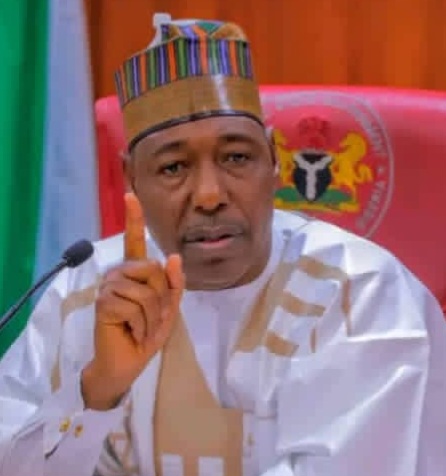
The African Leadership Organisation has honoured Borno State Governor, Professor Babagana Umara Zulum, with its prestigious African Leadership Persons of the Year Award in recognition of his distinguished leadership and impactful governance style.


The award ceremony was held in Accra, Ghana, on Saturday, 28 February 2026, bringing together some of the continent’s most accomplished public and private sector leaders, corporate institutions and change makers who have demonstrated measurable contributions to good governance, growth and development across Africa.
Governor Zulum was recognised alongside an array of iconic African figures, among them former Ghanaian President His Excellency John Kufuor, who was also celebrated at the event. First Bank of Nigeria was among the corporate entities that received distinguished honours on the night.
The Governor was represented at the ceremony by Professor Usman Tar, Honourable Commissioner for the Ministry of Information and Internal Security, and Dr Mairo Mandara, Chief Advisor and Coordinator on Humanitarian Affairs, Partnerships and Sustainable Development.
Dr Mandara delivered the acceptance speech on behalf of the Governor, and in doing so offered a compelling account of the governance philosophy and concrete achievements that earned Zulum the continental honour.
Dr Mandara opened by painting a stark picture of the environment in which Borno’s governance story has unfolded. She noted that the state, located in the northeastern corner of Nigeria and long engulfed by the Boko Haram insurgency, represents one of the most challenging subnational testing grounds on the continent. At the height of the crisis in 2014, armed groups had seized control of 25 of the state’s 27 local government areas.
The human cost was staggering: over half a million lives were lost, hundreds of thousands of children were orphaned, schools and public infrastructure were destroyed, and more than three million people were stripped of their livelihoods, plunging the region into hunger, disease and economic collapse.
As she observed, when development fails, insecurity accelerates poverty, and poverty in turn becomes the fuel for further insecurity.
It was against this backdrop, she explained, that Governor Zulum’s governance model took shape and ultimately earned its continental recognition.
Central to the Governor’s approach is the deliberate rebuilding of trust between the state and its citizens. Rather than relying on announcements or political pronouncements, Zulum has consistently chosen evidence as his currency of governance.
His unannounced visits to schools at dawn, where he has publicly rewarded the only teacher present while deliberately crossing lines of tribe and faith, have come to symbolise a leadership style rooted in genuine empathy and a sincere moral contract with the people he governs.
Physical presence has equally defined his tenure. Governor Zulum has made it a personal policy to meet citizens wherever they live, visiting and staying overnight in every local government area in the state, including the most volatile and remote communities.
His convoys have been attacked on several occasions during these tours, yet he has remained undeterred, often returning to the very communities that came under attack to reassure residents and coordinate responses.
In a conflict environment, his acceptance speech noted, that kind of physical presence does something that policy documents alone cannot achieve: it closes the distance between government and reality.
Borno’s recovery has also been anchored in structured long term planning. Within his first year in office, Governor Zulum oversaw the development of a 25 year development framework and a 10 year strategic plan that has guided the state’s budget and project implementation ever since.
Built around five core pillars encompassing human capital development, a healthy citizenry, agricultural leadership, regional trade and a sustainable environment, as well as four enabling cross cutting pillars covering infrastructure, rehabilitation, reconstruction and resettlement, good governance and accountability, and peace and security, this framework has not been left on a shelf.
For six consecutive years, it has shaped the state’s annual budgets and driven investment decisions, sending a clear message to civil servants, development partners and investors that Borno’s government will execute, not drift.
Recognising the complexity of managing a fragile state, Borno established an Agency for the Coordination of Sustainable Development, Partnerships and Humanitarian Response, which the Governor himself directly supervises.
The agency ensures that all government ministries, departments and agencies, as well as humanitarian and development assistance partners, work toward a unified recovery direction, reducing duplication and maximising complementarity between emergency relief, development finance and state resources.
One of the most historic achievements highlighted during the ceremony was the closure of all official internally displaced persons camps in Maiduguri township between 2021 and 2022. Close to one million displaced persons were relocated and resettled in a move described as unprecedented in the history of internal displacement management across Africa.
Families moved from camp settings into homes equipped with solar electricity, clean water, schools, health facilities and economic support to help them rebuild their lives. This initiative forms the foundation of what the Borno State Government calls its Durable Solutions to Internal Displacement.
The governance model also embraces peace building as an instrument of long term security. Drawing on lessons that no ideological conflict has ever been resolved by military means alone, the Borno State Government developed the Borno Model for Peace, Reconciliation and Development.
The model encourages the surrender and rehabilitation of former insurgents, with an emphasis on dignity, local ownership and community engagement. Following the death of Boko Haram’s leader Abubakar Shekau, mass surrenders accelerated significantly.
According to the Institute for Security Studies, Borno State government records show that approximately 160,000 individuals had left insurgent groups by 2024, a testament to the effectiveness of this locally grounded approach to reintegration.
Education has been treated not as a supplementary concern but as a primary instrument for draining the insurgency of future recruits. The number of out of school children in Borno has been reduced from 2.4 million in 2019 to fewer than 800,000 by December 2025.
In January 2026, the state government expanded digital learning across rural schools, distributing learning tablets to students and pushing the digitalisation of public secondary schools.
Several youth led information technology innovation hubs have also emerged in Maiduguri, providing training and delivering services to international companies. This is not cosmetic modernisation.
It is a deliberate strategy to address the root causes of the insurgency while simultaneously tackling immediate and medium term development gaps, a model increasingly described as Development Under Fire.
Borno’s recovery narrative is further bolstered by a clear eyed focus on the state’s comparative advantages. The state holds the second largest landmass of any state in Nigeria, shares borders with Niger, Chad and Cameroon, and has a young population of which 69 percent are below the age of 20.
With an average of 13 hours of daily sunshine, the state has embraced solar power not merely as an environmental policy but as survival infrastructure.
The Rural Electrification Agency has highlighted a 12 megawatt hybrid solar plant at the University of Maiduguri, developed under the World Bank supported Energising Education Programme, as a flagship example, pairing energy infrastructure with youth training to ensure long term sustainability.
Solar electrification is being rapidly scaled across health facilities, schools, water systems and residential communities.
On the trade and economic front, the city of Maiduguri is expanding rapidly with a projected growth of 50 kilometres from its centre along all six major exits.
The Africa Free Trade Zone in Banki is operational and aligned with the opportunities offered by the African Continental Free Trade Area.
A dry airport has been approved at the Maiduguri International Airport, and markets such as the cattle market in Gamboru have reopened after years of forced closure, signalling a steady return of economic life to communities long destabilised by conflict.
Accountability underpins the entire governance architecture. Governor Zulum personally led a midnight headcount of internally displaced persons that uncovered 650 ghost households out of 1,100 listed entries, an operation conducted between midnight and 5 a.m.
Surprise inspections of schools at 7 a.m. have triggered teacher suspensions when classrooms were found empty, and unannounced hospital visits at night have been a consistent feature of his oversight style.
The 2026 state budget, reported at 890.33 billion naira with 61 percent allocated to capital expenditure, with priority given to education, security, health, infrastructure and resettlement and reconstruction, reflects the measurable translation of vision into financial commitment.
Taken together, the governance attributes celebrated in Accra tell the story of a leader who chose not to wait for peace before governing. Borno State, as Dr Mandara concluded in her acceptance remarks, is what governance looks like when it refuses to surrender to adversity.
About The Author
