


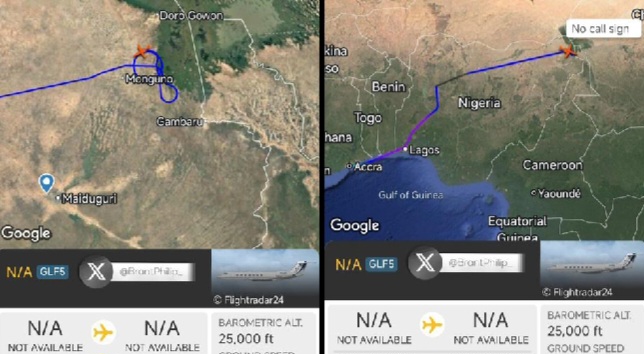
 operations over northeast Nigeria,)
The United States Air Force has restarted its intelligence, surveillance, and reconnaissance (ISR) operations over northeast Nigeria, focusing on ISWAP strongholds scattered across Borno State and the Lake Chad fringes, security sources confirmed on Tuesday.
The mission—part of a longstanding counterterrorism cooperation framework—took off once again from Accra, Ghana, in what has become a consistent pattern: American aircraft operating in Nigerian airspace without ever touching down on Nigerian soil.


Despite renewed diplomatic warmth between Abuja and Washington, the U.S. continues to rely on Ghanaian facilities for launch and recovery, sidestepping Nigerian airfields entirely. Analysts say this enduring choice underscores lingering operational concerns, including logistics, security, and the reliability of ground support infrastructure.
Tuesday’s flight reportedly swept across ISWAP zones of influence, tracking movements, supply routes, and establishing pattern-of-life intelligence in areas where Nigerian troops have faced ambushes and improvised explosive devices. ISR feeds from these missions are often shared with Nigerian security agencies, boosting situational awareness ahead of ground or aerial operations.
Residents in parts of Marte, Abadam, and Kukawa local government areas reported hearing the distant hum of high-altitude aircraft earlier today, consistent with similar missions conducted in recent months.
While neither Washington nor Abuja has issued a formal statement, defence insiders note that ISR missions tend to spike whenever ISWAP begins repositioning fighters around the Lake Chad basin—a sign that major operational moves may be underway.
For now, the skies over northeast Nigeria are once again hosting an American sentinel, quietly mapping the battlefield from far above, even as the runway it launches from remains hundreds of kilometres away in Accra.
Source:@BrantPilip
About The Author
