


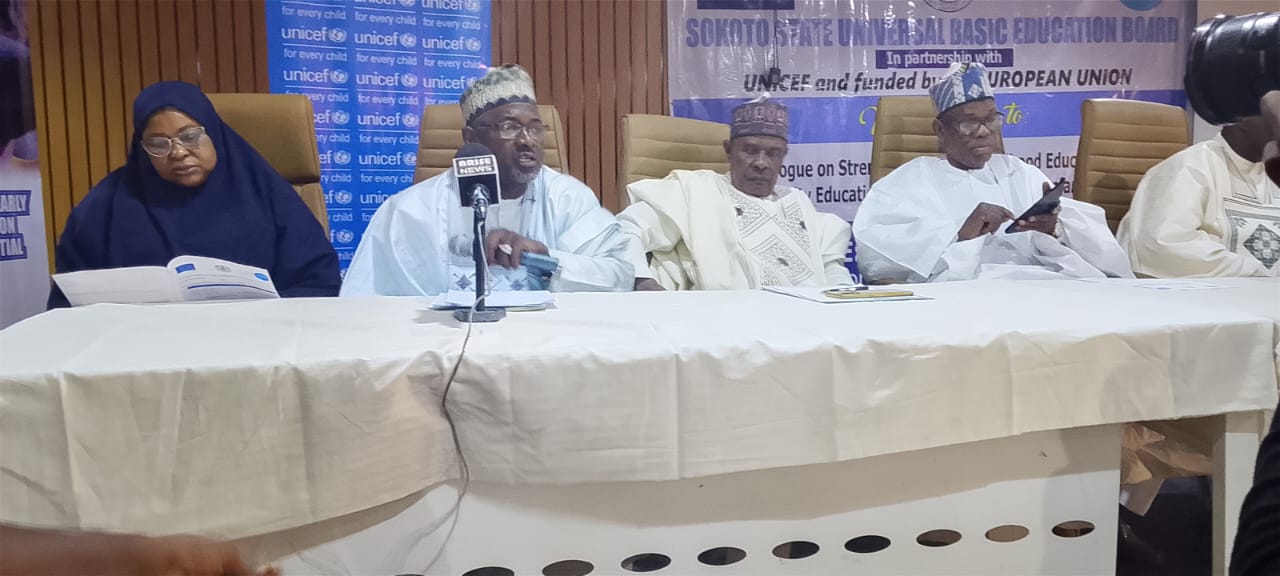

In a bold move to confront the alarming rate of out-of-school children in the North-West, the UNICEF has partnered with Sokoto, Kebbi and Zamfara States to rally the media behind sweeping education reforms.
At a high-level media dialogue on strengthening Early Childhood Education and access to quality learning, journalists were urged to amplify advocacy for legislation regulating the Almajiri system, expanding Early Childhood Education, and reviving home-grown school feeding programmes.


The dialogue, organised by the Sokoto State Universal Basic Education Board in collaboration with UNICEF and funded by the European Union, brought together media professionals from Sokoto, Kebbi and Zamfara States.
Speaking at the event, Sokoto State Commissioner for Education, Professor Ala Ahmed, described the journey to 2026 as one “paved with ambition and commitment,” stressing that the state is expanding technical teams and completing a comprehensive mapping of every school-age child.
He emphasized that the period from birth to age eight represents a critical window for brain development, noting that quality early childhood care remains the greatest equaliser, particularly for children from disadvantaged backgrounds.
According to him, the government, working closely with the Sultanate Council, has registered over 249,000 vulnerable children in Sokoto as part of efforts to transition from street begging to integrated school systems in Shuni, Gagi, Tambuwal and Wamakko.
To further entrench reforms, the state has commenced the establishment of three mega-schools across the senatorial zones: Aliyu Magatakarda Model Primary School in Wamakko (Sokoto Central), Muhammad Sambo Model Primary School in Goronyo (Sokoto East), and Government Day Junior Secondary School in Tambuwal (Sokoto South).
Chairman of SUBEB, Alhaji Umar Nagwari Tambuwal, said the meeting came at a critical time, stressing that early education stimulates and nurtures young minds while helping bridge inequality gaps.
He charged journalists to serve as a bridge between government and the public by intensifying awareness on the importance of enrolling children in school at an early age.
The renewed partnership signals a coordinated regional push to confront the out-of-school challenge head-on — with the media positioned as a powerful driver of change.
About The Author
