


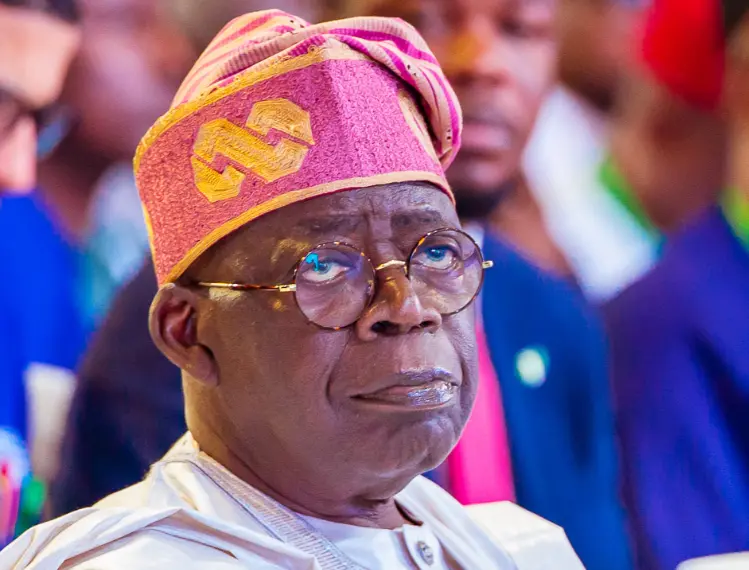

As Nigeria’s political clock ticks toward 2027, the early shape of President ’s Bola Ahmed Tinubu re-election campaign is already coming into sharp focus—and it reads like a roll call of raw political power. At the heart of the emerging strategy is an overwhelming coalition that brings together as many as 30 of the 36 state governors, hundreds of senators and members of the House of Representatives, and a vast constellation of national political heavyweights.
For a country where incumbency has always mattered, this is incumbency amplified.


Governors remain the single most potent force in Nigeria’s electoral machinery. They command party structures, influence candidate selection, and mobilise resources across states and local governments. With roughly four-fifths of the governors reportedly aligned with the President’s re-election push, Tinubu’s camp is positioned to dominate not just the national narrative, but the granular politics of ward-by-ward mobilisation.
Add to this the backing of hundreds of federal lawmakers—senators and House members who control grassroots networks, constituency projects, and legislative influence—and the picture becomes clearer: this is a campaign designed to be everywhere at once, from Abuja power corridors to rural polling units.
In Nigerian politics, momentum often precedes messaging. A broad alliance of officeholders sends a powerful signal to undecided elites, swing politicians, and even opposition figures weighing defections. The calculation is simple: politics follows power, and power gravitates toward coalitions that look inevitable.
By assembling governors, legislators, party leaders, and influential political blocs early, Tinubu’s re-election project appears aimed at locking down momentum long before ballots are printed. It is a strategy that discourages fragmentation within the ruling party while complicating coalition-building for rivals.
Beyond numbers, the coalition projects stability. Supporters frame it as a vote of confidence in the administration’s direction—economic reforms, fiscal realignments, security recalibration, and political restructuring. The message is subtle but deliberate: continuity over uncertainty.
Critics, however, see a different subtext. They argue that such an elite-heavy coalition risks widening the gap between political power and popular sentiment if bread-and-butter concerns—cost of living, jobs, and security—are not convincingly addressed before election season peaks. In Nigeria’s history, strong alliances have sometimes faltered when public mood turned sharply against the establishment.
For opposition parties, a Tinubu-led mega-coalition raises the stakes dramatically. Fragmentation becomes costly. Internal divisions become dangerous. Without a unified front or a compelling alternative narrative, challenging an incumbent backed by governors, lawmakers, and entrenched party machinery becomes an uphill climb.
This reality may trigger realignments: cross-party negotiations, tactical alliances, or even quiet defections as politicians position themselves for survival rather than symbolism.
Still, coalitions win elections—but they do not replace performance. As the campaign crystallises, Tinubu’s greatest test will be converting elite consensus into popular approval. The coming months will reveal whether policy outcomes can keep pace with political arithmetic.
One thing is certain: with governors, lawmakers, and national power brokers lining up in force, Tinubu’s re-election bid is shaping up not as a lone sprint, but as a full-scale political procession—disciplined, well-resourced, and determined to set the tempo of the 2027 race long before the starting gun is fired.
About The Author
