


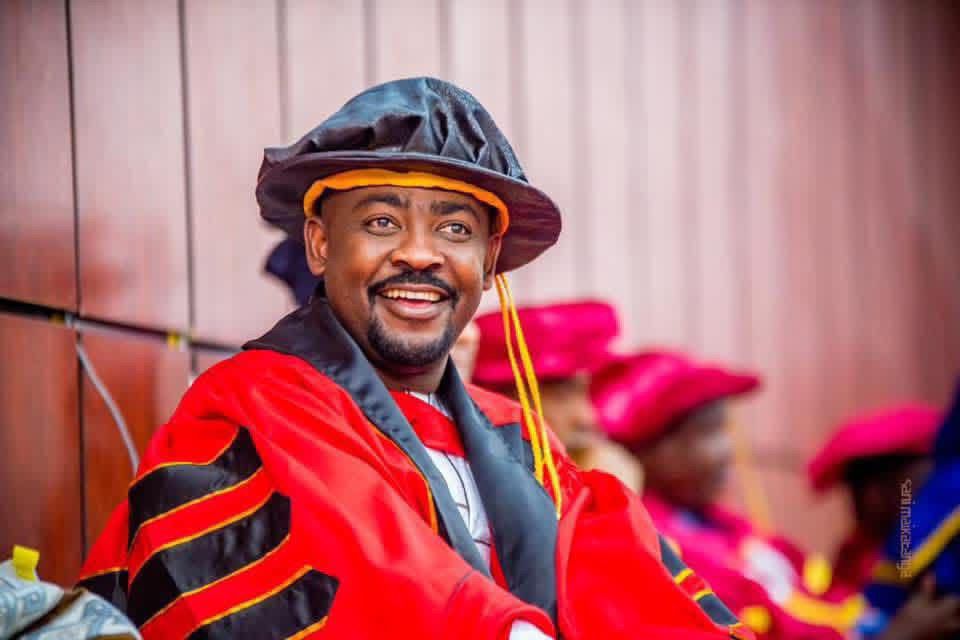

By Musa Abdullahi Sufi, Kano, Nigeria
In an era when private universities are often accused of widening inequality in Nigeria’s education system, one institution has become a surprising equalizer.


At the centre of that shift is Professor Adamu Abubakar Gwarzo, the founder and Chairman of MAAUN Group of Universities (Maryam Abacha American University of Niger/Nigeria (MAAUN), Franco British International University, Kaduna and Canfian Universtu of Nigeria Abuja) .
He is a leading voice in widening access to higher education across the region.
Gwarzo’s approach rejects the standard model of exclusivity that defines most private institutions. Instead of high fees and limited spaces, he has built a system intentionally designed to welcome students from all sides of Nigeria’s social ladder — from the children of low income to the children of executives.
A Private University That Breaks the Mold
MAAUN’s rise has drawn attention for one reason: it delivers global-level training at a price point that is unusually low for a private university with international standard.
While many private institutions demand heavy fees to maintain prestige, MAAUN operates on a contrasting philosophy, one anchored in affordability and broad access.
Despite its infrastructure, partnerships, and international recognition, it remains one of the cheapest private universities of its kind anywhere in the world.
This model has allowed families who once viewed private education as unattainable to step into a space previously reserved for the elite. Even affluent households, now pressured by Nigeria’s economic realities, openly acknowledge that MAAUN’s balance of cost, discipline, and academic quality is difficult to match.
A Lifeline for Thousands Shut Out of Public Universities
The university’s enrolment now over 5,000 students tells another part of the story.
Every year, thousands of qualified candidates are denied admission into public universities due to limited capacity, bureaucratic hurdles, and, at times, unfair influence. MAAUN has quietly become the fallback that keeps many academic ambitions alive.
Students who had lost hope after being screened out of public institutions have found new footing at MAAUN. In many cases, it has turned what would have been a lost year into the start of a promising academic journey.
Culture, Discipline, and a Training Ground for Character
MAAUN’s appeal goes beyond its affordability. One of the elements families highlight is the university’s cultural environment. A campus known for discipline, moral guidance, and a strong emphasis on responsible behaviour.
Gwarzo often argues that producing graduates without character is a national risk, and that principle is reflected in the institution’s daily life.
Parents say they find comfort in a university that mixes modern learning with a value-driven atmosphere at a time when young people face growing social pressures.
Beyond MAAUN: A Broad Push for Public Educational Access
Although his private university is the most visible part of his work, Prof. Gwarzo’s influence on education extends beyond the walls of MAAUN. Through donations, scholarship schemes, institutional partnerships, and advocacy, he has contributed to improving access within public schools as well.
His interventions range from supporting infrastructure to sponsoring students and promoting policies that favour equity.
In several communities across the North, public institutions have benefited from his push for better learning conditions and opportunities for disadvantaged learners.
A Response to National Hardship
Nigeria’s economic downturn has affected every layer of society. Even families once considered financially stable now struggle with expenses, forcing them to rethink educational choices.
In this atmosphere, MAAUN has emerged as a practical alternative, a place where parents do not have to compromise between affordability and quality.
This ability to attract both low-income and high-income families is part of what makes Gwarzo’s model unusual. It challenges the stereotype that private education must be limited to a privileged few.
A Legacy of Opening Doors
For decades, conversations about education in Nigeria have centred on limited access and unequal systems. Gwarzo’s model, whether in his private institution or through his engagements with public ones, offers a different narrative; one where quality education is not determined by the size of a family’s income but by a society’s willingness to rethink its priorities.
His work has expanded the number of students who can dream, apply, study, and graduate without being shut out by circumstances beyond their control.
Prof. Gwarzo is not celebrated for building an institution alone, but for building access and doing so at a scale rarely seen in Nigeria’s private sector. His impact is already being felt in classrooms, lecture halls, and families across the country.
In a nation still struggling to balance demand and opportunity, his story is a reminder that educational reform does not always begin with government policy. Sometimes, it begins with one person deciding that every child, whether rich or poor deserves a place in the future.
About The Author
