


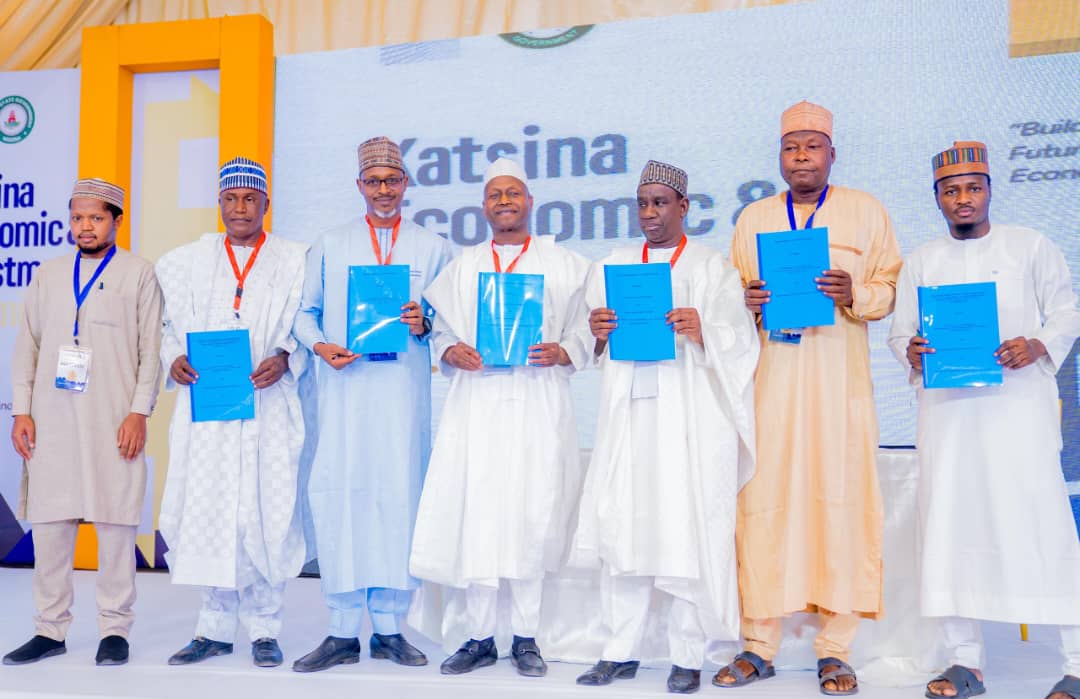

Investment, Desert-to-Greenland projects, and a new phase for Islamic finance
@Ibrahim Kaula Mohammed


After the curtains closed on the Katsina Economic & Investment Summit 2025, one question naturally followed: What has really changed since the summit ended?
The answer is now taking shape in concrete partnerships, financing commitments, and implementation plans — none more significant than the growing collaboration between Dar Al-Halal Group and the Katsina State Government.
Revisiting the summit presentations, the Chairman of Dar Al-Halal Group, Alhaji Dikko Ladan, outlined why the company is committing major capital and technical expertise to Katsina State.
He made it clear that Dar Al-Halal is not offering speeches or symbolic interest, but practical investment in agriculture, Islamic finance, and large-scale land development.
“Katsina is now a place where investment is real, practical, and backed by deliberate government policy,” he stated.
Below are the 10 key takeaways from Dar Al-Halal’s engagement with Katsina:
1. Partnership anchored in agriculture and land transformation
Dar Al-Halal emphasized that agricultural transformation is central to its partnership with Katsina State.
The group highlighted plans for:
large-scale primary production
modern mechanized farming
expansion of irrigation-based cultivation
Agriculture is being repositioned not just as subsistence activity, but as a commercial driver of jobs, revenue, and exports.
2. From summit speeches to structured partnership framework
The engagement moved beyond conference statements and entered the phase of structured collaboration.
Dar Al-Halal outlined:
joint project design
shared implementation responsibility
government–private sector co-ownership
“Our emphasis is partnership, not protocol,” Ladan noted.
3. Desert-to-Greenland projects enter planning stage
One of the boldest outcomes is the desert-to-greenland initiative planned for Katsina.
Dar Al-Halal previously signed an MoU with the Egyptian Authority for Sustainable Development, whose model converted millions of hectares of desert into green farmland.
Katsina is now preparing to replicate this success through:
land reclamation
phased cultivation
climate-smart irrigation
4. Modular farming system adopted
Instead of rushing into massive land conversion, Dar Al-Halal proposed a modular farming system:
develop land in phases
prove productivity
then expand systematically
This approach reduces risk while guaranteeing measurable progress.
5. Islamic finance expansion placed on the agenda
Another key summit outcome is the plan to expand Islamic finance architecture across Katsina State.
Dar Al-Halal committed to supporting:
Sukuk-style funding
Sharia-compliant investment instruments
interest-free financing options
This will deepen access to capital while aligning with community preferences.
6. Seed capital before secondary investors
Dar Al-Halal announced that it will deploy its own investment first before inviting others.
This signals:
seriousness
confidence
long-term commitment
It also sends a message to other investors that Katsina is worth backing.
7. Youth employment and skills development prioritized
The post-summit engagement placed young people and rural families at the center of new projects.
Benefits include:
farm-to-industry jobs
agribusiness entrepreneurship
technical and vocational training
Agriculture is being treated not just as land — but as livelihood transformation.
8. Confidence in Katsina’s leadership and stability
Alhaji Ladan stressed that investment confidence is rooted in Governor Radda’s reform direction.
He cited:
improved security environment
policy stability
supportive regulatory frameworks
“There is leadership certainty in Katsina,” he observed.
This stability reassures large-scale investors.
9. Multi-sector commitment beyond agriculture
Dar Al-Halal operates across several strategic sectors:
healthcare
venture capital
e-commerce and technology
food production and processing
lifestyle and leisure services
media and communications
This positions Katsina to benefit from diversified investment inflows, not agriculture alone.
10. From summit hall to implementation phase
The clearest message is that partnership has moved from conversation to coordination.
The administration is already aligning:
land development plans
irrigation systems
enabling infrastructure
Investor confidence is now being converted into projects
From summit promises to real projects
Katsina is moving from being only naturally endowed to being deliberately investment-ready.
The Dar Al-Halal partnership represents:
clearer policy direction
renewed private-sector confidence
modern, climate-smart agriculture
stronger Islamic finance ecosystem
job creation and rural upliftment
The journey has shifted:
from speeches to strategy to implementation.
About The Author
