


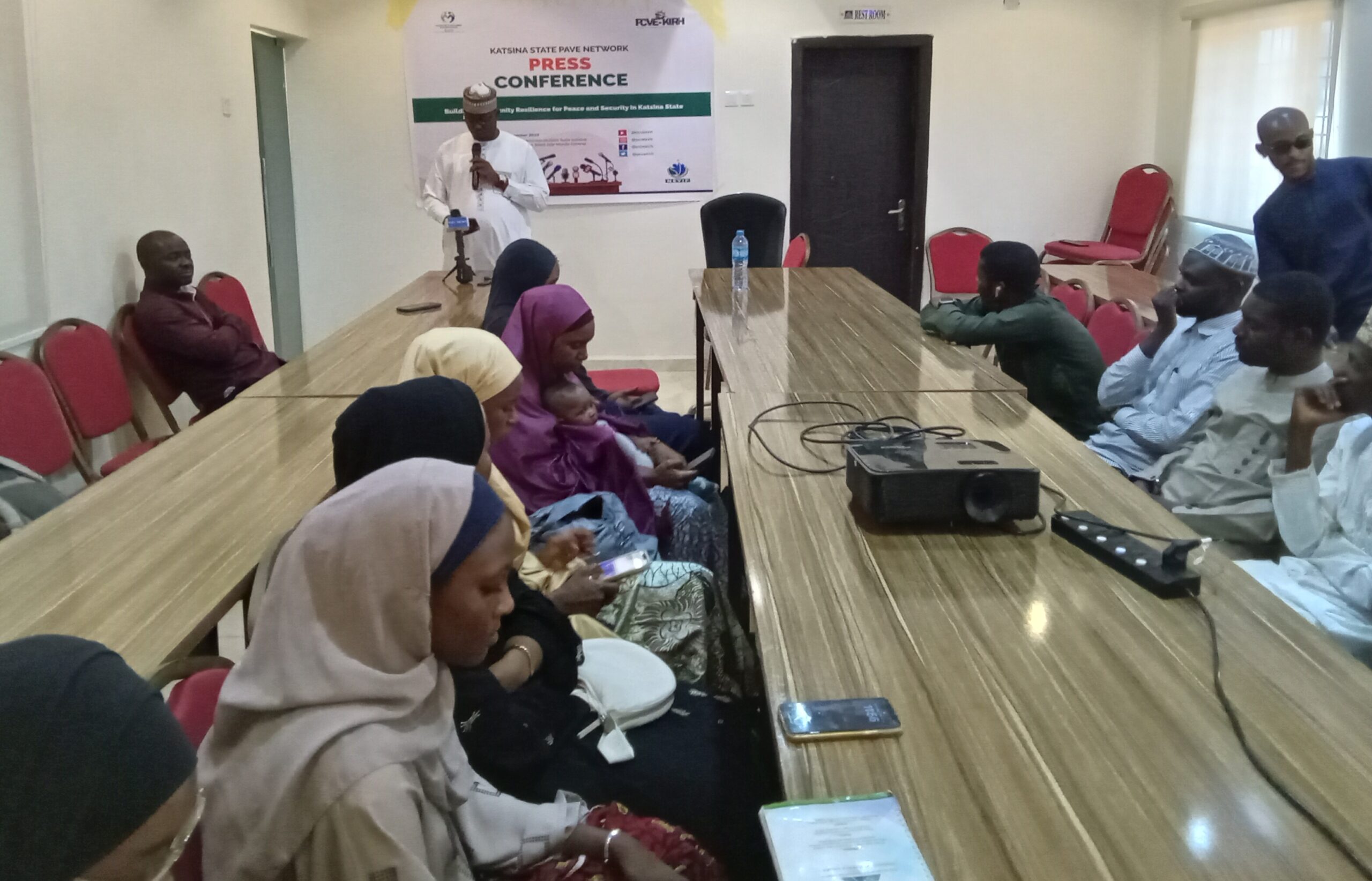

— Calls for united action as communities, government, and security agencies deepen PCVE efforts
The State Chair of the PAVE Network Dr.Bashir Kurfi has reaffirmed a renewed commitment to peace and resilience, declaring that preventing and countering violent extremism (PCVE) in Katsina State and across Nigeria’s North-West must be treated as a shared responsibility, not a security issue alone.


Addressing journalists and stakeholders at a press conference in Murjani Hotel hall Katsina State Capital, the Chair painted a clear picture of the region’s evolving security landscape, where violent extremism, banditry, and organised criminality continue to exploit weak governance structures, porous borders, economic hardship, and social exclusion.
“The North-West’s security challenge is complex and interconnected. It requires prevention, inclusion, and community resilience — not only force,” the Chair stressed.
The PAVE Network noted that extremist-linked groups and criminal gangs have continued to fuel instability in parts of the region, underscoring the urgent need for comprehensive, people-centred solutions that address root causes such as youth unemployment, marginalisation, and fragile community safety systems.
Despite the challenges, the Network reported significant progress in strengthening local capacity and coordination:
Stakeholder capacity-building workshops for government officials, security agencies, traditional rulers, women, youth groups, and civil society;
Co-creation sessions supporting the development of State Action Plans (SAPs) and Local Action Plans (LAPs);
Dialogue platforms bringing communities and authorities together to identify local priorities, including youth empowerment and early-warning systems;
Peer learning exchanges among North-West states to share best practices and reduce duplication;
Advocacy visits to government institutions and legislatures to secure political ownership and funding;
15-day community resilience campaigns promoting peace education, tolerance, and counter-extremism narratives at grassroots level.
“These engagements have strengthened trust, boosted local ownership, and empowered communities to play an active role in early warning and prevention,” the Chair noted.
Among the major milestones recorded are:Enhanced collaboration among MDAs, security agencies and non-state actors;Establishment of Technical Working Groups for SAPs and LAPs;Alignment with Nigeria’s Policy Framework and National Action Plan on PCVE;Introduction of PCVE priorities into state budget proposals;Growing participation from the private sector and development partners.
The Network identified fresh opportunities in deepening youth engagement, expanding economic interventions, and institutionalising PCVE within government planning systems.
However, the Chair cautioned that serious hurdles persist, including:Continued activities of armed groups in some areas;High youth unemployment and exclusion;Weak early-warning linkages in certain LGAs;
Inadequate integration of PCVE priorities into sectoral budgets.
“Military action alone cannot end violent extremism. This is a governance, development, and community challenge,” the Chair warned.
A Call for Collective Action, The PAVE Network urged: Residents to remain vigilant and reject extremist narratives;Traditional and religious leaders to champion peace and tolerance;Youth and women groups to lead resilience and positive-narrative campaigns; MDAs and LGAs to mainstream PCVE into planning and budgets;Security agencies to deepen community engagement and uphold human rights;State Government to take firm leadership of the PCVE process.
Closing the briefing, the Chair reaffirmed the Network’s resolve to pursue an inclusive, evidence-based, and collaborative approach, emphasizing that peace and prosperity depend on the actions of every citizen.
“Together, we can prevent violent extremism, protect our communities, and secure a peaceful future for [State Name] and the entire North-West,” the Chair concluded.
About The Author
