


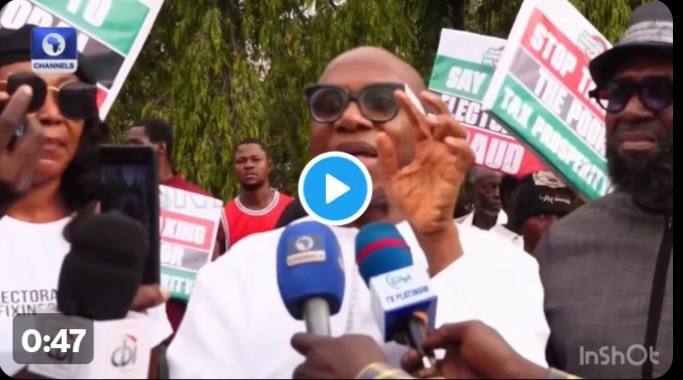

Former minister and political heavyweight Rotimi Amaechi on Tuesday punctured a popular accusation against Nigeria’s political class with a dramatic and personal statement—one delivered not from a podium, but from the protest ground itself.
“There are those who say that we, the politicians, want protests but our children are overseas,” Amaechi said. “Here is my first son; I brought him to join the protest.”


The words landed with force, drawing attention not just to the message, but to the symbolism behind it. Standing beside him was his son, a trained medical doctor—not as a spectator, but as a volunteer.
“His job is to treat the injured ones if there are any injuries,” Amaechi added, a line that instantly reframed the narrative around elite detachment and political hypocrisy.
For years, critics have accused Nigerian politicians of encouraging street action while keeping their own families safely tucked away abroad. Amaechi’s move, observers say, was a direct rebuttal—placing family where conviction is, and turning a protest into a statement of shared risk and responsibility.
The presence of his son also highlighted another layer of the protest: preparedness. In an environment where demonstrations can quickly turn tense, the former minister said the priority was clear—protect lives, not endanger them.
Political analysts describe the moment as both strategic and symbolic, blurring the line between leadership and participation. “This wasn’t just rhetoric,” one observer noted. “It was a visual answer to a long-standing accusation.”
As chants echoed and placards rose, Amaechi’s message rang louder than the crowd: protest is not a spectator sport—and if leaders call for change, they must be ready to stand in the same sun, face the same risks, and answer to the same consequences as everyone else.
About The Author
