


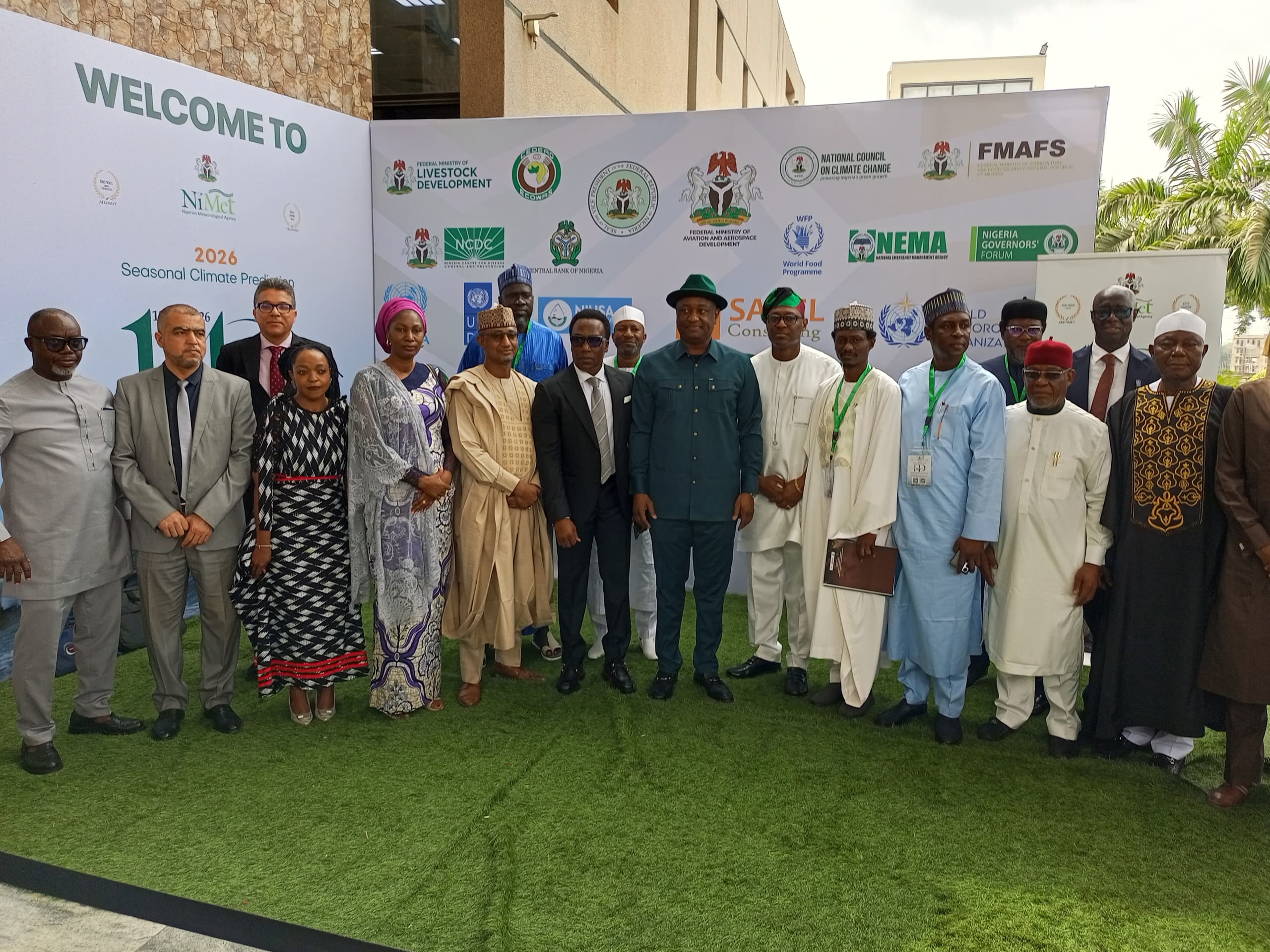
 has presented the 2026 Seasonal Climate Prediction (SCP) at the NAF Conference Centre, Abuja.)
By: Muhammad Jalal
The Nigerian Meteorological Agency (NiMet) has presented the 2026 Seasonal Climate Prediction (SCP) at the NAF Conference Centre, Abuja.


Unveiling the prediction, the Minister of Aviation and Aerospace Development, Festus Keyamo, said early rainfall onset is expected in Bayelsa, Rivers, Akwa Ibom, Cross River, Benue, Kogi, Nasarawa, Oyo, and parts of Kebbi, Niger, Jigawa, Katsina, Kano, Adamawa and Taraba states.
He also disclosed that a late onset of rainfall is expected in Borno State.
According to the Minister, rainfall cessation is anticipated to occur earlier than normal in parts of Ogun, Osun, Ondo, Imo, Rivers, Akwa Ibom, Kogi and Niger states.
However, a delayed end of the rainy season is predicted for Lagos, Ogun, Anambra, Enugu, Cross River, Benue, Nasarawa and Kaduna states.
Keyamo further noted that a longer-than-normal rainy season is expected in Lagos, Benue, Enugu, Ebonyi, Ogun, Oyo, Nasarawa, Anambra, Kwara, Kebbi, Kaduna, Gombe and Taraba states. Conversely, parts of Borno, Yobe and Niger states are projected to experience a shorter-than-normal rainy season.
He stated that normal rainfall amounts are anticipated across most parts of the country when compared to the long-term average.
However, above-normal rainfall is expected in Borno, Sokoto, Kebbi, Kaduna, Enugu, Cross River, Abia, Ebonyi and Akwa Ibom states, as well as the Federal Capital Territory (FCT), Abuja.
Below-normal rainfall is forecast for parts of Katsina, Zamfara, Kwara, Oyo and Ogun states.
The Minister explained that between March and May, severe dry spells exceeding 15 days are likely in parts of Oyo and Ogun states.
Moderate dry spells are expected in Ekiti, Kogi, Osun, Ondo, Ogun, Edo, Ebonyi, Abia, Cross River and Delta states, as well as parts of Kwara.
He further revealed that the “Little Dry Season,” commonly known as the August Break, is predicted to occur in July over Lagos, Ogun, Ekiti and parts of Oyo State.
Keyamo stated that the 2026 Seasonal Climate Prediction was developed in line with global best practices in meteorology and climate science, combining long-term climatological data with climate drivers such as the El Niño-Southern Oscillation (ENSO).
In his remarks, the Director-General of NiMet, Professor Charles Anosike, assured that the agency would continue to provide authoritative, science-based climate information to support planning and decision-making in Nigeria amid rapidly changing climate conditions.
He warned that climate variability and extreme weather events increasingly threaten lives, livelihoods, infrastructure, food security and economic growth, stressing that timely and reliable weather and climate information is indispensable for building safer and more resilient communities nationwide.
In his welcome address, the Permanent Secretary of the Ministry of Aviation and Aerospace Development, Dr. Yakubu Adam Kofarmata, said the unveiling of the 2026 Seasonal Climate Prediction was not merely to disseminate information but to encourage stakeholders to actively utilise the forecast for national development.
He emphasized that the prediction would deliver value when forecasts inform policies, guide investments, strengthen preparedness and ultimately protect lives and livelihoods.
Goodwill messages were delivered by the Director-General of the National Emergency Management Agency (NEMA), the Director-General of the Nigeria Hydrological Services Agency (NIHSA), a representative of the Secretary-General of the World Meteorological Organisation (WMO), and the Director-General of the National Council on Climate Change (NCCC).
About The Author
