


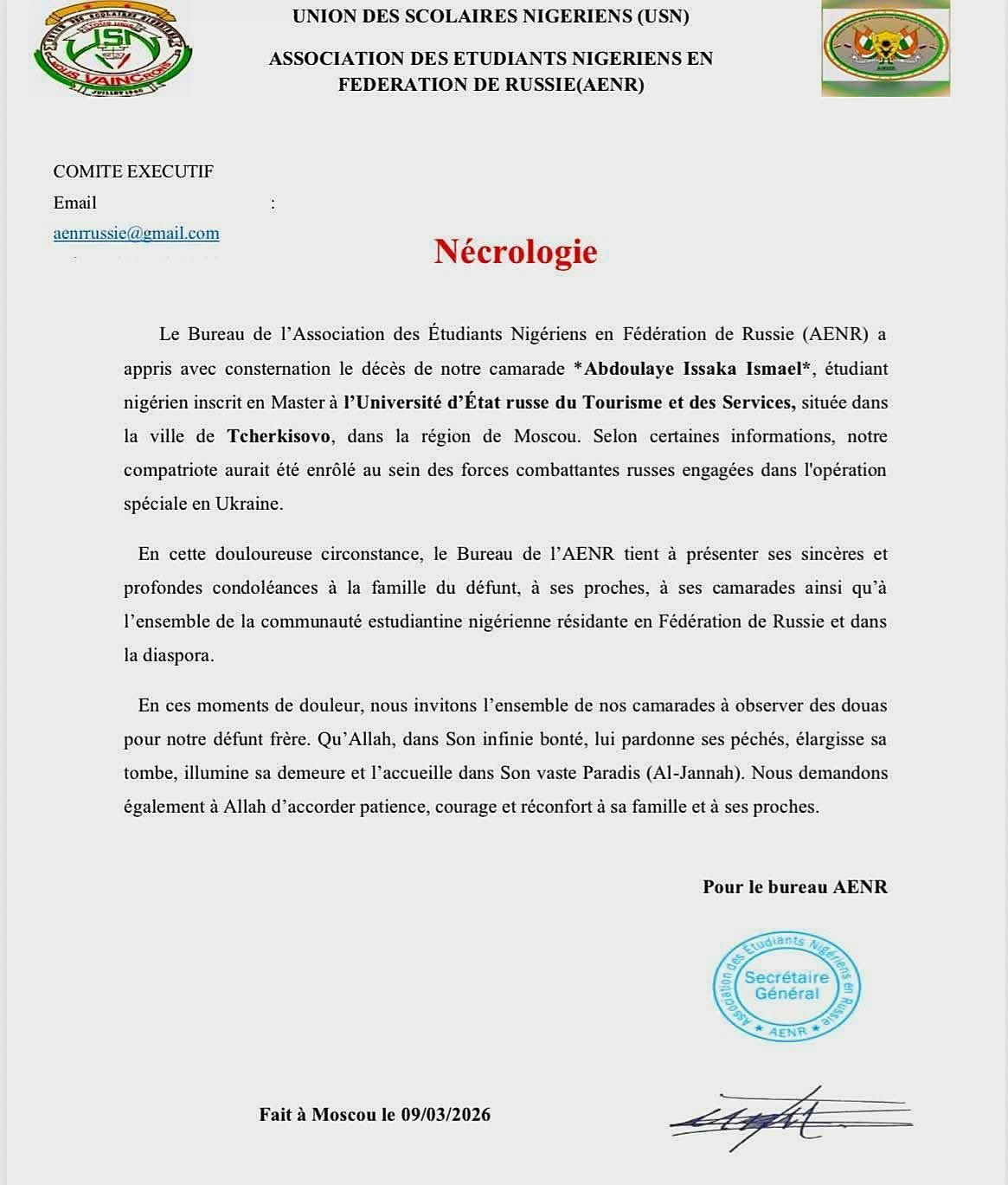

The death of a Nigerien student on the frontlines of the Russia–Ukraine war has sparked renewed concerns over the recruitment of African nationals into Russia’s military, with analysts warning of a growing pattern that is drawing young Africans into a distant and deadly conflict.
The student, who had travelled to Russia for academic studies, was reportedly recruited into the Russian military before being deployed to fight in Ukraine. His death has highlighted the risks faced by foreign nationals who find themselves caught in the ongoing war.


Security and intelligence sources said the development has drawn fresh attention to alleged recruitment networks that have targeted Africans living in Russia, including students and migrant workers.
According to findings reported by security analyst Zagazola Makama, the student’s death reflects a wider trend in which African nationals are being enlisted into Russian forces, sometimes under unclear or controversial circumstances.
A report published on February 11 by the investigative platform All Eyes on Wagner/INPACT estimated that nearly 1,500 Africans from about 35 countries were recruited into Russian military structures between 2023 and 2025.
Experts familiar with the recruitment networks said many of those drawn into the military were individuals who had travelled to Russia for legitimate purposes such as education, employment or immigration documentation.
However, some reportedly ended up signing military contracts after being promised jobs, legal residency or financial incentives.
The report further indicated that the recruitment process often involved opaque agreements, misleading promises or, in some cases, outright deception before the recruits were deployed to the battlefront in Ukraine.
Sources said the Nigerien student, whose identity has not yet been publicly disclosed pending notification of his family, died while serving with Russian forces in the war zone.
His death has reignited debate across parts of Africa about the vulnerability of young migrants and students abroad, particularly in countries directly involved in armed conflicts.
Analysts say the situation illustrates how foreign fighters are increasingly being used to supplement Russia’s war effort as the conflict with Ukraine drags into its fourth year.
With heavy casualties reported on both sides of the war, observers believe foreign recruits are sometimes viewed as additional manpower in a prolonged and costly military campaign.
Some security experts have described the recruitment practices as potentially exploitative, arguing that many of the individuals drawn into the war may not fully understand the risks involved before signing contracts.
According to analysts monitoring the issue, recruits are sometimes treated as “replaceable” manpower in a conflict environment where casualty rates remain high.
The situation has raised alarm among civil society groups and policy observers across Africa, many of whom are calling for stronger protections for citizens studying or working abroad.
They warn that without proper oversight and diplomatic engagement, more African nationals could be drawn into conflicts that have little connection to their home countries.
Officials and advocacy groups in several African states have previously urged governments to investigate the recruitment of their citizens into foreign armed forces and to strengthen support mechanisms for students and migrants living overseas.
The death of the Nigerien student has renewed calls for transparency regarding the circumstances under which foreign nationals are enlisted into military service in Russia.
Observers also stress the need for African governments to provide better guidance to citizens travelling abroad, particularly to countries involved in active conflicts.
As of the time of filing this report, the Nigerien government had not issued an official statement regarding the incident.
Efforts by journalists and investigators to confirm additional details surrounding the student’s recruitment and the circumstances of his death are ongoing.
For many observers, the tragedy underscores the broader human cost of the war and the growing global reach of a conflict that continues to claim lives far beyond the borders of Russia and Ukraine.
About The Author
