


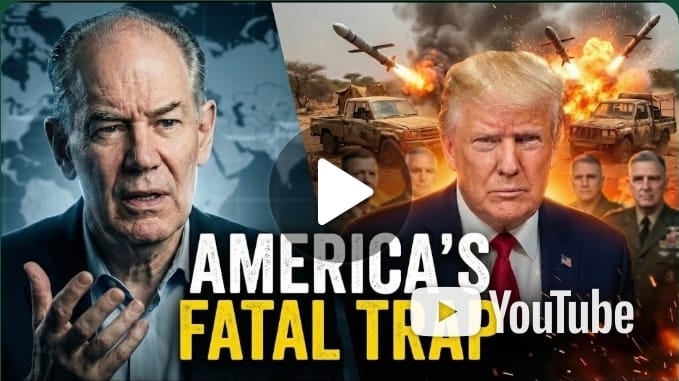

… Says U.S. Action in Nigeria Undermines Global Priorities
By: Babagana Bukar Wakil, Nigeria


Renowned American political scientist and leading realist theorist, Professor John J. Mearsheimer, has sharply criticized the recent United States missile strikes in Nigeria, warning that the action risks entangling Washington in a costly and strategically unnecessary conflict while diverting attention from what he describes as America’s only true existential challenge: a rising China.
In a video commentary titled America’s Strike in Nigeria Is a Fatal Trap, Strategic Suicide Has Begun, Mearsheimer argues that the intervention, widely portrayed in Western media as a decisive show of force against Islamist militants, reflects deeper strategic confusion rather than strength.
Media Narrative Versus Strategic Reality:
Mearsheimer begins by challenging the dominant narrative framing the strikes as a morally justified effort to protect Christian communities from extremist violence. He characterizes this portrayal as a strategic hallucination, cautioning that such simplified narratives obscure the complex political, economic, and social roots of Nigeria’s security crisis.
According to him, presenting the conflict through a religious lens risks internationalizing what are largely local struggles over governance, resources, and state capacity. He warns that this approach may inadvertently validate extremist propaganda and widen the conflict’s global appeal.
Costly Weapons, Limited Strategic Value:
The professor also questions the military logic behind the operation, highlighting what he describes as a stark mismatch between the cost of U.S. weaponry and the nature of the targets. He notes that deploying multi million dollar Tomahawk missiles against insurgent camps, often consisting of lightly equipped fighters using pickup trucks, represents a profound inefficiency with little long term strategic payoff.
Such actions, he argues, create the illusion of decisive action while failing to address the structural drivers of insecurity.
The China Factor and Strategic Distraction:
At the core of Mearsheimer’s critique is the concept of strategic opportunity cost. He contends that every military and political resource committed to peripheral conflicts such as Nigeria weakens Washington’s ability to focus on the Indo Pacific, which he describes as the primary arena where global power competition will be decided in the 21st century.
While the United States expands its military footprint across multiple regions, supporting Ukraine, backing Israel, and now intervening in West Africa, China, he argues, is concentrating on long term economic influence, infrastructure development, and resource acquisition.
Moral Hazard and Dependency Risks:
Mearsheimer further warns that U.S. intervention may enable what he calls buck passing by Nigerian authorities, reducing incentives for domestic reform. By stepping in militarily, Washington risks allowing local political elites to avoid confronting corruption, governance failures, and weaknesses within their own security institutions.
He draws parallels with past U.S. engagements in Afghanistan and Vietnam, where prolonged external support fostered dependency rather than durable stability.
No Military Solution to Political Problems:
Rejecting the idea that force alone can resolve deeply rooted crises, Mearsheimer emphasizes that killing militant leaders does not alter the underlying political realities that fuel insurgency. He cautions against what he sees as Washington’s habitual belief that complex socioeconomic problems can be solved primarily through military means.
Warning of Mission Creep:
In his conclusion, Mearsheimer predicts that limited strikes could gradually expand into a broader and more costly commitment, beginning with drones and advisors and potentially leading to American casualties. He urges policymakers and the public to resist being drawn into conflicts that, in his assessment, do not meaningfully affect the global balance of power.
“The real storm,” he argues, “is gathering in the Pacific,” and the United States risks strategic exhaustion by fighting on too many fronts at once.
About The Author
