



By Francis Okoye, Maiduguri
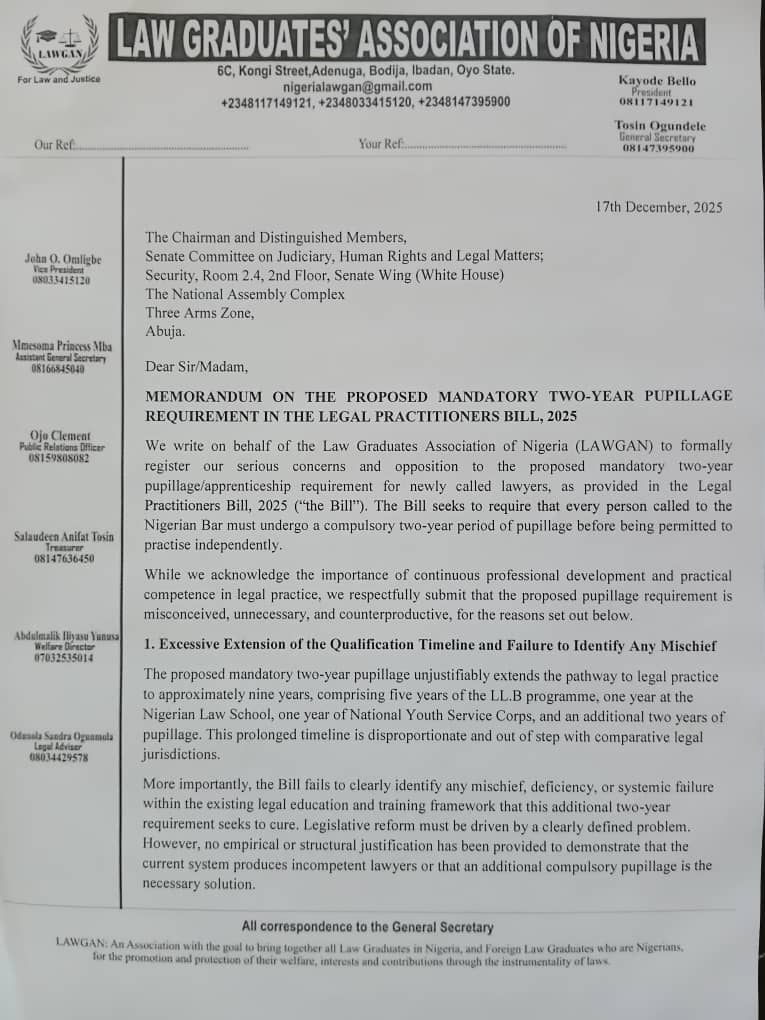
The Law Graduates Association of Nigeria ( LAWGAN ) has opposed the proposed mandatory two-year pupillage/ apprenticeship requirement for newly called lawyers, as provided in the Legal Practitioners Bill, 2025 before the National Assembly.


The Bill seeks to require that every person called to the Nigerian Bar must undergo a compulsory two-year period of pupillage before being permitted to practise independently.
Opposing the proposed Bill in a letter written by the President of LAWGAN, Kayode Bello and the public relations officer, Ojo Clement respectively, to the Chairman and distinguished members Senate Committee on Judiciary, Human Rights and Legal Matters , which was obtained by our correspondent on Thursday in Maiduguri, LAWGAN, said while they acknowledge the importance of continuous professional development and practical competence in legal practice, they respectfully submit that the proposed pupillage requirement is misconceived, unnecessary, and counterproductive.
LAWGAN reasoned that the proposed mandatory two-year pupillage unjustifiably extends the pathway to legal practice to approximately nine years, comprising five years of the LL.B programme, one year at the
Nigerian Law School, one year of National Youth Service Corps, and an additional two years ofpupillage.
They further reasoned that this prolonged timeline is disproportionate and out of step with comparative legal jurisdictions, saying more importantly, that the Bill fails to clearly identify any mischief, deficiency, or systemic failure within the existing legal education and training framework that this additional two-year requirement seeks to cure.
LAWGAN said, ” We write on behalf of the Law Graduates Association of Nigeria (LAWGAN) to formally register our serious concerns and opposition to the proposed mandatory two-year pupillage/apprenticeship requirement for newly called lawyers, as provided in the Legal Practitioners Bill, 2025 (“the Bill”).
” Legislative reform must be driven by a clearly defined problem. However, no empirical or structural justification has been provided to demonstrate that the current system produces incompetent lawyers or that an additional compulsory pupillage is the necessary solution.
” Duplication of Existing Vocational Training Provided by the Nigerian Law School Crucially, the proposal duplicates the vocational and practical training already provided by the Nigerian Law School, which is deliberately structured to expose students predominantly to the practical aspects of legal practice.

” Through court attachments, law clinics, mock trials, drafting
exercises, ethics training, and procedural practice, the Law School already serves as Nigeria’s central professional training institution.
” Introducing an additional mandatory apprenticeship, without reforming or integrating the existing framework, would result in unnecessary redundancy rather than meaningful improvement, while placing further financial and temporal burdens on law graduates.”
The body demands for coherent structural reform rather than piecemeal extension if Nigeria seeks to adopt a pupillage-based model akin to those in other jurisdictions, a more coherent and principled approach would be comprehensive structural reform, rather than merely appending two additional years to an already lengthy system.
Such reform LAWGAN said could include: reducing the LL.B programme to three years; introducing a structured two-year pupillage system; and requiring a standardised professional qualification examination set and administered by the Nigerian Law School or an equivalent regulatory body.
This approach the body noted would integrate academic learning with practical training, eliminate duplication, and ensure that any pupillage requirement forms part of a rational and streamlined professional
training framework.
” In the alternative there should be an inter-institutional approach between and among the Council of Legal Education, National Universities Commission and other law bodies or faculties to spread the internship within the four or five years of undergraduate studies.
” In conclusion, the proposed mandatory two-year pupillage requirement adds length without clarity, burden without justification, and duplication without reform. It risks discouraging young Nigerians from the legal profession, deepening inequality by favouring those with greater
financial means, and undermining confidence in the coherence of legal education reform.
” We respectfully submit that legislation governing access to the legal profession must be evidence-based, proportionate, and purposive. The Bill, as currently framed, does not meet these standards and should not be allowed to pass in its present form,” LAWGAN further said.
About The Author
