



… 168 traditional rulers from over 12 countries converge for peace and regional stability
By: Babagana Bukar Wakil


Maiduguri emerged as a global cultural diplomacy hub as the Second International Kanem Borno Cultural Summit brought together more than 168 prominent traditional rulers, title holders, and their contingents from over 12 countries across Africa, the Middle East, and beyond, in an unprecedented gathering that marked the growing prestige and international acceptance of the Kanem Borno heritage as a platform for peace, unity, and regional stability.
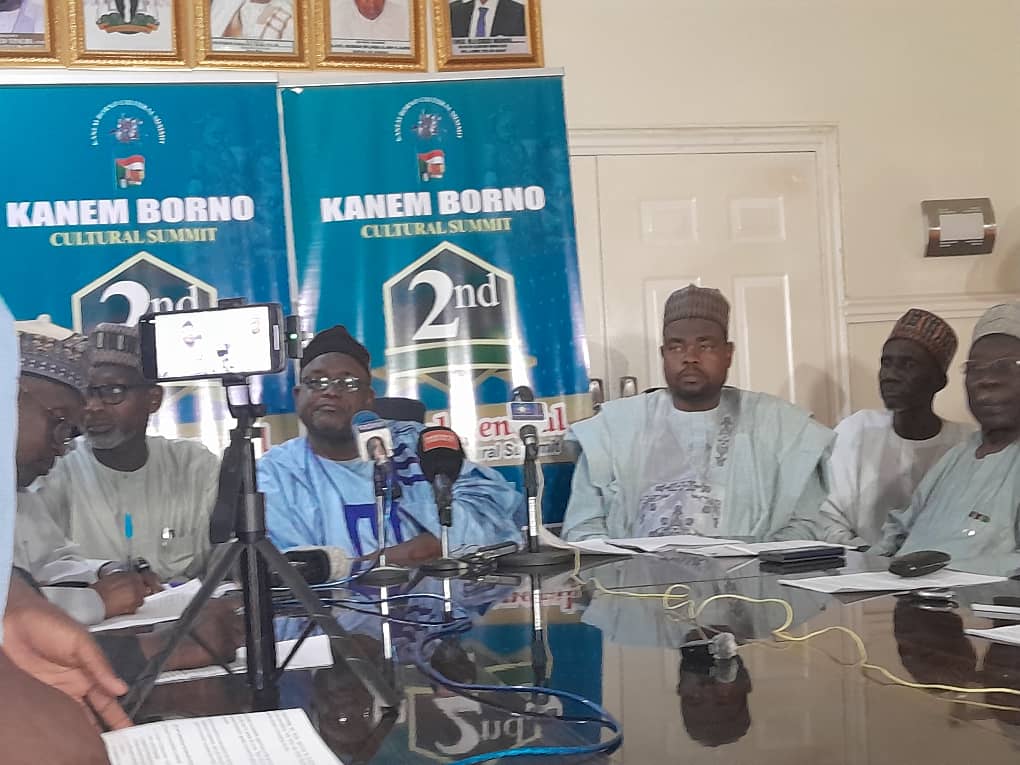
The Chairman of the Kanem Borno Cultural Summit Organising Committee, led by Alhaji Hasan Zanna Bogoma the Zanna Bogoma of Borno, announced the successful conclusion of the summit and festival, describing it as a historic convergence of cultures, nations, institutions, and peoples united by shared heritage and a collective commitment to peace and cooperation across the Lake Chad Basin and the wider international community.
Speaking at a press conference held on Tuesday, 6 January 2026, at the BICTDA Conference Hall in Maiduguri, Alhaji Bogoma said the summit reaffirmed the enduring relevance, unity, and resilience of the Kanem Borno civilisation and once again positioned Maiduguri, the historic capital of Borno State, as the cultural and historical centre of the Kanem Borno world.
He stated that the summit, held under the theme Harnessing Culture for Peace and Regional Stability and coinciding with the second edition of the Kanem Borno Cultural Festival, recorded significant improvements in scope, participation, organisation, and impact compared with the maiden edition. According to him, participants included Kanem Borno descendants and cultural stakeholders from across Africa, the Middle East, and other parts of the world.
According to the communiqué issued at the end of the summit, the gathering demonstrated through intellectual discourse, cultural exhibitions, traditional performances, the grand durbar, and high level engagements that culture remains one of the most sustainable and inclusive tools for peacebuilding, reconciliation, identity reconstruction, and regional cooperation.
The communiqué disclosed that the participation of over 168 traditional rulers, title holders, and their contingents marked an unprecedented turnout, reflecting the growing acceptance and international stature of the summit and festival across Africa and beyond. It noted that the activities, which spanned the New Year period, symbolically ushered participants into 2026 with a renewed sense of shared identity and collective destiny.
Despite prevailing security narratives associated with the region, the communiqué emphasised that the summit was conducted peacefully with no recorded security incidents, describing this as a remarkable achievement deserving of national and international recognition. The success was attributed to strong coordination among traditional institutions, community leaders, and security agencies.
The communiqué expressed profound appreciation to the Executive Governor of Borno State, Professor Babagana Umara Zulum, for his visionary leadership, unwavering support, and guidance, which it said were central to the successful planning and execution of the summit. It also acknowledged the solidarity and support of the Governor of Yobe State, Mai Mala Buni.
Special recognition was accorded to the Shehu of Borno, Alhaji Abubakar ibn Umar Garbai El Kanemi, for his royal blessings, guidance, and steadfast support, symbolising the living continuity and unifying authority of the Kanem Borno legacy.
The communiqué further acknowledged the Sultan of Sokoto, Alhaji Muhammad Saad Abubakar, for honouring the summit by attending the grand durbar, noting that his presence reaffirmed historic bonds between the Sokoto Caliphate and the Kanem Borno civilisation and highlighted the enduring role of traditional institutions in promoting peace, unity, and national cohesion.
It also commended other royal fathers for their participation and appreciated the approval granted by the Chadian authorities, which enabled broad participation from Chad, represented by Engineer Ahmat Mbodou Mahamat. The presence of governors and official representatives from Cameroon, Niger, Ghana, Benin, Gabon, Guinea, Libya, Saudi Arabia, and other countries was described as reinforcing the transnational character of the Kanem Borno heritage and shared responsibility for peace and stability across borders.
The communiqué acknowledged diplomats, government officials, academics, captains of industry, sociocultural groups, and international participants whose contributions enriched the summit intellectually and culturally.
It commended the Nigerian Armed Forces, particularly the Theatre Command, alongside the Nigeria Police Force, Department of State Services, Nigeria Security and Civil Defence Corps, Nigeria Customs Service, Nigeria Immigration Service, Fire Service, Civilian Joint Task Force, and other security agencies for their professionalism and coordination in ensuring the safety of participants and the seamless movement of guests.
According to the communiqué, the summit achieved key objectives including the preservation and revival of Kanem Borno arts, customs, attire, music, and language, the reinforcement of shared history and collective memory, the strengthening of traditional institutions across borders, the reconnection of families and communities separated by modern national boundaries, and the promotion of unity, solidarity, and inter nation cultural cooperation.
On the way forward, the communiqué called for sustained unity and commitment to preserving Kanem Borno culture and traditions, advocating the institutionalisation of the summit as a recurring cultural diplomacy platform, the establishment of a standing Kanem Borno Cultural Committee, the creation of a Kanem Borno Cultural Network, expanded participation of youth and women, and comprehensive documentation and digital archiving of the summit. It also appealed to UNESCO and other international cultural institutions to recognise the Borno Durbar as a World Cultural Heritage and to support the Kanem Borno Cultural Summit as a flagship African initiative for peacebuilding, regional cooperation, and cultural integration.
At the close of the press conference, the Vice Chairman of the Organising Committee, Alhaji Goni Dunoma, in his vote of thanks, commended all participants and members of the committee for what he described as a job well done, applauding their dedication, discipline, and collective effort in ensuring the success of the summit.
About The Author
