


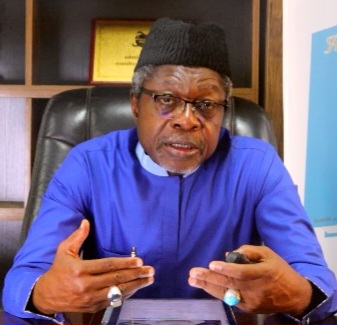

By: Hassan Gimba
The Arbiter


A few days ago, I woke in the night, anxious and checking the news, half-expecting America and Israel to have attacked Iran.
Given this tension, the central issue is the longstanding American-Israeli effort to destabilise Iran. Even though it cannot be exhausted in one article, I’d like you to come along as we look over the underlying hostility, the motives behind American and Israeli actions, and why both countries believe only a fractured, weakened Iran will serve their interests.
The apparent lowering of tensions and talk of de-escalation are largely superficial. America—the dog—and Israel—the tail that wags it—will never rest until they see a balkanised Iran; regime change to install a malleable monarchy is just a ruse. It is a first step to the annihilation of Iran, but at first, the people of the country have to be deceived into thinking they are going to have a new government.
The tag team of Donald Trump and Benjamin Netanyahu will not be satisfied with merely installing a malleable regime, because they represent a concept whose custodians plan in decades and think in centuries. As long as Iran remains intact, a future “antagonistic” government could replace their pliable proxy—and that is unacceptable to them. What they desire is a shattered Iran, broken into fragments and at each other’s throats.
America wants to neutralise Iran to limit China’s growing influence and weaken Russia. Iran currently acts as a buffer and supplies vital energy resources to China. For Israel, Iran obstructs its ambition for a so-called “Greater Israel.” Aware of Iran’s strength and resilience, Netanyahu has worked relentlessly to push America into confronting Iran on his country’s behalf.
China now sources almost all its oil from Iran, with Venezuela no longer a viable alternative. Should America succeed in cutting off Iran’s crude oil exports to China, the Land of the Dragon would lose a critical fuel supply that sustains its economy. Without it, China’s economic stability could be severely threatened.
For these reasons, America and Israel—long-time siamese twins with converging interests—have kept Iran in their sights. During the recent periods of unrest, Iran accused the CIA and Mossad of fomenting it, and both countries reportedly contemplated military action “to save Iranians” with the protests as an excuse. Following events in Venezuela involving Nicolás Maduro, Trump even considered a “limited” and “targeted” strike on Ayatollah Ali Khamenei. He publicly declared America was “locked and loaded,” but several factors restrained them.
One such factor was Iran’s disruption of internet services and the jamming of Elon Musk’s Starlink system, rendering GPS unreliable. Without satellite navigation and insider support, American and Israeli aircraft and missiles would struggle to operate effectively and could be easily neutralised.
Another deterrent was Iran’s acquisition of advanced weaponry from China and Russia, as well as the testing of its own Intercontinental Ballistic Missiles (ICBM). This proved Iran could hit back, raising the risk of Mutually Assured Destruction (MAD), recalling the Cold War.
There was also palpable fear in Tel Aviv. After Iranian missiles inflicted significant damage during the 12-day conflict last June, Netanyahu’s aircraft—the Wing of Zion—was reportedly flown to Crete, Greece, with some commentators suggesting he was on board. Israel was unprepared for a direct military confrontation with Iran, goading America, instead, into it. It instead favoured indirect tactics, including fomenting internal unrest.
Most Gulf states—except the UAE—reportedly informed America they would not allow their bases to be used for an attack on Iran. Turkey’s President, Recep Tayyip Erdoğan, also urged Trump to avoid military action.
These factors collectively compelled Trump to pause. Initially, he remarked that “they have stopped shooting people,” later adding that “they have stopped the killing of about 800 people,” the majority of whom were reportedly American and Israeli operatives.
Still, Iran must punish lawbreakers according to its laws—just as America, Israel, and all sovereign nations committed to the rule of law do. Failing to act would only embolden saboteurs and invite other unpatriotic citizens to commit more destabilising acts.
History is replete with examples of nations weakened by impunity. In Nigeria, Boko Haram members and bandits are often forgiven or even treated better than their victims. Those who lost homes and loved ones are rarely compensated, while perpetrators are “rehabilitated.”
That is the civilian reality. Imagine the fate of soldiers, police, and security agents. I remember a harrowing video of a woman in Maiduguri, Borno State, accused—despite her denials—of being a DSS agent, brutally beheaded by Boko Haram. It was devastating.
But to appreciate the long-term planning of the concept the duo of Trump and Netanyahu represent, consider the recent “escape” of about 3,000 ISIS detainees from prisons run by American-backed Syrian Democratic Forces (SDF) in Syria, and America’s reported attempt to relocate another 7,000 ISIS prisoners to Iraq, which borders Iran. This could be interpreted as laying the groundwork for a future proxy force to destabilise Iran and push for regime change or fragmentation.
Meanwhile, Trump, who claimed he wanted to help Iranians, recently warned that he would destroy the people if anything were to happen to him. He remarked, “If anything happens, they’re going to wipe [Iran] off the face of the earth,” and that, “I’ve left notification for that.”
Neither Trump nor his partner-in-crime, Netanyahu, stepped back out of a desire for peace. Trump still wants to strike Iran because it is what Netanyahu seeks. Military action remains firmly on the table. They may not have been ready before, but preparations are clearly underway. US carrier groups, fighter jets, and command units, what Trump called “Armada”, are moving closer, assembling enough firepower for air, sea, cyber, and special-forces operations designed to prevent Iran from mounting an adequate response. However, it could also be a show of force meant to intimidate Iran not to pass judgment on the 800 arrested agents.
However, US activist Calla Walsh captured their mindset succinctly when she said: “Israel (and America) doesn’t need you to like Israel; it only needs you to support them in destroying Iran.”
Others echo this warning, urging the Persians to remain vigilant, as these Siamese twin warmongers appear eager to strike—whether through the fangs of January, the scourge of February, or, at the latest, the ides of March.
Beyond open warfare, covert operations and crushing sanctions aimed to make Iranians suffer economically and so rise against their government, they want to isolate Iran globally. However, despite repeated provocations from both parties for Iran to fire the first salvo, it has resisted taking the bait, consistent with its policy of avoiding war. Yet its leaders have vowed to retaliate decisively if attacked.
The Foreign Ministry stated that Iran is prepared to respond “with everything we have.” President Masoud Pezeshkian warned on X that any American attack would provoke a “severe and regret-inducing” response. Yahya Rahim Safavi, adviser to Imam Khamenei, declared, “We are preparing for the final battle with Israel,” stressing that “we are in a war phase” with no ceasefire or agreements in place.
Major General Mohammad Pakpour, head of the Islamic Revolutionary Guard Corps (IRGC), reinforced this Thursday, saying Iranian forces “have their hands on the trigger,” and warned against miscalculation, citing lessons from June.
Next, we will examine the choices available to both sides and how a military confrontation might unfold. It is worth noting that Israel reportedly contemplated the use of nuclear weapons in its last war with Iran—a doctrine known as the Samson Option. Should this occur, Israel would become only the second nation, after the United States in Hiroshima and Nagasaki in 1945, to deploy atomic weapons in warfare.
Least I Forget
What is wrong with our politicians that they almost always fail the test of trust or amana, in Hausa? People who were literally licking the feet of Governors turn against them the moment the Governors elevate them to that seat.
God willing, we will examine how Governor Mai Mala Buni of Yobe State and Vice President Kashim Shettima are exceptional in maintaining trust and remaining loyal to their predecessors.
Hassan Gimba is the Publisher and CEO of Neptune Prime.
About The Author
