


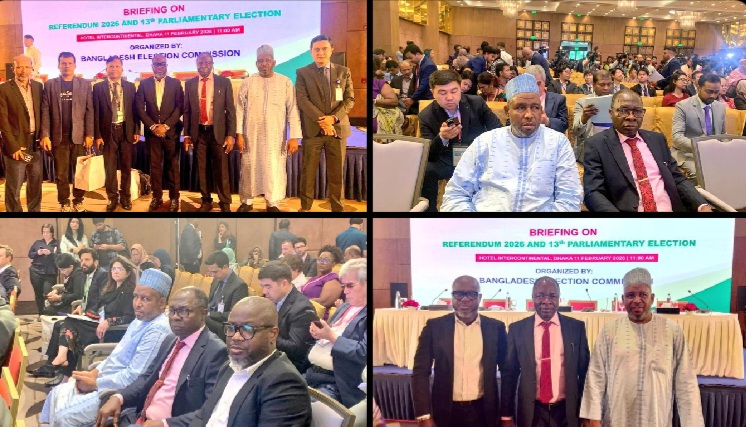

Dhaka, Bangladesh – As Bangladesh braces for what many describe as a defining moment in its democratic evolution, a high-powered delegation from Nigeria’s Independent National Electoral Commission (INEC) has arrived in Dhaka to monitor the country’s 13th Parliamentary Elections and a historic National Referendum slated for February 12, 2026.
The Nigerian observers joined hundreds of international monitors at a comprehensive briefing addressed by the Chief Election Commissioner of the Bangladesh Election Commission, Mr. A. M. M. Nasir Uddin.


He was accompanied by fellow Electoral Commissioners—Mr. Abdur Rahmanel Masud, Begum Tahmida Ahmed, Mr. Md. Anwarul Islam Sarker, and Brigadier General Abul Fazal Md. Sanaullah (Rtd.).
At the briefing, officials unveiled the staggering scale of the exercise: nearly 128 million registered voters are expected to cast their ballots across 299 constituencies, choosing from 2,028 candidates representing 50 political parties.
In a parallel decision of national significance, citizens will also vote in a referendum on the proposed “July National Charter,” a far-reaching blueprint for constitutional and institutional reforms.
The international spotlight on the South Asian nation is intense. About 330 foreign observers—including 220 from the European Union—and over 160 international journalists have been accredited. On the home front, the numbers are even more remarkable, with 45,000 domestic observers and 60,000 local journalists cleared to cover proceedings.
To deepen global observers’ appreciation of Bangladesh’s democratic heritage, officials organized a guided tour of the iconic Jatiya Sangsad, the country’s National Parliament building—an architectural symbol of legislative authority and civic pride.
Security arrangements for the polls are equally massive. The Bangladesh Election Commission confirmed that about 900,000 security personnel have been deployed nationwide to guarantee a peaceful and credible exercise. Voting will take place within a single-day window, opening at 7:30 a.m. and closing at 4:30 p.m.
Representing INEC Chairman Professor Joash Amupitan, SAN, the Nigerian delegation is led by National Commissioner Prof. Sunday Ajah. The team includes the Resident Electoral Commissioner for Plateau State, Mallam Mohammed Abubakar Sadiq, and the Chief Press Secretary/Media Adviser to the INEC Chairman, Mr. Adedayo Oketola.
Already, the INEC delegation has commenced pre-election observation activities, inspecting polling stations across Dhaka and assessing final logistical deployments ahead of the vote.
For Bangladesh, the February 12 exercise is more than an election—it is a referendum on reform and a test of democratic resilience. For Nigeria’s INEC, it is another step in deepening global electoral collaboration and reinforcing international best practices in democratic governance.
About The Author
