


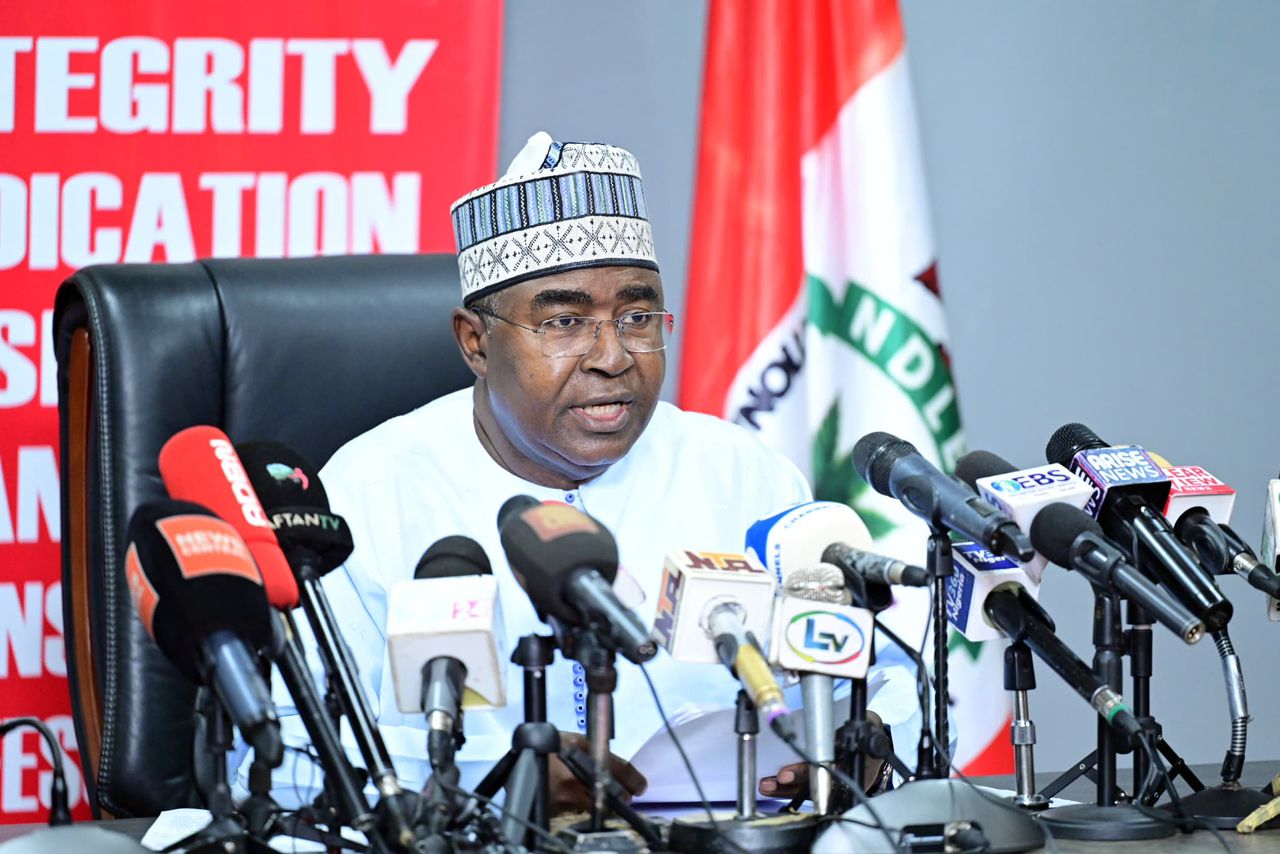

Nigeria’s war against illicit drugs has entered a decisive new phase as the Chairman and Chief Executive Officer of the National Drug Law Enforcement Agency (NDLEA), Mohamed Buba Marwa (rtd), on Tuesday issued a strong call for a nationwide response and sustained backing for the country’s groundbreaking Alternative Development programme.
Speaking at a press conference in Abuja, Marwa described the initiative as Africa’s first people-focused drug control strategy—one designed not only to crush illicit cannabis cultivation, but to lift rural communities, weaken criminal networks and reinforce national security.


The pilot scheme, launched last week in Ilu Abo, Ifon and Eleyewo communities of Ondo State, has already sent a powerful message: drug control works best when communities are empowered, not abandoned.
“This programme goes far beyond crop substitution,” Marwa declared. “It strengthens rural economies, reduces pressure on law enforcement and the justice system, promotes peace in crime-prone areas, boosts food production and improves Nigeria’s standing in global drug control and development cooperation.”
He described the Ondo pilot as a turning point, saying the overwhelming acceptance by farmers, traditional rulers and community leaders proves that lawful livelihoods can replace illicit drug economies when government support is visible and sincere.
“They have told us clearly: this programme has renewed their hope in Nigeria and restored their confidence in government,” he said.
Marwa called on all stakeholders—federal and state governments, traditional institutions, donor agencies, private sector players, civil society and the media—to rally behind the initiative and help scale it nationwide. He also urged communities affected by illicit cultivation to embrace the model and partner with the NDLEA in building secure and productive futures.
Painting a sobering picture of Nigeria’s drug challenge, the NDLEA boss cited the 2018 National Drug Use Survey by the National Bureau of Statistics, conducted with support from the United Nations Office on Drugs and Crime. The survey revealed that over 14 million Nigerians—more than twice the global average—used psychoactive substances within a year, with cannabis dominating both consumption and cultivation.
“Cannabis is not a marginal problem,” Marwa warned. “It is the most widely used illicit drug in Nigeria, with over 10 million users and nearly 8,900 hectares of land under cultivation, often hidden in forests and controlled by organised networks.”
He added that the consequences extend far beyond drug use, fueling insecurity, youth dependency, lost productivity and an overstretched healthcare system. Of the 15 million kilograms of illicit drugs seized by NDLEA in the last five years, more than 75 per cent were cannabis. “That is a frightening threat to our youths and our national security,” he said.
Despite the grim statistics, Marwa expressed confidence that Alternative Development—fully aligned with the Renewed Hope Agenda of President Bola Ahmed Tinubu—offers a lasting solution by attacking the root causes of drug production: poverty, vulnerability and lack of opportunity.
He commended international partners backing the initiative, including UNODC, IITA, GPDPD (Berlin), the Mae Fah Luang Foundation of Thailand, and development partners from Africa, Europe, Asia and the Americas. He also acknowledged the support of Ondo State Governor Lucky Ayedatiwa and the Federal Ministry of Agriculture and Food Security under Senator Abubakar Kyari.
“Alternative Development is not just about drugs,” Marwa concluded.
“It is about dignity, livelihoods and hope. It is a people-centred pathway to safer communities, stronger security and a more prosperous Nigeria.”
About The Author
