


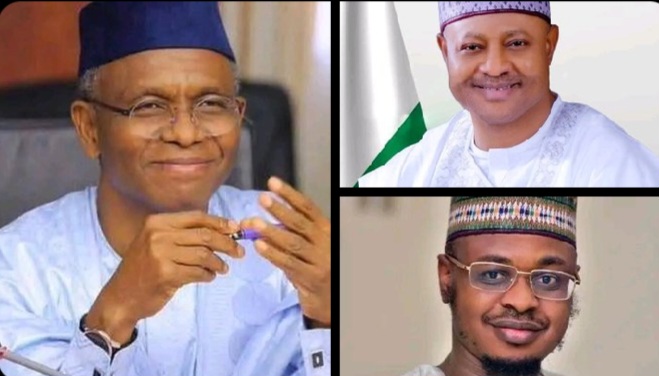

A single handshake at a graveside has ignited a storm of political reflection across Northern Nigeria, exposing what many now describe as a widening gulf between public unity and private rivalry among the region’s elite.
At the heart of the controversy is the symbolic moment at Gudu Cemetery on March 29, 2026, where former Kaduna State governor Nasir El-Rufai and his successor, Uba Sani, appeared to reconcile during the burial of El-Rufai’s mother.


The scene, reportedly facilitated by Isa Ali Pantami, was widely interpreted as a sign of healing within Northern political ranks.
But within days, that narrative began to unravel.
Fresh developments surrounding Nasir El-Rufai, alongside the reported ordeals of former Attorney-General Abubakar Malami, have fueled speculation that beneath the surface of solidarity lies a far more complex—and troubling—political reality.
Observers point to what they describe as a pattern of “performative unity,” where public gestures of reconciliation mask deeper fractures. The timing of events, particularly high-profile visits by political figures followed by swift state actions, has raised uncomfortable questions about trust, loyalty, and the true nature of alliances within the Northern establishment.
Even the involvement of prominent figures such as former Vice President Atiku Abubakar in solidarity visits has not escaped scrutiny, as analysts debate whether such gestures reflect genuine support or political signaling in an increasingly tense environment.
Compounding the unease are growing allegations tied to Nigeria’s security architecture under Nuhu Ribadu. Claims of surveillance, intelligence overreach, and political maneuvering—though unverified—have deepened suspicion among political actors, feeding a climate where trust is rapidly eroding.
For many in the North, the implications are profound.
Analysts warn that internal divisions among the region’s elite risk weakening its collective political influence at a time when security challenges—ranging from banditry to insurgency—continue to demand unified leadership.
Instead, critics argue, attention appears increasingly diverted toward internal contests and strategic positioning ahead of future elections.
“The real danger is distraction,” a political analyst in Abuja observed. “While leaders are locked in power struggles, the pressing issues affecting ordinary people—security, poverty, and development—remain unresolved.”
The situation also raises broader concerns about the health of Nigeria’s democracy. If political competition devolves into what some describe as selective battles and shifting loyalties, public confidence in governance could suffer further erosion.
Yet, voices within the region caution against sweeping conclusions, urging restraint and a focus on verified facts rather than speculation.
They argue that political disagreements are not unusual in a vibrant democracy, but must be managed in ways that do not undermine collective stability.
Still, the imagery of the Gudu Cemetery handshake continues to resonate—less as a symbol of unity, and more as a question mark hanging over the future of Northern political cohesion.
As the region grapples with its internal contradictions, one message is becoming increasingly clear: unity cannot be staged—it must be sustained.
For now, the North watches, waits, and wonders whether its leaders will rise above division or remain entangled in a cycle of suspicion that threatens both its influence and its future.
About The Author
