


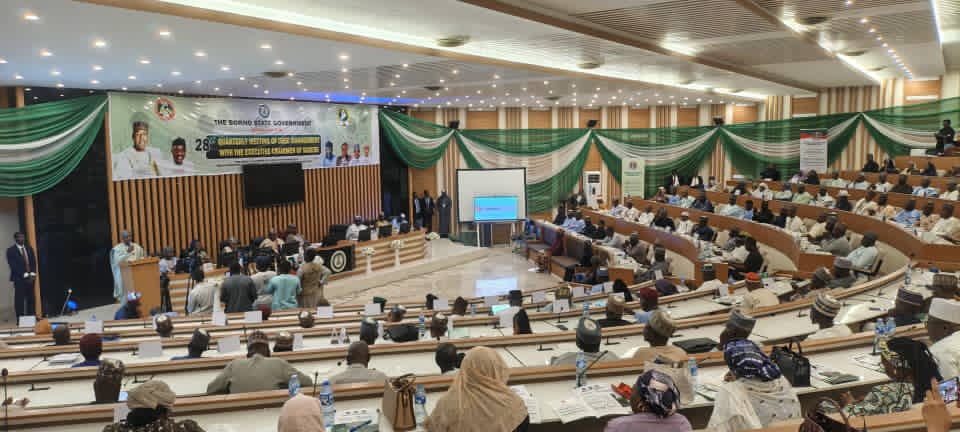

The Federal Government has restated its determination to ensure that every Nigerian child enjoys equitable access to quality basic education, as it opened the 28th Quarterly Meeting of the Universal Basic Education Commission (UBEC) with State Universal Basic Education Board (SUBEB) chairmen on Wednesday in Maiduguri, Borno State.
Delivering his remarks at the opening ceremony, the Minister of Education, Dr. Maruf Olatunji Alausa, said the administration remains unwavering in its push for an inclusive education system that leaves no child behind. He stressed that inclusive schooling environments create opportunities for young people and adults to learn together, deepen mutual respect, and build stronger communities.


Dr. Alausa emphasised that teacher development remains central to rebuilding the nation’s education sector. Well-trained teachers, he noted, help address underlying drivers of conflict and provide students with the skills to resist extremist narratives. He encouraged participants to channel their efforts toward programmes that tangibly improve the lives of ordinary Nigerians.
As part of his visit, the minister also commissioned a newly completed Federal Government School in Ngarannam, Maiduguri Metropolitan Council. The project, financed by the Islamic Development Bank (IsDB) and implemented through the Federal Ministry of Education in partnership with UBEC, is aimed at expanding access to quality learning facilities in the state.
UBEC Executive Secretary, Aisha Garba, described the quarterly meeting as a strategic platform for review and alignment, noting that Nigeria’s future depends on ensuring that every child—regardless of socioeconomic status—can access quality and inclusive learning opportunities. She praised the minister for championing reforms in the sector and acknowledged the support of Governor Babagana Umara Zulum toward improving education in Borno State.
Garba reaffirmed UBEC’s resolve to strengthen the foundations of basic education nationwide. Although millions of children have benefitted from UBEC-led interventions, she highlighted persistent challenges in data accuracy, which hinder full assessment of progress. This informed the meeting’s theme, which focuses on enhancing digital monitoring systems for improved accountability, transparency, and efficiency. UBEC, she disclosed, has already adopted digital data collection tools to generate dependable annual statistics that will improve planning and help states respond more effectively to their unique education needs.
Describing education as a catalyst for national transformation and a proven route out of poverty, Garba urged stakeholders to use the meeting to build stronger partnerships and refine ongoing initiatives. She stressed that the ultimate goal is to ensure that every Nigerian child has the ability to learn, innovate, and realise their full potential.
Governor Zulum, in his goodwill message, reiterated his administration’s long-standing commitment to raising education standards in Borno State. He noted that improving teacher welfare is a priority and revealed plans to provide more housing for teachers and introduce new incentives to motivate them. According to him, technical and vocational training must be deliberately scaled up to prepare young people for real-world opportunities.
He added that Borno State has already implemented the national minimum wage for teachers at both primary and secondary levels, underscoring the government’s continued dedication to strengthening the education sector.
About The Author
