


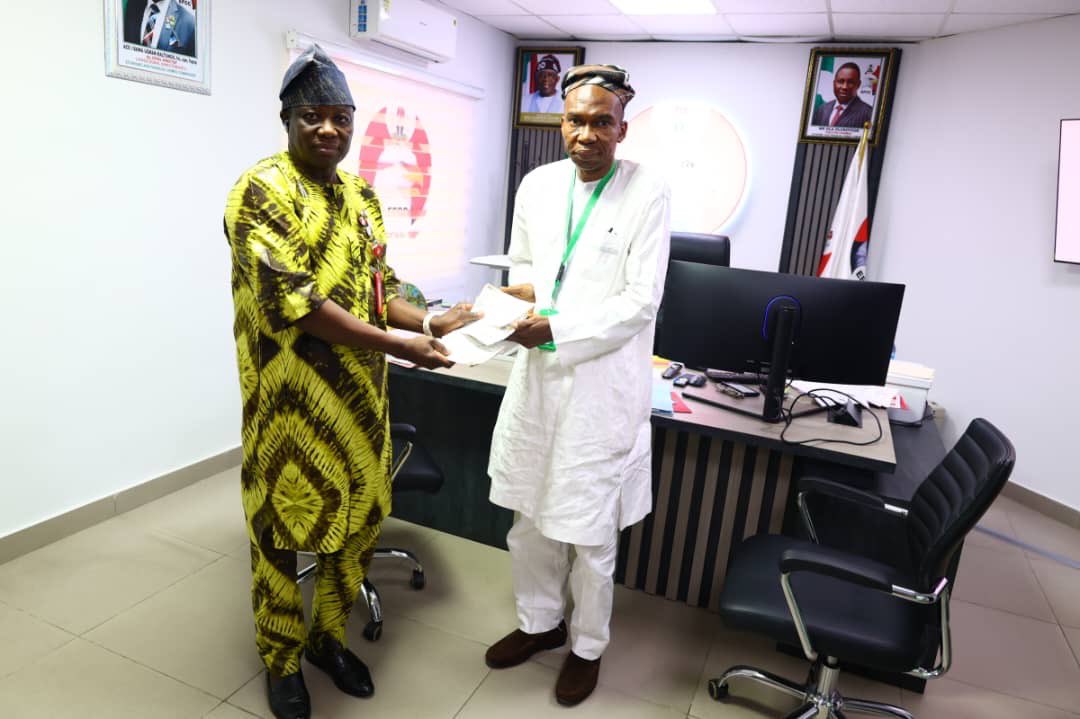
 has handed over a recovered sum of N279 million to the Wole Soyinka Centre for Culture and the Creative Arts, formerly known as the)
The Economic and Financial Crimes Commission (EFCC) has handed over a recovered sum of N279 million to the Wole Soyinka Centre for Culture and the Creative Arts, formerly known as the National Theatre Lagos, as part of ongoing efforts to recover looted public funds and strengthen accountability in Nigeria’s cultural institutions.
The handover ceremony took place on Friday at the EFCC’s Lagos Zonal Directorate 2 in Ikoyi, Lagos.


The recovery stems from a petition submitted in 2009 by Kabir Yusuf, then General Manager and Chief Executive Officer of the National Theatre, against Prince Benjamin Apugo and others over alleged irregularities in a contract valued at N299.7 million.
Investigations by the anti-graft agency revealed that the contract—awarded through the Ministry of Tourism, Culture and National Orientation to Techno Exportstroy Nigeria Limited—was meant for the construction of five gates, sand filling, and reclamation works at the National Theatre complex.
However, the EFCC discovered that Yusuf Ahmed Atai, acting in his capacity as Acting General Manager of the theatre, released N334.2 million to the contractor—an excess of N34.5 million above the approved contract sum.
Further findings showed that the contractor executed work valued at only N55.9 million, leaving a massive N243.8 million worth of work uncompleted, while the excess payment was also not refunded.
Following the conclusion of investigations, the suspect was charged to court, and during the trial proceedings, the EFCC successfully recovered N279 million on behalf of the theatre management.
Speaking during the handover, EFCC Chairman Ola Olukoyede, represented by the Acting Zonal Director of Lagos Zonal Directorate 2, ACE I Bawa Usman Kaltungo, reaffirmed the commission’s determination to ensure that recovered public funds are returned to their rightful institutions and properly utilised.
He warned the theatre’s management to ensure the money is used strictly for its intended purpose.
“We cannot suffer to recover this money for you and then have it used for purposes other than what it is meant for. Nigerians want to see what recovered funds are used for,” he said, adding that the commission would monitor the projects funded with the recovered money.
Olukoyede also disclosed that EFCC officials would conduct periodic inspections to track the progress of projects financed with the funds.
Receiving the bank drafts on behalf of the centre, Jatto Kabiru, Head of Finance and Accounts, expressed appreciation to the EFCC for what he described as a remarkable recovery.
He assured the commission that the money would be utilised judiciously for the benefit of the institution and Nigerians at large.
The recovery marks another milestone in the EFCC’s anti-corruption campaign aimed at restoring public assets and strengthening transparency in government institutions.
About The Author
