


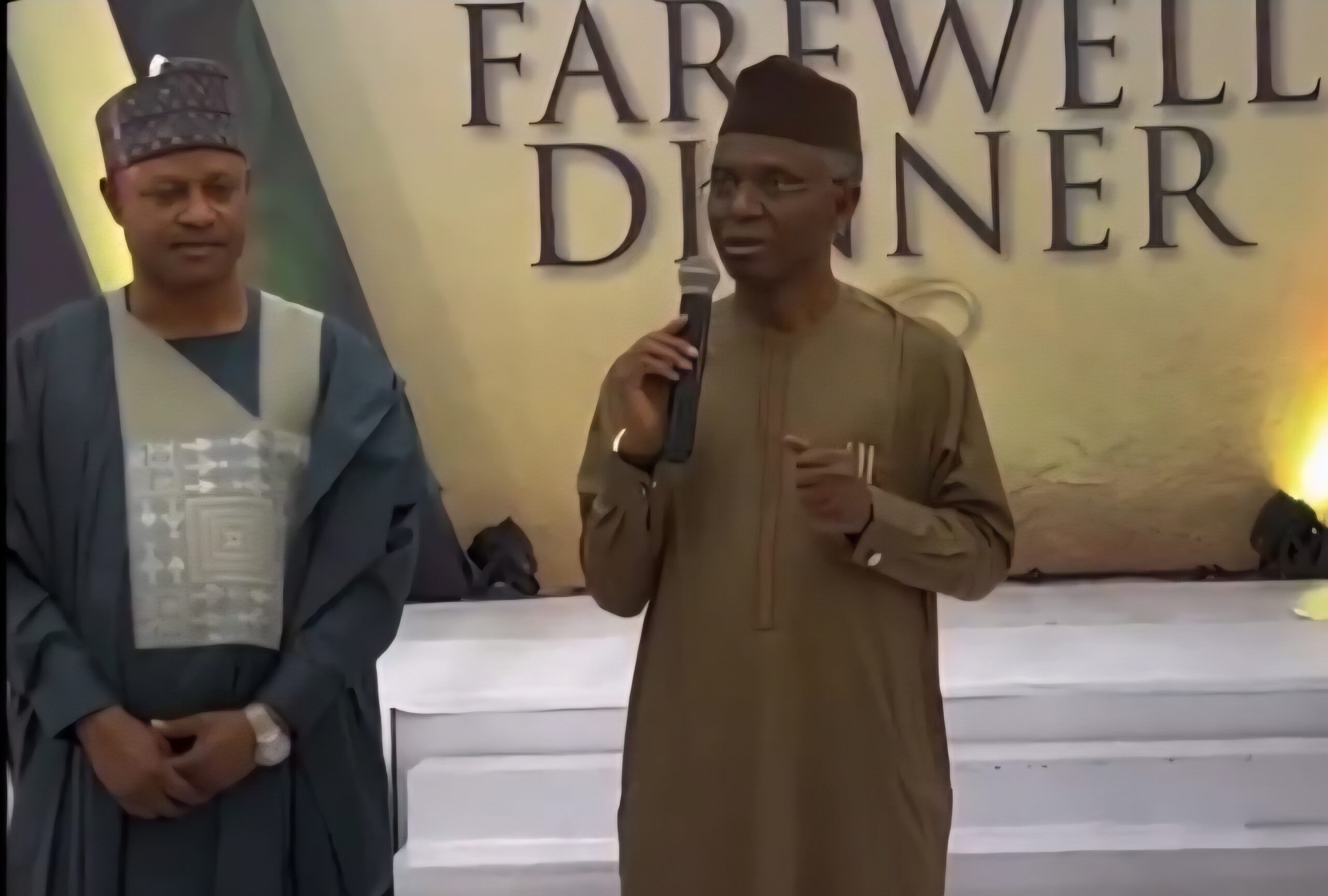

In a farewell remark that has continued to reverberate across Nigeria’s political landscape, former Kaduna State Governor, Nasir El-Rufai, declared pointedly: “I will be gone. You will not see me around, and don’t come looking for me in Abuja. You mind your business; I mind mine.”
The statement, delivered at an emotional farewell dinner on the eve of his handover, has since stirred widespread speculation about his future in national politics and the meaning behind his sudden withdrawal from the public stage.


For a man widely regarded as one of the most influential and controversial figures in Nigeria’s modern political history, the remark was both dramatic and unexpected. Known for his outspokenness, reform-driven policies, and fierce political engagements, El-Rufai’s apparent decision to step back from the spotlight marks a striking turn in a career that has spanned decades.
The dinner, attended by close political allies, aides, and associates, was meant to mark the end of El-Rufai’s eight-year tenure as governor. However, it was his closing words that captured national attention.
Observers say the tone of his statement was not merely reflective but deliberate—sending a clear signal that he intended to distance himself from Abuja’s political corridors, at least for the foreseeable future.
His remark, “Don’t come looking for me in Abuja,” has been widely interpreted as a rejection of the usual post-office political maneuvering that often sees former governors repositioning for federal appointments, legislative seats, or kingmaker roles.
In Nigeria’s political tradition, leaving office rarely means retiring from influence. Former governors often maintain a strong presence in the capital, engaging in consultations, lobbying, and strategic alliances.
But El-Rufai’s statement suggests a different path—one that breaks from the norm.
Political analysts note that his words may reflect a desire to disengage from the intense political battles that have defined his career. Others believe it could be a strategic retreat, allowing him to recalibrate before making a potential comeback at a later stage.
“Knowing El-Rufai, silence does not necessarily mean absence,” one analyst noted. “It could simply mean he is choosing when and how to re-emerge.”
During his time in office, El-Rufai built a reputation as a reformer unafraid of controversy. His administration in Kaduna State was marked by sweeping changes in education, urban development, and public service reforms.
Supporters credit him with taking tough decisions that previous administrations avoided, including restructuring the civil service and implementing policies aimed at improving governance efficiency.
However, his tenure was not without criticism. Opponents frequently accused him of adopting hardline approaches and making policies that sparked public backlash.
Yet, even critics acknowledge that El-Rufai remained a central figure in national discourse, often shaping debates beyond his state.
Speculation and Political Calculations
Since his farewell speech, speculation has been rife about what lies ahead for the former governor.
Some political watchers believe his statement could signal a temporary withdrawal rather than a permanent exit. Others suggest he may be exploring opportunities outside the public sector, including international engagements, private consultancy, or intellectual pursuits. There are also those who interpret his words as a subtle message to political allies and rivals alike—that he intends to step away from immediate power struggles while maintaining independence. The ambiguity of his statement has only deepened public curiosity.
Abuja, Nigeria’s political nerve centre, is often seen as the arena where influence is sustained even after leaving office. For many politicians, remaining visible in Abuja is crucial to staying relevant.
El-Rufai’s explicit rejection of this path has therefore raised eyebrows. By saying, “Don’t come looking for me in Abuja,” he appears to be distancing himself from the traditional power networks that dominate the capital.
Whether this represents a genuine withdrawal or a calculated repositioning remains to be seen.
Reactions to El-Rufai’s remarks have been mixed. While some supporters have praised his decision as a sign of maturity and self-awareness, others view it with skepticism.
Critics argue that Nigerian politics rarely allows for complete disengagement, especially for figures of El-Rufai’s stature.
On social and political circles, the statement has sparked debates about leadership transitions and the role of former officeholders in shaping the country’s future.
Despite the speculation, El-Rufai himself has not provided further clarification on his remarks, leaving room for interpretation.
For now, his words stand as both a farewell and a puzzle—one that reflects the complexity of Nigerian politics and the unpredictable nature of its key players.
As Nigeria continues to navigate its evolving political landscape, the absence—or strategic silence—of a figure like El-Rufai will undoubtedly be felt.
Whether he truly fades from Abuja’s scene or returns in a different capacity, one thing remains certain: his influence, built over years of active engagement, will not easily disappear.
For now, his message is clear, even if its full meaning is not yet understood: he is stepping away, on his own terms.
And as the echoes of his farewell linger, Nigeria watches closely—waiting to see if this is truly goodbye, or simply the beginning of another chapter.
About The Author
