


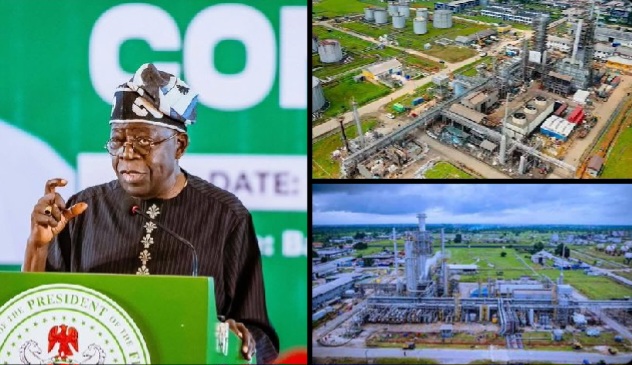

After decades of broken promises and endless fuel imports, Nigeria may finally be staring at a historic energy reset.Industry operators say the long-running refining crisis is cracking—fast.
The Petroleum Products Retail Outlets Owners Association of Nigeria (PETROAN) has confirmed that 23 refineries are nearing completion nationwide, a development many insiders describe as the clearest sign yet that President Bola Ahmed Tinibu’s bold energy reforms are reshaping Nigeria’s downstream sector.


For years, Africa’s biggest crude oil producer wore an embarrassing badge: exporting crude only to import petrol at crippling cost. Under President Tinibu, that paradox is being confronted head-on—with deregulation, investor confidence, and a private-sector-led refining boom.
Fuel subsidies are gone. Price controls have loosened. And refining—once a government liability—is now a competitive investment frontier.
The result? A surge of refinery projects, largely modular and mid-scale, springing up across oil-producing and industrial corridors from Lagos to the Niger Delta and beyond. For the first time in decades, refining is no longer a promise—it is steel, pipes and concrete on the ground.
Leading the charge is the mega Dangote Petroleum Refinery in Lekki, alongside the expanding BUA Refinery in Akwa Ibom.
Backing them is a growing army of modular refineries either operational, expanding or at advanced stages:
Waltersmith Modular Refinery
Duport Midstream Refinery
Edo Refinery and Petrochemical Company
OPAC Refinery
Aradel Refinery
Ikpoba Modular Refinery
Private modular units in Port Harcourt, Rivers State
Ibigwe Modular Refinery, Imo State
Add licensed projects like MRO Energy Refinery and Process Design and Development Limited, and the scale becomes unmistakable.
When fully operational, these facilities could inject hundreds of thousands of barrels per day into domestic refining—enough to drastically cut imports and even turn Nigeria into a net exporter of refined products.
Tinibu’s High-Stakes Energy Gamble
At the core of this surge is a clear three-part strategy:
Total downstream deregulation
Policy clarity that attracts private capital
Fast-tracked modular refineries—cheaper, faster, and closer to demand
Supporters say the reforms were politically painful but economically unavoidable—and are already delivering results.
Why 23 Refineries Matter
If sustained, the impact could be seismic:
Lower fuel imports and reduced FX pressure
Improved fuel availability and price stability
Thousands of new jobs
Stronger energy security and export potential
PETROAN’s endorsement is crucial. Retailers sit at the sharp end of fuel supply—and their confidence signals that the system is shifting.
Beyond Promises, Toward Proof
Nigeria has heard refinery talk before. What makes this moment different is scale, spread, and private capital—backed by hard policy choices.
If the momentum holds, history may record this phase as the moment Nigeria finally broke free from fuel dependency—when structural reform replaced subsidies, and refining moved from rhetoric to reality.
One country. Twenty-three refineries. And perhaps, at last, a turning point.
About The Author
